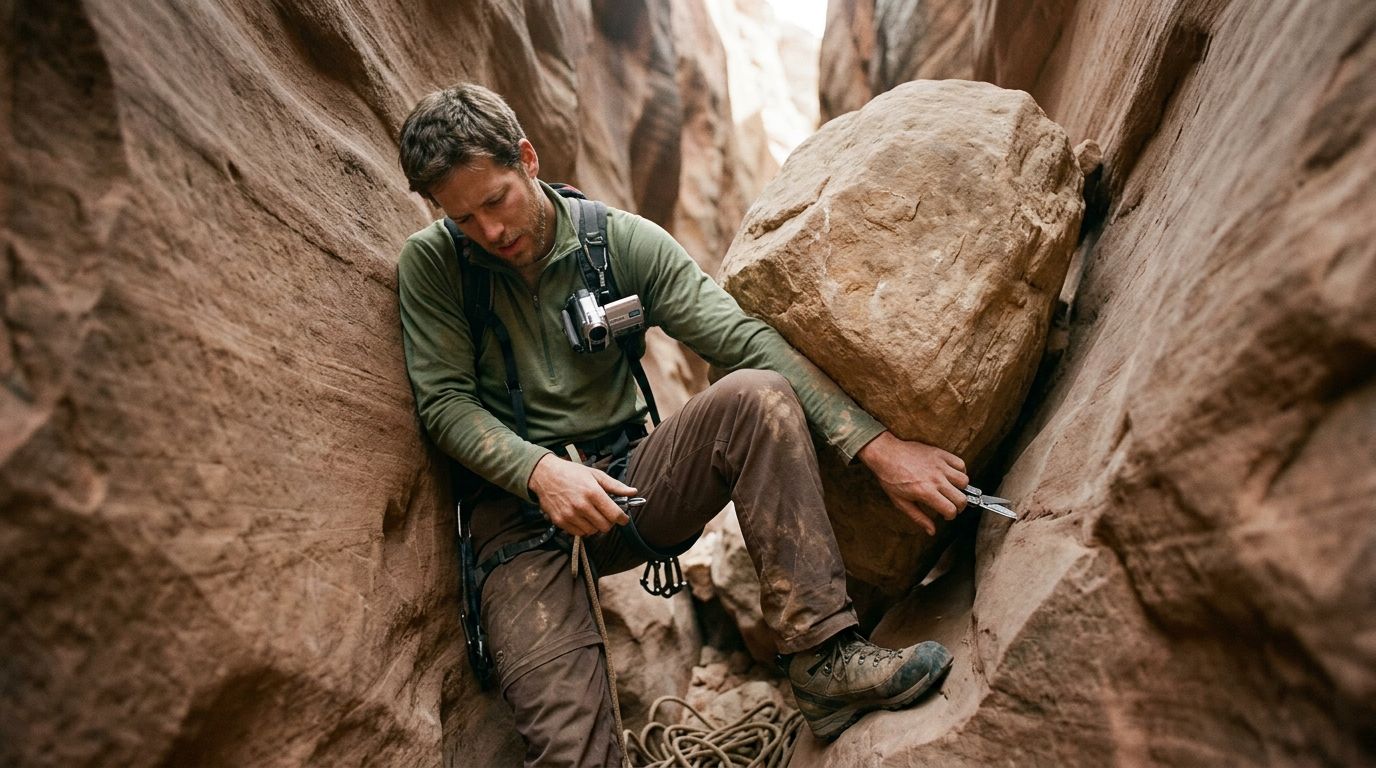
The True Story of Aron Ralston
On April 26, 2003, a 27-year-old mechanical engineer from Colorado named Aron Ralston drove alone into the Utah desert.
He didn’t tell anyone exactly where he was going.
That decision would nearly cost him his life.
The Man Who Loved the Edges of the Map
Aron Ralston wasn’t reckless in the way thrill-seekers are often portrayed. He was disciplined. Methodical. Obsessed with mountains and self-reliance.
He had set a goal for himself: climb all of Colorado’s fourteeners — peaks above 14,000 feet — in winter, solo. He thrived on isolation. The silence of wild places felt honest to him. Clean.
That April weekend, he drove to Blue John Canyon, a remote slot canyon in southeastern Utah near Canyonlands National Park. It was a place of narrow sandstone corridors, twisting rock passageways, and sudden vertical drops carved by water over millions of years.
It was beautiful.
And unforgiving.
Ralston parked his truck, unloaded his gear — climbing rope, harness, small camcorder, minimal water — and stepped into the canyon.
He left no note.
He told no one his route.
He assumed he would be back by evening.
The Fall of the Boulder
The canyon narrowed as he descended.
The walls rose high above him — smooth, rust-colored sandstone glowing under the desert sun. In some places, the passage was so tight he had to wedge himself sideways to move through.
Then he reached a drop — a boulder wedged between the canyon walls with open space below it.
It looked stable.
He had maneuvered over obstacles like this before.
He carefully climbed down, using the boulder as support.
That’s when it shifted.
The sound was sudden — stone scraping against stone.
In an instant, the massive rock dropped.
And with it, his right arm.
The boulder slammed his hand and forearm against the canyon wall, pinning him in place.
The rock weighed approximately 800 pounds.
He was trapped.
The First Hours: Problem-Solving
At first, he didn’t panic.
Aron did what engineers do — he assessed.
He tried pulling his arm free. It didn’t move.
He pushed against the boulder with his legs. It didn’t budge.
He chipped at the rock with his multi-tool knife. The blade barely scratched it.
The canyon was silent except for his breathing and the occasional whisper of wind far above.
He assumed someone would find him.
Then reality began to settle in.
No one knew where he was.
Day One Turns to Day Two
He rationed his water carefully — a few sips at a time.
The desert heat intensified during the day and dropped sharply at night. In the darkness, temperatures fell, and the canyon became a cold stone chamber.
He tried rigging a pulley system using his climbing rope.
It failed.
He tried chipping away at the rock again.
Nothing.
His arm began to swell beneath the pressure.
Time lost structure.
Without movement, without change, minutes stretched endlessly.
Day Three: Isolation
By the third day, dehydration had begun to take its toll.
His lips cracked.
His tongue felt thick.
His thoughts slowed.
He began recording goodbye messages on his camcorder.
He spoke calmly to his family — apologizing, expressing love, explaining what had happened.
He even etched what he believed would be his name and date of death into the canyon wall.
There was a shift inside him during this time.
The possibility of dying stopped feeling abstract.
It felt scheduled.
Day Four: The Breaking Point
He ran out of water.
The desert air dried his skin until it felt tight and brittle.
Hallucinations flickered at the edges of his awareness — not dramatic visions, but mental fog, memory distortions.
He slept in short intervals, waking disoriented.
His right arm had lost sensation.
The tissue had begun to deteriorate from lack of circulation.
He realized something critical:
The arm was no longer alive in the way the rest of him was.
It was trapped — and dying.
And it was taking him with it.
Day Five: The Decision
On the morning of May 1, 2003, after approximately 127 hours trapped in the canyon, Aron Ralston reached clarity.
He later described it not as desperation — but as realization.
He could not lift the boulder.
He could not wait for rescue.
His only option was to free himself.
He used his dull multi-tool knife.
The blade was not designed for what he was about to do.
He first had to break the bones in his forearm by leveraging his body weight against the trapped limb.
It was a calculated, horrifying act of survival.
Then, methodically, he worked through muscle and tissue.
It took nearly an hour.
He remained conscious the entire time.
When it was done, he was free.
The Climb Out
But freedom was not the end.
It was the beginning of another ordeal.
He rappelled down a 65-foot cliff one-handed.
He navigated miles of desert terrain in extreme dehydration.
He hiked until he encountered a family of hikers.
They gave him water.
They alerted authorities.
A rescue helicopter airlifted him to safety.
He survived.
After the Canyon
Aron Ralston lost his right arm below the elbow.
But he did not lose his love for climbing.
Within a year, he returned to mountaineering — adapting with a prosthetic limb.
He eventually completed his goal of climbing all Colorado fourteeners in winter.
He wrote a memoir titled Between a Rock and a Hard Place, which later inspired the film 127 Hours starring James Franco.

