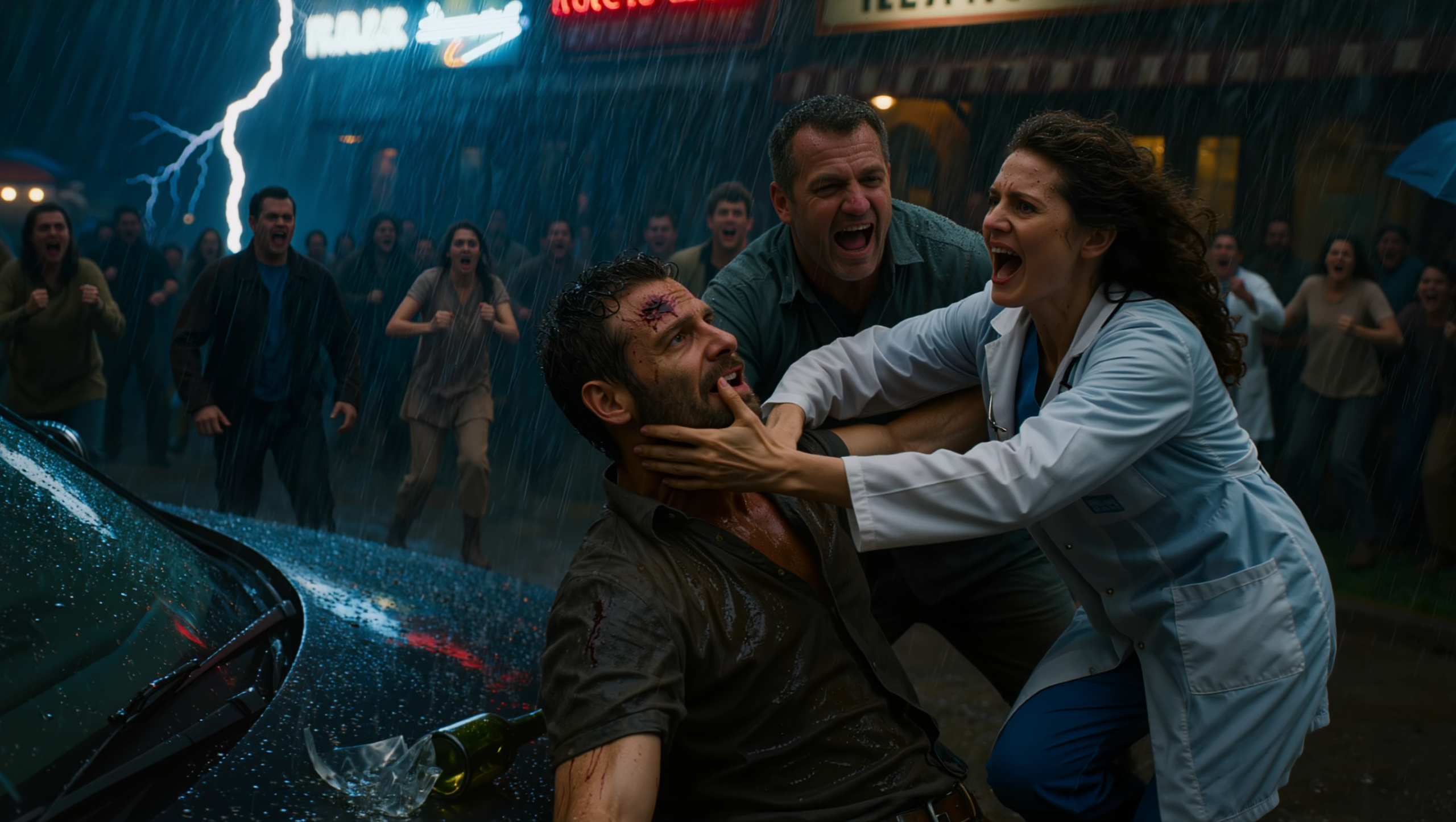
The first time Ava Mercer saw Daniel Hale bleed, she thought he was going to die.
It was late October, the kind of cold that crept under the skin and made even the emergency room lights feel brittle. The ambulance doors burst open with a metallic shriek, and two paramedics rushed in with a stretcher slick with rainwater and blood.
“Male, thirty-two,” one of them barked. “Multiple blunt-force trauma. Assault outside Miller’s Bar. Possible concussion. He lost consciousness twice.”
Ava didn’t think. She moved.
The ER at Blackridge County Hospital was small—four trauma bays, peeling paint in the hallway, the smell of antiseptic that never quite masked the underlying scent of exhaustion. It served a town of twelve thousand people and their secrets.
She stepped up to the stretcher and saw him.
Dark hair matted to his forehead. Split lip. Blood trailing from his temple down the sharp angle of his jaw. His right eye was already swelling shut. His hands—large, calloused—curled reflexively, as if he were still trying to fight.
“Daniel Hale,” the paramedic added. “Local contractor. No known medical conditions.”
His name registered. Ava had seen it on permits, on charity boards, on whispered gossip. The Hale family had built half the houses in Blackridge.
Now he looked breakable.
“Daniel,” she said firmly, leaning over him. “Can you hear me?”
His eyelids fluttered. For a split second, his left eye opened, unfocused and storm-dark. It found her face.
“Yeah,” he rasped. “Guess I’m not dead.”
The corner of her mouth twitched before she could stop it.
“Not yet,” she replied. “Let’s keep it that way.”
—
Daniel would later remember fragments of that night. The ceiling lights passing overhead like distant stars. The sting of disinfectant. The steady, unhurried voice of the woman stitching his eyebrow.
“Six stitches,” she murmured. “You’re lucky.”
He tried to turn his head toward her and winced.
“Lucky?” he croaked.
“You could’ve fractured your skull. Whoever hit you didn’t hold back.”
He gave a short, humorless laugh. “Yeah. That sounds about right.”
Her hands were precise. Warm. He noticed that through the haze. The way she pressed gauze to his skin without flinching at the blood. The way she didn’t ask questions he didn’t want to answer.
“What’s your name?” he asked.
She didn’t look up from the sutures. “Dr. Ava Mercer.”
“You always this gentle, Dr. Mercer?”
She tied off the thread, clipped it neatly. Finally met his gaze.
“Only with patients who don’t try to flirt while concussed.”
He would swear later that the first spark happened right then.
Not because she was beautiful—though she was, in a quiet way. Dark curls pulled into a low bun. Serious brown eyes. A faint scar at her chin that suggested childhood recklessness.
No.
It was because she didn’t seem impressed by him.
In a town that treated him like he’d inherited a crown he didn’t ask for, she treated him like a body that needed mending.
It unsettled him.
It intrigued him.
—
Ava didn’t think about Daniel Hale after that night.
At least, that’s what she told herself.
She had moved to Blackridge two years earlier after her residency in Richmond. She’d told everyone she wanted a slower pace. Fewer politics. A place where she could matter.
The truth was less noble.
She needed distance.
Distance from a fiancé who had chosen ambition over her. Distance from a hospital corridor where she had told a mother that her child wasn’t going to wake up. Distance from the sound of a flatline that still echoed in her dreams.
Blackridge was supposed to be quiet.
Safe.
Then Daniel Hale walked into her ER with blood on his face and defiance in his eyes.
She saw him again two weeks later.
This time he wasn’t on a stretcher.
He was standing in the grocery store, arguing with the clerk about the price of lumber.
Ava paused at the end of the aisle, a carton of milk in her hand.
“I’m telling you,” Daniel was saying, jaw still faintly bruised yellow, “if the supply truck didn’t come in, that’s not my fault.”
The clerk rolled her eyes. “Daniel, this isn’t about fault. It’s about payment.”
He exhaled sharply, running a hand through his hair. He looked less intimidating without blood. More tired.
Ava didn’t mean to step in.
But she did.
“Is this about the elementary school renovation?” she asked.
Both of them turned.
Recognition flashed in his eyes. Slow. Warm.
“Dr. Mercer,” he said. “You stalking me?”
The clerk snorted and walked away, muttering something about “rich men and their drama.”
Ava folded her arms. “You’re behind on payments?”
Daniel’s mouth tightened. “No. I’m behind on patience.”
She studied him. “You’re renovating the school pro bono, aren’t you?”
He hesitated.
That was answer enough.
“It’s not pro bono,” he said quietly. “It’s just… complicated.”
Her chest tightened unexpectedly.
“Why?” she asked.
He shrugged. “My dad built that school. Before he died. Figured I’d finish what he started.”
Something in his voice—rough, unpolished—made her look at him differently.
Not the Hale heir.
Just a son.
“I can write a letter,” she said. “From the hospital. Supporting the project. Might speed up county approval.”
He blinked. “Why would you do that?”
She thought of the children she treated. The asthma inhalers. The sprained wrists. The way small towns survived on people who cared.
“Because,” she said simply, “it matters.”
For a moment, they just stood there, the hum of fluorescent lights overhead.
Then he smiled.
And this time, it wasn’t defensive.
It was grateful.
—
Their first real conversation happened on a Wednesday night in January.
Snow fell in thin, hesitant sheets outside the hospital windows. Ava was finishing a twelve-hour shift when she heard shouting from the waiting room.
She stepped out.
Daniel stood there, fists clenched at his sides, facing a man twice his size.
“You don’t get to talk about her like that,” Daniel snapped.
The other man sneered. “Relax. It was a joke.”
“It wasn’t funny.”
Ava moved between them.
“Gentlemen,” she said sharply. “This is a hospital.”
The larger man scoffed and walked out, boots thudding against tile.
Daniel exhaled, shoulders tense.
“What was that about?” she asked.
He hesitated. “Nothing.”
“Daniel.”
He looked at her then, really looked. His eye was clear now, healed. But there was something darker beneath it.
“He was talking about you,” he said.
Her stomach dropped. “About me?”
“Small town,” he muttered. “People like to talk.”
“What were they saying?”
His jaw worked. “That you’re only here because you couldn’t cut it in the city. That you ran from something.”
The words hit harder than she expected.
She lifted her chin. “And you punched him for that?”
“I didn’t punch him,” Daniel said defensively. “Yet.”
She should have been annoyed.
Instead, heat rose to her face.
“You don’t need to fight my battles,” she said quietly.
“Maybe I want to.”
Silence fell between them.
The fluorescent lights buzzed. A nurse called out a name down the hall.
Ava crossed her arms. “Why?”
He swallowed.
“Because,” he said slowly, “you’re the first person in this town who looks at me like I’m not a last name.”
The honesty in his voice made her pulse stutter.
“You are a last name,” she said softly.
“Yeah.” His mouth curved faintly. “But I’m more than that.”
Their eyes held.
Something shifted.
Slow.
Unavoidable.
—
The symbolic object came in early spring.
Ava had worked a brutal overnight shift. A teenage car accident. A heart attack. A miscarriage that left her hollowed out.
She stepped outside at dawn, exhausted, and found Daniel sitting on the hospital steps.
He stood when he saw her.
“I figured you’d be out around now,” he said.
She frowned. “Have you been here all night?”
He shrugged. “Couldn’t sleep.”
In his hand was a small object wrapped in cloth.
“For you,” he said awkwardly.
She hesitated before taking it.
Inside was a piece of sea glass. Smooth. Pale blue. Worn by time and tide.
“I found it years ago,” he said. “When my dad and I used to drive out to the coast. It was sharp once. Broken. But the ocean… softened it.”
She traced it with her thumb.
“It’s imperfect,” he added. “But it survived.”
Her throat tightened.
“Why are you giving this to me?”
He looked at her like she already knew.
“Because,” he said quietly, “you don’t look broken. But sometimes… I think you are.”
The world narrowed to the space between them.
“I don’t need fixing,” she whispered.
“I know,” he replied. “I just thought maybe you’d like something that proves broken things can still be beautiful.”
That was the moment she fell in love with him.
Not all at once.
But enough.
—
Their first kiss happened in the middle of a storm.
Not romantic.
Not planned.
They were arguing.
It had taken six months for their connection to deepen into something fragile and electric. Six months of coffee after her shifts. Of him showing up at the hospital with takeout. Of her visiting the construction site and watching him work, sweat darkening his shirt, sunlight catching in his hair.
Six months of almost.
Then one night, Ava found him outside Miller’s Bar again.
This time, he was the one being held back.
“You think you can just threaten my crew?” Daniel shouted at a man in a leather jacket. “You don’t own this town!”
The man lunged.
Daniel swung.
Ava didn’t think. She ran.
“Daniel, stop!” she yelled.
A fist connected with Daniel’s jaw. He staggered.
Rage—sharp and unfamiliar—flooded her veins.
She shoved between them, pushing the other man back.
“Enough!” she screamed.
The crowd fell silent.
Rain started to fall, heavy and sudden.
Daniel grabbed her arm. “You shouldn’t be here.”
“And you shouldn’t be fighting like you’re still eighteen!” she shot back.
“They threatened my workers!”
“You think breaking your face again will fix that?”
They were inches apart now, rain plastering her hair to her cheeks.
“You don’t understand,” he said, voice raw.
“Then make me understand!” she demanded.
Lightning split the sky.
He looked at her like he was losing something.
“Everything I build,” he said hoarsely, “people assume it was handed to me. I fight for it, Ava. I fight for every damn thing.”
She stepped closer.
“You don’t have to fight alone.”
The words hung between them.
His breath hitched.
Rain ran down his temple, along the scar she had stitched months ago.
“Then don’t leave,” he said suddenly.
Her heart stopped.
“I’m not leaving,” she whispered.
He searched her face, as if looking for a lie.
Then he kissed her.
It wasn’t gentle.
It was desperate. Fierce. Full of everything they hadn’t said.
The crowd faded. The storm roared.
And for the first time in years, Ava let herself feel something that terrified her more than any emergency room crisis.
Hope.
—
The conflict didn’t come from nowhere.
It arrived quietly.
In the form of an envelope.
Ava found it in her mailbox one humid July afternoon.
Richmond Memorial Hospital.
Her chest tightened before she even opened it.
Inside was an offer.
Chief of Emergency Medicine.
Prestigious.
Powerful.
Everything she had once dreamed of.
Her hands trembled as she read.
She hadn’t applied.
Or had she?
Months earlier, during a particularly brutal week, she had sent in her résumé in a moment of weakness. Of doubt.
She had forgotten.
Apparently, they hadn’t.
That night, she sat across from Daniel at his kitchen table, the sea glass in her pocket.
“I got an offer,” she said carefully.
He stilled.
“Where?”
“Richmond.”
Silence stretched.
“That’s… good, right?” he asked.
“It’s everything I worked for.”
He nodded slowly.
“And?”
She swallowed. “It means leaving.”
The word dropped between them like a stone.
“For how long?” he asked.
“It’s permanent.”
The air shifted.
He leaned back, staring at the ceiling.
“You applied?” he asked.
“It was months ago. I didn’t think—”
“You didn’t tell me.”
“I didn’t think it would matter!”
“It matters,” he snapped.
Her temper flared. “You think I don’t deserve this?”
“I think,” he said tightly, “that every time something good happens to you, you look for an exit.”
“That’s not fair.”
“Isn’t it?” His eyes burned. “You ran from Richmond once. Now you’re running back.”
She stood abruptly. “This is my career.”
“And what am I?”
The question sliced through her.
“You’re not a detour,” she said.
“Then don’t treat me like one.”
They stared at each other across the table that had held a hundred small, tender moments.
“I need time,” she whispered.
“You don’t have time,” he said. “They’ll want an answer.”
“So what are you saying?” she asked.
He hesitated.
And in that hesitation, something cracked.
“I’m saying,” he said slowly, “if you go… I can’t follow.”
Her breath left her lungs.
“Why?”
“My dad built this town,” he said, voice breaking. “I can’t abandon it. I won’t.”
“And I’m supposed to abandon my dream?”
“I’m not asking you to.”
“Yes, you are.”
Silence.
Heavy.
Unforgiving.
“If you leave,” he said finally, “I won’t ask you to stay.”
The devastation didn’t come as shouting.
It came as stillness.
She nodded once.
Then she walked out.
—
The unexpected twist came three weeks later.
Ava had accepted the Richmond position.
Her last shift in Blackridge was scheduled for September 1st.
She hadn’t seen Daniel since that night.
Then the call came.
“Dr. Mercer,” the nurse said urgently. “We have a construction accident. Multiple injuries.”
Ava’s pulse quickened. “Who?”
“Daniel Hale’s crew. And—”
The line crackled.
“And Daniel.”
The world tilted.
She ran.
He was unconscious when they wheeled him in.
A collapsed beam. Head trauma. Internal bleeding.
Ava’s hands moved automatically, but her mind screamed.
Not him.
Not like this.
Hours blurred.
Surgery.
Blood.
Monitors beeping.
Finally, the surgeon stepped out.
“He’s stable,” he said. “But he needs time.”
Ava sat beside Daniel’s bed long after visiting hours ended.
His face was pale. Too still.
She reached into her pocket and pulled out the sea glass.
Pressed it into his hand.
“You don’t get to choose for both of us,” she whispered.
His fingers twitched.
Her breath caught.
His eyelids fluttered.
“Ava?” he rasped.
She broke.
“I thought I lost you,” she choked.
He looked at her, confusion clearing slowly.
“You’re still here,” he murmured.
She laughed through tears. “I haven’t left yet.”
His gaze sharpened.
“Don’t,” he said weakly.
Her heart pounded.
“You told me not to stay.”
“I was scared,” he admitted. “I thought… if I let you choose me, you’d resent me.”
She pressed her forehead to his hand.
“I’m terrified,” she whispered. “Of choosing wrong. Of losing myself.”
“You won’t,” he said. “Not with me.”
Tears slid down her cheeks.
“Then what do we do?” she asked.
He squeezed her hand.
“We stop running.”
—
The final choice didn’t look like sacrifice.
It looked like compromise.
Ava declined the Richmond position.
But not entirely.
She negotiated.
Part-time consulting. Telemedicine leadership. A role that allowed her to stay in Blackridge while expanding emergency services across rural Virginia.
It wasn’t the dream she had envisioned.
It was better.
Daniel healed slowly.
The town rallied.
And on a crisp November evening, one year after the night he bled under ER lights, Daniel stood with Ava on the same hospital steps.
In his hand was something small.
A ring.
Not extravagant.
Simple silver.
“I don’t want you to choose between me and your dreams,” he said. “I want to build them with you.”
She smiled through tears.
“You fight for everything,” she said softly.
“Yeah,” he replied. “Including you.”
She slipped the ring onto her finger.
The sea glass rested against her heart, tucked inside a locket he had given her during his recovery.
Broken.
Softened.
Enduring.
As snow began to fall, Ava realized something quiet and profound:
Love wasn’t about staying or leaving.
It was about standing still long enough to let someone see the parts of you that still felt sharp—and trusting them not to turn away.
Daniel brushed snow from her hair.
“You’re not broken,” he said.
She looked at him, at the scar above his eye, at the stubborn devotion in his gaze.
“Neither are you,” she replied.
And for the first time, neither of them felt like they had to fight.
The hospital lights glowed behind them.
The town stretched out ahead.
And somewhere between what they had lost and what they had chosen, they found something stronger than fear.
They found each other.
The snow kept falling.
And this time, nothing broke.

