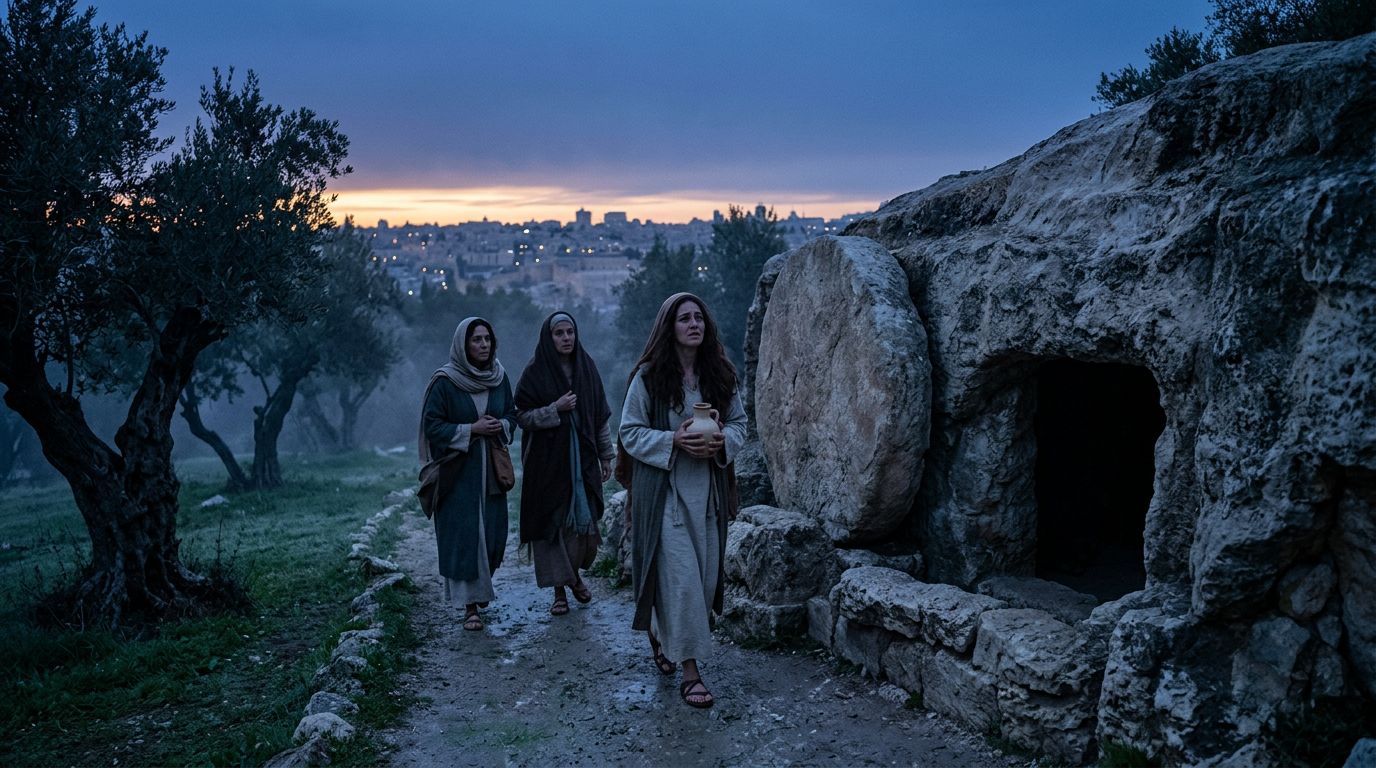
The city was still asleep when the women stepped into the cold air.
Jerusalem before dawn felt different than Jerusalem by day. The shouting merchants were silent. The Roman soldiers at the gates leaned on their spears, weary-eyed. The narrow streets that had roared with Passover pilgrims only hours before now lay hushed beneath a fading night sky.
Mary Magdalene walked first.
She carried spices in trembling hands.
Beside her was another Mary, and not far behind, Joanna. Their sandals scraped softly against stone as they made their way outside the city walls toward the garden tomb.
None of them spoke.
There are griefs that silence language.
Two days earlier, they had watched Him die.
They had stood near the cross when many others fled. They had heard the final cry. They had seen the Roman soldier pierce His side to confirm what they already feared.
They had watched Joseph of Arimathea and Nicodemus wrap His body in linen and lay Him inside a rock-hewn tomb. They had seen the heavy stone rolled into place.
They had memorized the location.
And now, before the sun could rise fully, they came to finish what love would not let them leave undone.
The Weight of the Stone
The path downward toward the tomb curved around olive trees twisted with age. Morning dew clung to leaves. The horizon held a faint band of gray-blue, hinting that light would soon break.
Mary Magdalene’s thoughts churned.
She remembered the moment He had spoken her name months earlier—when she had been a woman tormented and fractured inside. He had not recoiled from her brokenness. He had set her free.
She had followed Him since.
Through Galilee.
Through Judea.
Through whispers of kingdom and mercy.
Through miracles she could not explain but had seen with her own eyes.
The blind seeing.
The lame walking.
The dead raised.
But she had not imagined this ending.
They approached the garden.
And then—
Mary stopped.
The stone.
It was not where they had left it.
The massive circular stone that had sealed the tomb entrance—secured and guarded—had been rolled aside.
For a moment none of them moved.
Grief can prepare you for death.
It does not prepare you for mystery.
The Empty Place
Mary rushed forward first.
She did not wait for caution.
She reached the opening and looked inside.
The tomb was dim, lit only by the growing light of dawn filtering through the entrance.
The stone bench where His body had been laid was visible.
The linen wrappings lay there.
Folded.
Empty.
There was no body.
Her breath caught in her throat.
“They’ve taken Him,” she whispered, her voice breaking. “They’ve taken the Lord.”
Fear replaced sorrow.
Who would disturb a grave?
Romans? Religious leaders? Grave robbers?
The other women stepped inside.
The air was cool, still carrying the scent of spices and stone.
But something else stirred.
A presence.
Not frightening in the way of violence—but overwhelming in its purity.
Suddenly they became aware that they were not alone.
Two figures stood within the tomb’s interior—radiant, yet not consuming. Their garments shone in the dim space, as if reflecting a light not sourced from the sun.
The women fell low, faces toward the ground.
Not because they were commanded.
But because awe bent them naturally.
The Question That Changed History
One of the figures spoke.
The voice was clear—neither thunderous nor soft, but steady with authority.
“Why do you seek the living among the dead?”
The question struck deeper than their fear.
The living.
Among the dead.
“He is not here,” the messenger continued. “He has risen.”
The words felt impossible.
And yet—
Had He not said it?
In Galilee, on the road, in private moments with the disciples—He had spoken of suffering, of death, and of rising again on the third day.
They had not understood then.
Grief had clouded memory.
But now those words returned with piercing clarity.
“Remember how He told you,” the voice continued, “that the Son of Man would be delivered into the hands of sinners, be crucified, and on the third day rise.”
The women lifted their faces slowly.
Memory broke through disbelief.
He had told them.
He had told them.
This was the third day.
The tomb was empty.
The linen lay folded.
And heaven itself bore witness.
From Fear to Movement
Something shifted inside Mary Magdalene.
Grief that had crushed her chest loosened.
Not fully formed joy—not yet—but a spark.
Hope began as a tremor.
Then urgency followed.
“We must tell the others,” Joanna whispered.
They stumbled out of the tomb into the growing light. The sky had begun to blush gold along the horizon.
The city still did not know.
Rome did not know.
The chief priests did not know.
But history had already changed.
They ran.
Sandals kicking dust behind them. Breath sharp in their lungs.
The world still looked the same.
But it was not.
The Disciples’ Doubt
When they reached the place where the disciples were staying, words tumbled over one another.
“The tomb—”
“The stone—”
“He is not there—”
“Angels—”
“He is risen—”
But grief makes the heart suspicious of hope.
To the disciples, their words sounded like delirium born from sorrow.
Peter, however, could not remain seated.
He ran.
John ran beside him.
Through the streets.
Past curious glances.
Toward the garden.
John reached the tomb first but stopped at the entrance.
Peter did not stop.
He went inside.
The linen cloths lay there.
The head covering folded separately.
No sign of struggle.
No sign of theft.
Only absence.
And order.
John stepped inside after him.
And something began to dawn—not yet full understanding, but a crack in disbelief.
They left the tomb quietly.
Confused.
Wondering.
The One Who Called Her Name
Mary Magdalene had returned.
After running to tell the others, she found herself drawn back.
She stood outside the tomb and wept.
The others had gone.
The questions remained.
She leaned into the entrance once more.
The two radiant figures were still there.
“Woman, why are you weeping?” they asked gently.
“They have taken my Lord,” she replied, “and I do not know where they have laid Him.”
She turned away, overwhelmed.
And saw a man standing nearby.
Through tears and morning light, she did not recognize Him.
“Woman,” the man said, “why are you weeping? Whom are you seeking?”
She assumed he was the gardener.
“Sir, if you have carried Him away, tell me where you have laid Him, and I will take Him.”
Then He spoke her name.
“Mary.”
Nothing more.
Just her name.
But the way He said it—steady, personal, alive—
It shattered the last wall of doubt.
She knew that voice.
She had heard it before when darkness ruled her life.
She turned fully toward Him.
“Rabboni!” she cried.
Teacher.
Alive.
Not memory.
Not vision.
Not rumor.
Alive.
The First Witness
He told her not to cling to Him, for there was still work ahead—He would ascend to the Father. But she was to go and tell the brothers.
Tell them He was alive.
Tell them the grave had not won.
Tell them death had been entered—and defeated.
She ran again.
But this time her feet carried something different.
Not confusion.
Not panic.
Joy.
Not the loud, reckless joy of celebration yet—but a sacred, trembling joy that felt too holy to shout.
The sun had fully risen now.
Jerusalem bustled awake.
Markets opened.
Guards changed posts.
Priests prepared offerings.
And none of them yet understood—
The stone had been rolled away.
Not to let Him out.
But to let witnesses in.
The Meaning of the Morning
The resurrection was not spectacle.
It was not performed before crowds.
It was revealed first to those who had stayed near the cross.
To women whose testimony was often dismissed in that culture.
To hearts that had loved deeply.
The power of God did not arrive with military force.
It arrived in a garden at dawn.
Death had seemed final.
The cross had seemed decisive.
Hope had seemed buried.
But the grave could not hold the Author of life.
The One who had wept at Lazarus’ tomb now walked out of His own.
The One who had forgiven sinners now bore scars that told of sacrifice completed.
The One who had said, “I am the resurrection and the life,” had proven it—not only for Himself, but for all who would believe.
What Changed That Day
The disciples who had hidden would soon preach boldly.
Peter, who had denied Him, would stand before thousands declaring His resurrection.
Thomas, who doubted, would touch wounded hands and believe.
Fear would turn into proclamation.
Cowards into martyrs.
A scattered group into a movement that would cross empires.
All because a tomb stood empty at dawn.
All because death met One it could not contain.
The stone was moved.
The tomb stood open.
The linen lay folded.
And the question still echoes across centuries:
Why seek the living among the dead?
He is not here.
He has risen.
Have you ever stood in a place that felt final—only to discover that God was not finished yet?

