So I want to tell you about something that happened in 1959 in the mountains of Russia.
And before I get into it, I want you to understand something. The people in this story were not reckless. They were not inexperienced. They were not making amateur mistakes. These were some of the most skilled winter mountaineers in the Soviet Union. People who had spent years training for exactly these kinds of conditions. People who knew the mountains the way most of us know our own neighborhoods.
And every single one of them died.
In one night.
In circumstances that the Soviet government itself — one of the most powerful governments on earth — could only describe as the result of an unknown compelling force.
That was their official conclusion. Unknown compelling force. Nine people dead. No further explanation available.
Here is what we know.
The Group
It starts, like most things, with a plan that sounds completely reasonable.
January 1959. The city of Sverdlovsk, in the Soviet Union, which is today called Yekaterinburg in Russia. A twenty-three year old engineering student named Igor Dyatlov is putting together an expedition. He wants to take a group into the northern Ural Mountains and reach the summit of a mountain called Otorten.
Now, Igor Dyatlov is not some college kid who just decided to go hiking on a whim. This guy is serious. He builds his own radio equipment. He has been leading expeditions since his late teens. His peers at the Ural Polytechnical Institute consider him one of the most capable winter mountaineers of his generation. He is methodical, experienced, and careful. He plans this trip for months.
The route he designs is classified Category III by Soviet mountaineering standards. That is the highest difficulty rating that exists. Category III in February, in the northern Urals, means temperatures down to minus forty degrees Celsius. It means hurricane-force winds. It means conditions that would kill an unprepared person within hours. You cannot be on this route accidentally. You have to earn the right to be here.
Igor assembles a group of nine other people, and almost all of them are his peers from the Institute.
There is Zinaida Kolmogorova, twenty-two years old, known for her exceptional physical endurance and a personality that made people want to follow her anywhere. She keeps a diary throughout the trip and her entries are full of humor and warmth.
There is Lyudmila Dubinina, twenty years old, the youngest of the group, a dedicated and serious hiker who has been on multiple expeditions before this one. She also keeps a diary.
There is Alexander Kolevatov, twenty-four, a physics student who worked at a classified nuclear research facility before returning to the Institute. Quiet, methodical, described by everyone who knew him as someone who always figured out a way to help.
There is Rustem Slobodin, twenty-three, an engineering graduate, physically imposing and known for his ability to push through conditions that would stop most people.
There is Yuri Krivonishchenko, twenty-three, a civil engineer who has been working at a nuclear facility called the Mayak plant. He is known as the jokester of the group, always singing, always making people laugh.
There is Yuri Doroshenko, twenty-one, one of the younger members, close friends with Krivonishchenko, the two of them nearly inseparable on expeditions.
There is Nikolai Thibeaux-Brignolles, twenty-three, a graduate whose very French-sounding name comes from a great-grandfather who emigrated to Russia in the nineteenth century. He is easygoing and well-liked.
And there is Semyon Zolotaryov, thirty-eight years old, and he is different from the others in several ways. He is significantly older. He is a decorated World War Two veteran. He is a certified ski instructor working on his master’s certification in mountain hiking. He joined this specific group at the very last minute, switching from another expedition he had been assigned to. Nobody knows exactly why he made this switch. The other members of the group found it slightly unusual. But he had the credentials. He was accepted.
And there is one more person. Yuri Yudin, twenty-two years old. And Yuri Yudin is important because of what he does not do rather than what he does.
So that is ten people total. They leave Sverdlovsk on January 23rd, 1959, by train, heading north into one of the most remote and inhospitable regions on earth.
The First Days
The journey starts with a train, then a truck, then their own legs and skis.
They arrive in a small town called Ivdel and then get driven by truck to a settlement called Vizhai, which is the last human outpost before the wilderness begins. From here, they ski north, into the deep forest, into the cold, toward the mountains.
The first few days are described in their diaries and it makes for cheerful reading. They are in good spirits. They joke about the food. They argue playfully about who has to do the cooking. Zinaida writes about how beautiful the forest is. The group puts together a fake newspaper they call Evening Otorten, a satirical publication with headlines making fun of themselves and referencing the discoveries of the local yeti population. They are happy. They are doing what they love.
On the fourth day of the trek, January 28th, Yuri Yudin wakes up with debilitating knee and joint pain. The rheumatism he has lived with for years has flared into something he cannot push through. He makes the painful decision to turn back.
The group gathers around him to say goodbye.
They give him equipment to carry back so he is not hiking out empty-handed. He takes the geological samples they have collected so far. And then he watches his nine friends ski away into the trees.
He would spend the rest of his life — he lived until 2013 — trying to understand what happened to them that night. He gave interviews. He participated in investigations. He never stopped. The guilt of the survivor who does not know what happened is a particular kind of torture, and Yuri Yudin carried it for fifty-four years.
The Last Days
January 31st. The group reaches the highlands and begins preparing for the climb. They are smart about this. They build what is called a labaz — a food cache buried in the snow in a wooded area at lower elevation. They leave behind extra food, extra gear, anything they will not need on the climb itself. They plan to pick it all up on the way back down. They are thinking about the return trip. They are thinking about the future.
February 1st. They begin the crossing toward Otorten.
And then the weather turns.
A blizzard moves in. Wind picks up. Visibility drops to almost nothing. In these conditions, navigating in the mountains is like trying to find your way across a dark room where someone keeps moving the furniture. You think you know where you are going and then you realize you have been walking in the wrong direction for an hour.
This is what happens to the group.
They drift west when they should be going north. They realize their error, but it is late in the day, and the conditions are still deteriorating. They are now on the eastern slope of a mountain called Kholat Syakhl.
The name Kholat Syakhl comes from the Mansi language. The Mansi are the indigenous people who have lived in these mountains for centuries. They know this landscape intimately, in the way that only generations of survival can teach you.
In their language, Kholat Syakhl means Dead Mountain.
Igor Dyatlov makes a decision. Rather than losing the altitude they have gained, he orders the group to set up camp on the slope. There is a forest about a kilometer and a half below them, which would offer shelter and firewood. But going down means losing the ground they have worked all day to gain. Dyatlov decides to stay high.
They dig a platform into the slope. This is standard winter camping technique — you cut into the snow to create a flat surface for your tent, so you are not sleeping on an angle. They set up the tent. They eat dinner inside. They take photos of each other. Some of the photos from the last roll of film show the group setting up camp, their faces tired but calm.
The last known photograph is taken around five in the afternoon.
After that, nothing.
No more diary entries. No more photographs. No more evidence of anything happening, good or bad, until the search team arrives nearly a month later.
Whatever happened to those nine people happened in the dark. In a blizzard. On the slope of Dead Mountain. And there were no witnesses.
The Discovery
The sports club at the Institute had been told to expect a telegram from Dyatlov no later than February 12th, when the group should have returned to Vizhai. February 12th comes and goes. No telegram.
The director of the sports club actually tells the parents of some of the hikers that a telegram arrived and that the group is just running a few days late. This is a lie. He is trying to prevent panic. He assumes the group will turn up any day now with some story about bad weather and a delayed descent.
They do not turn up.
By the 20th of February, the pressure from families becomes impossible to ignore. A search party is organized, mostly students and professors from the Institute. The military and police are brought in. Helicopters and planes are mobilized to search from the air.
On February 26th, twenty-five days after the group set up their last camp, the search team finds the tent on the slope of Kholat Syakhl.
And what they see stops them cold.
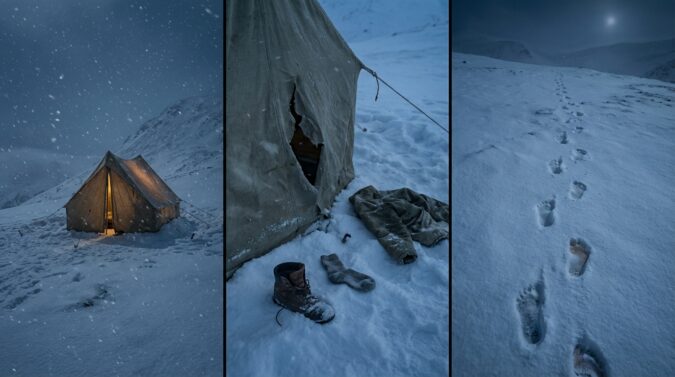
The tent is half buried in snow. It is damaged badly. But not from the outside. Not torn by wind or collapsed by weight. Someone on the inside of that tent used knives to cut through the canvas walls. Multiple cuts. The kind of cuts you make when you are in a hurry and you need out right now and you do not have time to find the zipper.
Inside the tent, everything is still there. Nine pairs of shoes, all neatly arranged. Heavy winter coats. Food. Equipment. The warm, practical, life-saving gear of nine experienced mountaineers who spent months preparing for exactly these conditions.
All of it left behind.
Nine people cut their way out of their tent in the middle of the night, in a blizzard, in minus forty degree temperatures, and ran into the darkness without their shoes.
The search team follows the footprints in the snow. They can see them clearly — the impressions of bare feet and socked feet, walking, not running. Eight or nine sets of tracks leading down the slope toward the tree line.
After five hundred meters or so, the fresh snow has covered the rest of the trail.
They follow the direction the tracks were heading, down toward the forest.
And under a large cedar tree, more than a mile from the tent, they find the first two bodies.
The Bodies — First Wave
Yuri Doroshenko. Yuri Krivonishchenko. The two friends who were practically inseparable.
They are dressed only in their underwear. No shoes. No coats. No protection from the cold. They are lying near the remains of a small campfire, cold and long dead.
The cedar tree above them has something strange about it. The branches on the lower part of the tree, up to about fifteen feet high, are broken. Several of them. As if someone climbed the tree and broke them while climbing, or broke them to use as fuel. There are abrasions on the tree consistent with someone having climbed it. What would drive a person to climb a tree in the middle of a blizzard in the dark, in their underwear, in minus forty degree temperatures?
Nobody knows.
The fire they built was inadequate. Too small. These men knew how to build fires for survival. They had done it many times. But this fire was not built for survival. It was built by people who were either injured, confused, or both.
Krivonishchenko — the jokester, the singer, the man who made everyone laugh — had apparently bitten off a piece of his own knuckle at some point before he died. The flesh was missing. The medical examiner notes this in the report without explanation.
Searching between the cedar tree and the tent site, the team finds three more bodies over the following days.
Igor Dyatlov himself is found three hundred meters from the cedar tree, face up in the snow, his hands clenched in front of his chest, his head pointing toward the tent. The medical examiners note that his jacket is unbuttoned, which is unusual for someone dying of hypothermia. He was vomiting blood at some point before he died.
He appears to have been trying to walk back to the tent.
Zinaida Kolmogorova is found six hundred and thirty meters from the cedar tree, also heading toward the tent. She has a bruise on her waist described as baton-shaped — a long, linear bruise, the kind left by an impact with something narrow and hard.
Rustem Slobodin is found between them. He died trying to return to the tent as well. His autopsy reveals a fracture in his skull. Not a hairline fracture. A significant fracture, 6 centimeters long. The medical examiner notes it cautiously — this injury alone would not necessarily be fatal, but it would have severely impaired his ability to walk and reason.
All five of these people are officially listed as having died from hypothermia. They were alive when they left the tent. They survived long enough to try to walk back to it.
The other four members of the group are not found.
Not yet.
Two Months of Searching
The snow in the northern Urals in February is not going anywhere quickly. Search parties probe the area with poles, trying to find anything under the surface. They find nothing.
The investigation continues. Forensic experts examine the tent and confirm what the first searchers suspected — the cuts in the canvas were made from the inside. This changes the entire interpretation of what happened. Whatever drove these people out into the blizzard was not an outside force physically cutting through the tent. It was the people inside, trying to get out. Trying to escape something.
The investigation is classified. The Soviet government is running this now, not the university. In 1959, in the Soviet Union, when the government classifies an investigation it means most people will never know what was found.
The prosecutor leading the investigation, Lev Ivanov, will write in his personal memoirs many years later that he was instructed to close the case and classify the files. He will write that he found evidence he was not permitted to fully explore. He will write about witnesses in the area who reported seeing glowing orange spheres in the sky on the night the group died — multiple independent witnesses, dozens of miles apart, all describing the same thing. Glowing orange spheres, moving over the mountains.
He could not put this in his official report.
In May, when the snow begins to melt, searchers using poles probe a ravine further into the forest below the cedar tree. A Mansi guide and his dog detect something in the snow. They follow the trail and find clothing on the surface — a pair of black sweatpants with the right leg cut off. A piece of a brown wool sweater, cut down the middle.
And then, under four meters of snow, they find the remaining four members of the group.
The Bodies — Second Wave
Alexander Kolevatov. Nikolai Thibeaux-Brignolles. Semyon Zolotaryov. Lyudmila Dubinina.
They had made it further than the others. They had built a snow den — a deliberate survival structure, a hole dug into the snow to preserve body heat. Building a snow den takes knowledge and effort. These four people were thinking clearly enough to do it. They were trying to survive.
They are better dressed than the first five. They are wearing clothes taken from the bodies of those who died first. Krivonishchenko’s burned pants have been cut and wrapped around Dubinina’s foot. Someone took clothing from the dead to keep the living warm.
Think about that for a moment. Someone, in the dark, in the middle of a blizzard, with temperatures at minus forty, found the strength and the clarity to strip clothing from the dead and give it to the living.
These people did not give up. Right up until the very end, they were doing everything they could to survive.
But what the medical examiners find when they examine these four bodies is something else entirely.
Thibeaux-Brignolles has a fractured skull. Not a hairline. Not a crack. A caved-in skull, the kind of injury associated with extreme blunt force trauma — the kind of impact you see in high-speed car accidents.
Zolotaryov has multiple fractured ribs on his right side. The medical examiner describes the force required to cause this injury as extraordinary. Massive. The kind of compression force that does not come from a simple fall.
Dubinina has six broken ribs — three on the left, three on the right. Her chest has been compressed by something with enormous force.
And here is the detail that will follow this case for the rest of its existence: the medical examiner notes that despite these catastrophic internal injuries, the external tissue of all four victims shows no corresponding damage. No bruising on the surface of the skin consistent with an impact. No lacerations. Nothing on the outside that would tell you what happened on the inside.
The force came from somewhere. It broke bones. Shattered ribs. Cracked skulls. And it left no marks on the skin.
Dubinina is also missing her tongue. Her eyes are gone. Zolotaryov is missing his eyes and eyebrows.
And then there is the radiation.
When the clothes of two of the victims are tested, they come back with elevated levels of radioactive contamination. The Soviet investigators note this. They offer an explanation — contamination from the Mayak nuclear facility where Krivonishchenko had been working, transferred through contact. It is possible. It is also the kind of explanation that is very convenient when you are a Soviet government in 1959 and you do not want to discuss what kind of activity might be happening in this region of the Urals.
The investigation is closed in May 1959. Less than a month after the last four bodies are found.
The official conclusion, written into the record and then sealed away in classified archives, is nine words long.
The hikers died as a result of a compelling unknown natural force.
The files are sealed. The region is closed to hikers for three years. And the Soviet government moves on.
The Theories
For sixty-five years, the Dyatlov Pass incident has attracted more theories than almost any unsolved mystery in modern history. People have dedicated their lives to this. Researchers, investigators, journalists, amateur sleuths from every country on earth have gone over every piece of evidence available and come up with explanations ranging from the almost plausible to the completely unhinged.
Let me walk you through the serious ones.
The Avalanche Theory
The most obvious explanation is also the most contested.
The theory says that a mass of snow slid down the slope and hit the tent while the group was sleeping. Woken in darkness, partially buried, some of them immediately injured by the impact, the survivors cut through the tent to escape, believing the mountain was about to come down on top of them entirely. In the chaos and darkness and terror, there was no time to grab shoes or coats. They just ran.
The massive injuries found on four of the victims — the shattered ribs, the caved-in skull — are consistent with being hit by a dense slab of snow moving at speed. The reason there are no external marks on the skin is because the force was distributed across the entire body surface, like being hit by a moving wall rather than a fist.
The problems with this theory have always been the same. When the search team arrived in February, they found no evidence of an avalanche. The slope where the tent was set up was measured at thirty degrees — steep enough to make camping uncomfortable, but generally considered too shallow for a significant avalanche. The ski poles the group had planted outside the tent were undisturbed, which is inconsistent with a wall of snow having passed over the area.
For decades, investigators looking at photographs of the site said: there was no avalanche here.
The Slab Avalanche Revision
In 2021, two researchers at Swiss universities — Johan Gaume at EPFL in Lausanne and Alexander Puzrin at ETH Zurich — published a study in the journal Communications Earth and Environment.
They had built a computer model.
Here is what they found. When the Dyatlov group dug their platform into the slope to set up the tent, they created a cut in the snowpack. This cut created a structural weakness. As the night progressed, strong katabatic winds — cold air flowing down from the mountain peaks — deposited a new layer of dense, compacted snow above the tent, on top of this weakness.
The critical thing about this process is the timing. The snow does not fall immediately. It builds up over hours. The hikers could have been asleep for a long time before the weight reached a critical threshold.
And then a slab — not a full avalanche, not a wall of snow rolling down a mountain, but a plate of dense, compressed snow a few centimeters thick but covering a large area — slides down the slope and directly onto the part of the tent where people are sleeping.
The model shows this specific type of slab impact can produce exactly the injuries found on Dubinina and Zolotaryov. Massive compressive force on the chest and skull. No external marks because the impact is distributed across the full surface of the body through the tent fabric and snow. The force is extraordinary but it comes from weight and momentum, not from a sharp impact.
The people directly under the slab are seriously injured. Some may be immediately incapacitated. The others, woken by screaming, in complete darkness, with snow pressing down on the tent fabric, have no way of knowing if this is a small event or the beginning of a full mountain coming down on them. They grab the nearest knives and cut their way out and they run.
Gaume and Puzrin’s model was the most sophisticated analysis of the physical evidence ever produced, and it was taken seriously by the scientific community.
The Russian government, which had reopened the investigation in 2019, arrived at a similar conclusion. A combination of a slab avalanche or similar snow event, hurricane-force winds, and extreme cold. Natural causes. Not a crime.
The Military/Weapons Testing Theory
There are things about this case that the avalanche theory, however sophisticated, does not neatly explain.
The radioactivity on the clothing. The glowing spheres in the sky that multiple witnesses reported. The fact that Krivonishchenko had been working at the Mayak nuclear facility, the site of a major nuclear accident in 1957 — one of the worst in history — that the Soviet government suppressed from public knowledge. The fact that the investigation was classified almost immediately. The fact that Lev Ivanov, the lead investigator, wrote in his personal memoirs that he was told to stop asking certain questions.
The northern Urals in 1959 were not an empty, peaceful wilderness. The Soviet military conducted weapons tests in the region. Ballistic missile tests. The R-12 intermediate-range ballistic missile was being actively tested during this period, and its flight path took it through the Ural mountains region. When these missiles reentered or were tested at night, they could appear as glowing spheres to observers on the ground.
Some researchers have proposed that a missile with a defective warhead, or carrying a payload of aerosolized chemical or biological material, could have descended into the valley where the hikers were camped. Exposure to certain chemical agents can cause extreme disorientation, hallucinations, panic responses — all the things that might cause a group of experienced mountaineers to flee their tent in terror, abandoning all rational survival behavior.
This would also explain the radiation on the clothing, the unusual injuries, the speed of the investigation’s closure, and the classification of the files.
There is no direct evidence for this theory. But there is also a specific absence of evidence that is itself notable — certain types of evidence that should exist if the scene was exactly what it appeared to be are missing. Some investigators find this significant. Others say absence of evidence is not evidence of anything.
The Infrasound Theory
This one is fascinating in its specificity.
In certain mountain terrain configurations, wind moving at high speeds over irregular surfaces can generate infrasound — sound waves below the threshold of human hearing, typically below 20 hertz. These waves can travel extremely long distances and pass through solid objects.
At certain frequencies, infrasound causes specific physiological effects in humans. Vibrations in the eye at around 19 hertz can cause visual disturbances — shapes, colors, things that are not there. At slightly higher intensities, infrasound causes a sense of overwhelming dread, a feeling of presence, a conviction that something is terribly wrong without knowing what. At high intensities it causes panic responses that override rational thought.
The theory suggests that the specific geography of the Kholat Syakhl slope, combined with the hurricane-force winds recorded that night, could have produced infrasound of sufficient intensity to cause the group to experience a sudden, overwhelming, physically-produced sense of terror. Not imagined terror. Not psychological panic. A physiological response to low-frequency sound waves hitting the human body.
They would not know what was happening to them. They would only know they needed to get out immediately.
This theory has supporters in the acoustic physics community. It is difficult to prove or disprove because you cannot recreate the exact atmospheric conditions of that specific night.
What Actually Happened
The honest answer is that nobody knows with absolute certainty.
The most scientifically rigorous explanation — the slab avalanche model produced by the Swiss researchers — is also the most defensible. It accounts for the injuries. It accounts for the tent cuts. It accounts for the flight without footwear. It is the conclusion that serious scientific institutions have reached after analyzing the physical evidence without political constraints.
But it does not explain everything perfectly.
It does not fully explain the radiation. It does not explain the missing soft tissue from the faces of the last four victims in a way that satisfies everyone. It does not explain why experienced mountaineers, who had trained for exactly these survival scenarios, made decisions in those hours between leaving the tent and dying that are difficult to reconcile with rational survival thinking.
Why did Krivonishchenko bite off his own knuckle? Why did someone climb that cedar tree? Why did those five people try to walk back uphill to the tent rather than staying in the forest near the fire? Why was the fire so small?
These are the questions that have kept this case alive for sixty-five years.
Because the answers matter. Not abstractly. Not just as a puzzle to be solved. They matter because nine real people died in those mountains. Nine people who had families and friends and plans for the future. Yuri Krivonishchenko, who made everyone laugh. Zinaida Kolmogorova, who wrote about how beautiful the forest was. Lyudmila Dubinina, twenty years old, the youngest of them. Igor Dyatlov, twenty-three, found in the snow with his fists clenched in front of his chest and his head pointed toward the tent he was trying to reach.
They matter because Yuri Yudin — the one who turned back, the one who survived because his knee hurt on the fourth day — spent fifty-four years asking the same questions and never got answers he could fully live with.
He died in 2013, at seventy-five, from a heart condition. The last person who had seen all of them alive.
The Mountain
The mountain pass where this happened was named Dyatlov Pass in memory of the group.
There is a memorial there now. A rock outcrop with the names of all nine carved into it. People still make the journey to see it — researchers, hikers, people who became obsessed with this story the way people become obsessed with things that do not resolve cleanly.
The mountain itself is still called Kholat Syakhl.
Dead Mountain.
The Mansi named it that long before 1959. Long before Igor Dyatlov was born. Long before the Soviet Union existed. Some things have names that turn out to be exactly right, and you only understand why afterward.
Nine people climbed its slopes on February 1st, 1959.
They set up camp as the light faded.
They ate dinner.
They went to sleep.
And somewhere in the deep dark hours of that night, something happened that was violent enough and terrifying enough to drive every one of them out of the only thing keeping them alive, barefoot, into a minus forty degree blizzard, running into the dark toward a forest they could not see.
They never made it back.
And we are still, sixty-five years later, not entirely sure why.

