A Powerful Biblical Story of Justice in the Second Temple
Jerusalem was swollen with pilgrims.
Passover always transformed the city into a living river of humanity. Families traveled from Galilee, Judea, and distant provinces under Roman rule. They came with offerings, coins, livestock, and expectation. The Temple Mount rose above the city like a crown of stone, its white limestone reflecting sunlight so intensely it almost seemed to glow.
The Second Temple stood as the spiritual heart of Israel.
And in its outer court, business thrived.
The Marketplace Inside the Sacred Walls
The Court of the Gentiles had been designed as a place of access — a space where even foreigners could come close to the God of Israel. It was wide and open, paved with smooth stone, framed by colonnades casting thin strips of shade.
But during festival season, it barely resembled a place of prayer.
Money changers sat behind wooden tables stacked with coins from across the empire: Roman denarii, Greek drachmae, Tyrian shekels. Since Roman coins bore Caesar’s image — and sometimes pagan symbols — they were considered unsuitable for Temple offerings. So pilgrims were required to exchange their currency.
For a fee.
A generous fee.
MERCHANT EZRA worked quickly, his fingers stained dark from constant handling of silver. He weighed coins with precision, then skimmed profit through small manipulations in exchange rates. His expression was sharp, calculating.
Nearby, TEMPLE SELLER DARIUS managed cages filled with doves. The birds flapped nervously, wings brushing wooden slats. Families who could not afford lambs purchased doves instead. Darius charged extra for those deemed “without blemish.”
He justified it easily.
Everyone did.
The priests allowed it.
The Temple treasury benefited.
The system was established.
And systems rarely question themselves.
The Arrival of Jesus of Nazareth
When JESUS OF NAZARETH entered the courtyard, the noise did not diminish.
He did not enter like a soldier.
He did not shout immediately.
He did not demand attention.
He stopped.
And He observed.
His disciples lingered behind Him, exchanging uncertain glances. They had seen Him heal lepers, calm storms, confront Pharisees with words sharper than swords. But this — this was different.
He watched a widow count her coins three times before handing them to Ezra.
He watched a shepherd argue over the price of a lamb.
He watched priests glance at the tables but never intervene.
He watched the House of His Father transformed into commerce.
The house meant for prayer had become a marketplace.
His jaw tightened.
The disciples recognized the look.
Not rage.
Resolve.
The First Table Falls
Without announcement, Jesus stepped forward.
Ezra barely noticed Him at first.
“Exchange?” Ezra muttered automatically.
Jesus’ hands gripped the edge of the table.
For a breathless moment, the entire courtyard felt suspended.
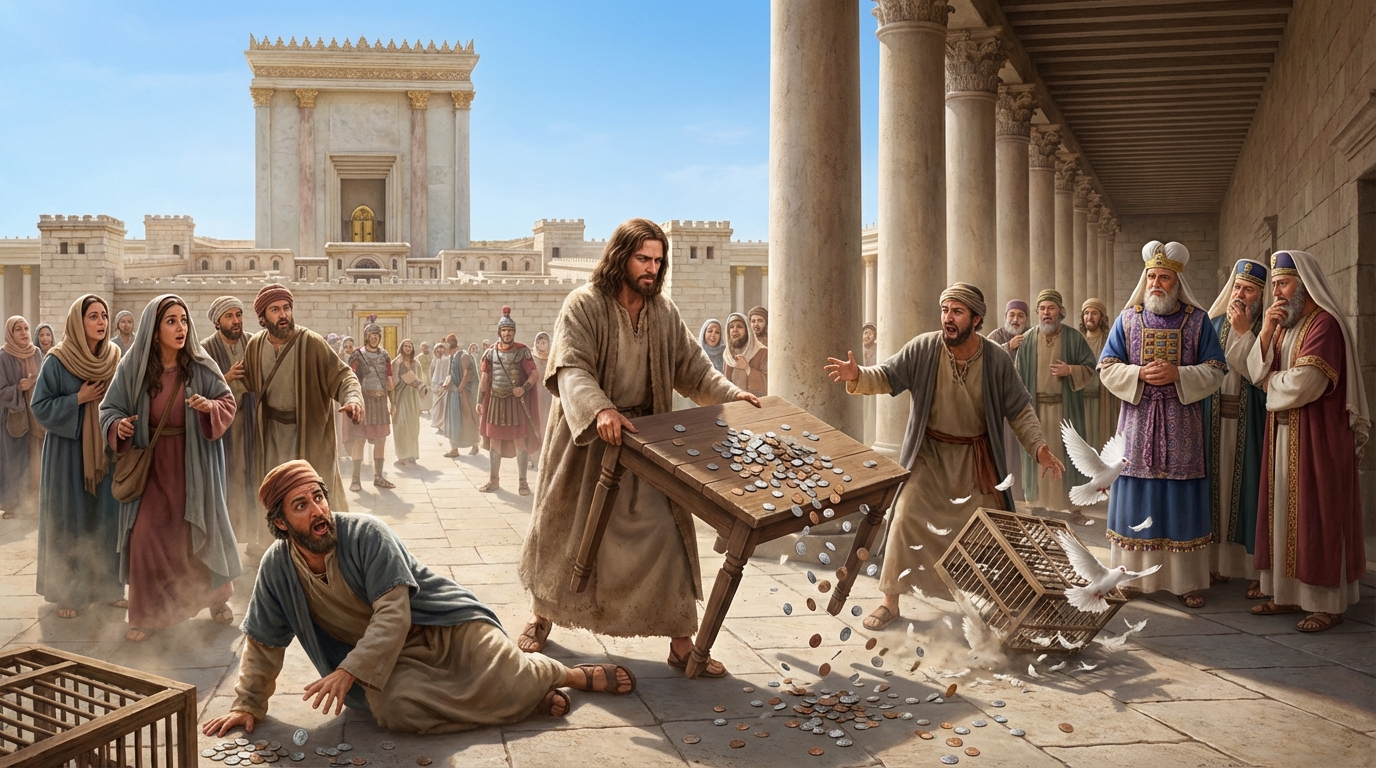
Then the table flipped.
Wood struck stone with explosive force.
Coins erupted into the air like metallic rain, scattering in all directions. Silver disks spun wildly across pavement, clattering and ringing against one another.
Ezra fell backward in shock, scrambling desperately to retrieve rolling coins.
Gasps spread through the crowd.
Jesus moved again.
Chaos in the Court of the Gentiles
Another table overturned.
Then another.
Darius shouted silently as cages tipped sideways. Doves burst into the air in a flurry of feathers, wings beating violently against sunlight.
Children screamed.
Merchants flailed.
Pilgrims stumbled backward.
Dust rose from the stone floor, mixing with feathers and the sharp scent of livestock.
But Jesus’ movements were not wild.
They were purposeful.
Measured.
Driven by conviction.
He pointed toward the towering Temple structure beyond the courtyard.
“My house shall be called a house of prayer…”
His voice carried with authority that silenced more effectively than shouting.
“But you have made it a den of thieves.”
The words landed heavier than the crashing tables.
The accusation struck at the core of the system.
This was not about spilled coins.
It was about corruption.
Righteous Anger vs. Human Rage
There is a difference between uncontrolled fury and righteous anger.
Human rage seeks revenge.
Righteous anger seeks restoration.
Jesus did not attack people.
He confronted exploitation.
He did not wound the poor.
He disrupted those who profited from them.
His anger was not impulsive.
It was protective.
The disciples remembered Psalm 69:
“Zeal for Your house will consume Me.”
They were witnessing it in real time.
The Temple Authorities React
From beneath shaded colonnades, Temple officials gathered.
Their robes were immaculate.
Their expressions hardened.
They saw disorder.
They saw disruption.
They saw threat.
But beneath their outrage was fear.
Because the crowd was watching.
And many among the pilgrims nodded quietly.
They had felt the injustice.
They had whispered about inflated prices.
About unfair exchange rates.
About the burden placed on worship.
And now someone had acted.
Authority approached Jesus cautiously.
“By what authority do You do these things?” they demanded.
It was the real question.
Not about tables.
Not about coins.
Authority.
Jesus did not hesitate.
He spoke of destruction and rebuilding.
Of a Temple that could be torn down and raised in three days.
They misunderstood.
Or perhaps they refused to understand.
Because what He threatened was not architecture.
It was control.
The Symbolism of the Cleansing
This moment in the Temple was more than an act of protest.
It was prophetic.
The Temple represented covenant.
Worship.
Access to God.
By cleansing it, Jesus declared that access to God would no longer be mediated through corruption.
The scattered coins symbolized a broken system.
The released doves symbolized freedom.
The overturned tables symbolized judgment.
And standing alone amid dust and debris symbolized courage.
Jesus was not merely angry.
He was revealing something.
Holiness cannot coexist with exploitation.
Prayer cannot thrive in greed.
Sacred spaces cannot be governed by profit.
The Crowd’s Silent Response
As the dust settled, silence replaced noise.
Coins lay scattered across stone.
Feathers drifted in warm air.
Merchants stood stunned.
Pilgrims watched with wide eyes.
Some were afraid.
Others felt relief they could not articulate.
For a brief moment, the Temple courtyard felt like what it was meant to be.
Still.
Honest.
Sacred.
Jesus stood firm among overturned tables.
His breathing steady.
His eyes unwavering.
He had not come to preserve comfort.
He had come to confront compromise.
The Consequences of Confronting Corruption
The tables would be lifted upright again.
The coins would be gathered.
Commerce would resume.
But something irreversible had happened.
The Temple leaders began seeking a way to silence Him.
Because righteous anger threatens systems built on advantage.
And those systems rarely surrender quietly.
Yet the memory remained.
A man standing alone against institutional corruption.
A voice declaring that God’s house belonged to prayer, not profit.
A moment where justice shattered routine.
Why This Biblical Story Still Matters Today
The cleansing of the Temple is not merely a historical event.
It is a confrontation that echoes across centuries.
It asks uncomfortable questions:
What have we allowed into sacred spaces?
Where has worship been replaced with transaction?
What systems exist that burden the vulnerable while benefiting the powerful?
The story forces reflection.
Because the Temple is not just a building.
It represents the heart.
And every heart must decide what it permits inside.
The Final Image
Under harsh Jerusalem sunlight, amid scattered coins and drifting dust, Jesus stood unshaken.
The house meant for prayer had become a marketplace.
And for a powerful, unforgettable moment —
it was reclaimed.

