The River
The night was quiet, but not peaceful.
Jochebed held her baby close as soldiers passed outside. Every Hebrew mother in Egypt knew the sound of those boots.
A decree had gone out from Pharaoh:
“Every son that is born to the Hebrews you shall cast into the Nile.”
Her child stirred.
She pressed her forehead to his.
“I will not give you to the river,” she whispered.
For three months she hid him.
But babies grow. And cries grow louder.
One dawn, with trembling hands, she sealed a small basket with pitch and laid the infant inside. His sister Miriam stood nearby.
“Watch him,” Jochebed whispered. “Don’t let him out of your sight.”
They placed the basket among the reeds of the Nile.
The river that swallowed sons would carry this one.
Soon, laughter approached — the laughter of royal women.
Pharaoh’s daughter stepped toward the water.
“What is that?” she asked.
A servant parted the reeds.
A baby cried.
Pharaoh’s daughter lifted him gently.
“This is one of the Hebrew children.”
The infant reached out, grasping her finger.
She smiled.
“I will keep him.”
From the bank, Miriam ran forward.
“My lady, shall I find a Hebrew woman to nurse the child for you?”
“Yes,” the princess said without hesitation.
And so the child returned — for a time — to his mother’s arms.
She named him Moses.
“Drawn out,” she would later say. “Drawn out of water.”
The Palace and the Secret
Years passed.
Moses grew tall in Pharaoh’s courts. He learned language, war, administration. He walked marble halls.
But sometimes, at night, he heard a different sound — the crack of whips across Hebrew backs.
One afternoon, he wandered from the palace and saw an Egyptian striking a Hebrew slave.
The slave cried out.
Moses looked left.
He looked right.
No one.
He struck the Egyptian.
The man fell silent in the sand.
The next day he tried to intervene in a fight between two Hebrews.
“Why are you striking your companion?” Moses demanded.
The man sneered.
“Who made you prince and judge over us? Do you mean to kill me like you killed the Egyptian?”
Fear gripped him.
The secret was known.
Pharaoh heard.
“Bring him to me.”
But Moses fled before soldiers arrived.
From prince…
To fugitive.
The Desert
Midian was harsh. Endless horizon. Burning sun.
Moses sat by a well when shepherds drove away seven women trying to water their flock.
He stood.
“Leave them.”
The shepherds laughed.
He stepped forward.
They left.
One of the women looked at him curiously.
“Thank you,” she said.
Her name was Zipporah.
He married her.
He became a shepherd.
Forty years passed.
The palace faded.
The desert remained.
The Fire That Did Not Burn
One day, leading sheep near Mount Horeb, Moses stopped.
A bush was on fire.
But it was not consumed.
He stepped closer.
“Moses.”
The voice was not thunder.
It was steady.
“Moses.”
He froze.
“Here I am.”
“Do not come near. Remove your sandals. The place where you stand is holy ground.”
Moses fell to his knees.
“I am the God of your father — the God of Abraham, Isaac, and Jacob.”
Moses covered his face.
“I have seen the affliction of My people in Egypt. I have heard their cry.”
A pause.
“I am sending you to Pharaoh.”
Moses lifted his head slowly.
“Me?”
“Yes.”
“I am nobody. What if they do not believe me?”
“What is in your hand?”
“A staff.”
“Throw it down.”
He did.
It became a serpent.
He jumped back.
“Pick it up.”
He obeyed. It became a staff again.
“They will believe.”
Moses swallowed.
“What if I cannot speak?”
“I made your mouth.”
A long silence.
“Please… send someone else.”
The air grew heavy.
“Your brother Aaron is coming. He will speak. But you will go.”
Moses nodded.
The desert had prepared him.
Let My People Go
Pharaoh sat upon his throne.
Moses and Aaron stood before him.
Aaron spoke first.
“Thus says the Lord, the God of Israel: Let My people go.”
Pharaoh laughed.
“Who is the Lord?”
Moses stepped forward.
“You will know.”
Then the river turned to blood.
Frogs covered the land.
Gnats swarmed.
Flies darkened the air.
Livestock died.
Boils broke out on skin.
Hail shattered crops.
Locusts devoured what remained.
Darkness fell for three days.
Each time Pharaoh said:
“I will let them go.”
Each time he changed his mind.
Finally, Moses stood before him one last time.
“At midnight,” he said quietly, “the firstborn in Egypt shall die.”
Pharaoh’s face hardened.
“Get out of my sight.”
The Night of Blood and Bread
Hebrew families stood inside their homes, lamb’s blood on their doorposts.
Children asked, “Why are we eating standing up?”
“Because tonight,” their fathers whispered, “we leave.”
A cry rose from Egypt at midnight.
The firstborn were gone.
Pharaoh summoned Moses.
“Go. Take your people. Leave.”
They left in haste.
But freedom was only beginning.
The Sea
The Red Sea stretched before them.
Behind them: chariots.
The people panicked.
“Was it because there were no graves in Egypt that you brought us here to die?”
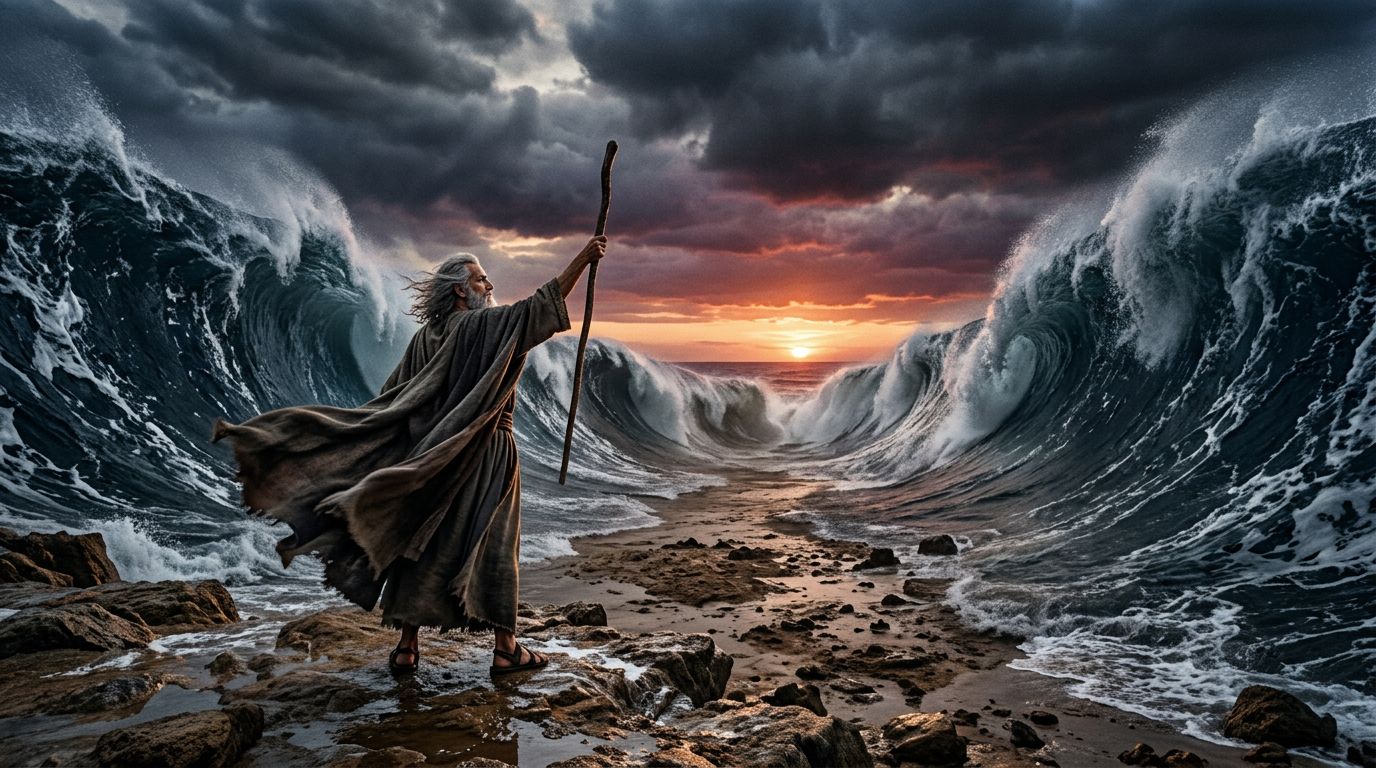
Moses lifted his staff.
“Fear not. Stand firm.”
The wind began to howl.
All night it blew.
The waters split.
Walls rose.
The ground dried.
“Go,” Moses said.
They walked between walls of water.
Children stared upward in awe.
When the last crossed, Egyptian chariots entered.
Moses lowered his staff.
The sea returned.
The army vanished beneath the waves.
On the shore, Miriam lifted a tambourine.
“Sing to the Lord,” she cried, “for He has triumphed gloriously!”
The Mountain
At Sinai, thunder shook the earth.
Lightning split the sky.
Smoke covered the mountain.
The people trembled.
Moses climbed alone.
From the cloud, a voice spoke commandments.
“You shall have no other gods before Me.”
“You shall not murder.”
“You shall not steal.”
“You shall not bear false witness.”
When he returned, he found the people dancing before a golden calf.
Aaron stood awkwardly.
“They gave me gold… and it came out like this.”
Moses’ face burned with anger.
“Is this what you do so quickly?”
He smashed the tablets.
Later, he climbed again.
“Forgive them,” he pleaded.
And mercy was given.
The Long Road
Years passed in the wilderness.
The people complained.
“There is no water.”
Moses struck a rock. Water flowed.
“There is no food.”
Manna fell from heaven.
“There is no meat.”
Quail covered the camp.
But fear remained.
When spies returned from Canaan, ten said:
“We cannot go. They are giants.”
Two said:
“The Lord is with us.”
The people chose fear.
They wandered forty years.
The Rock and the End
Near the end, once more there was no water.
God said, “Speak to the rock.”
But Moses, weary, angry, shouted:
“Must we bring water out for you?”
He struck it twice.
Water flowed.
But the voice returned.
“You did not trust Me before the people.”
Moses would see the Promised Land.
But not enter it.
The Final Climb
Old and tired, Moses climbed Mount Nebo.
God showed him the land — valleys, rivers, promise.
“There,” the voice said softly.
Moses exhaled.
After slavery.
After plagues.
After sea and mountain.
After rebellion and mercy.
He smiled.
And he slept.
His grave was hidden.
But his story was not.

