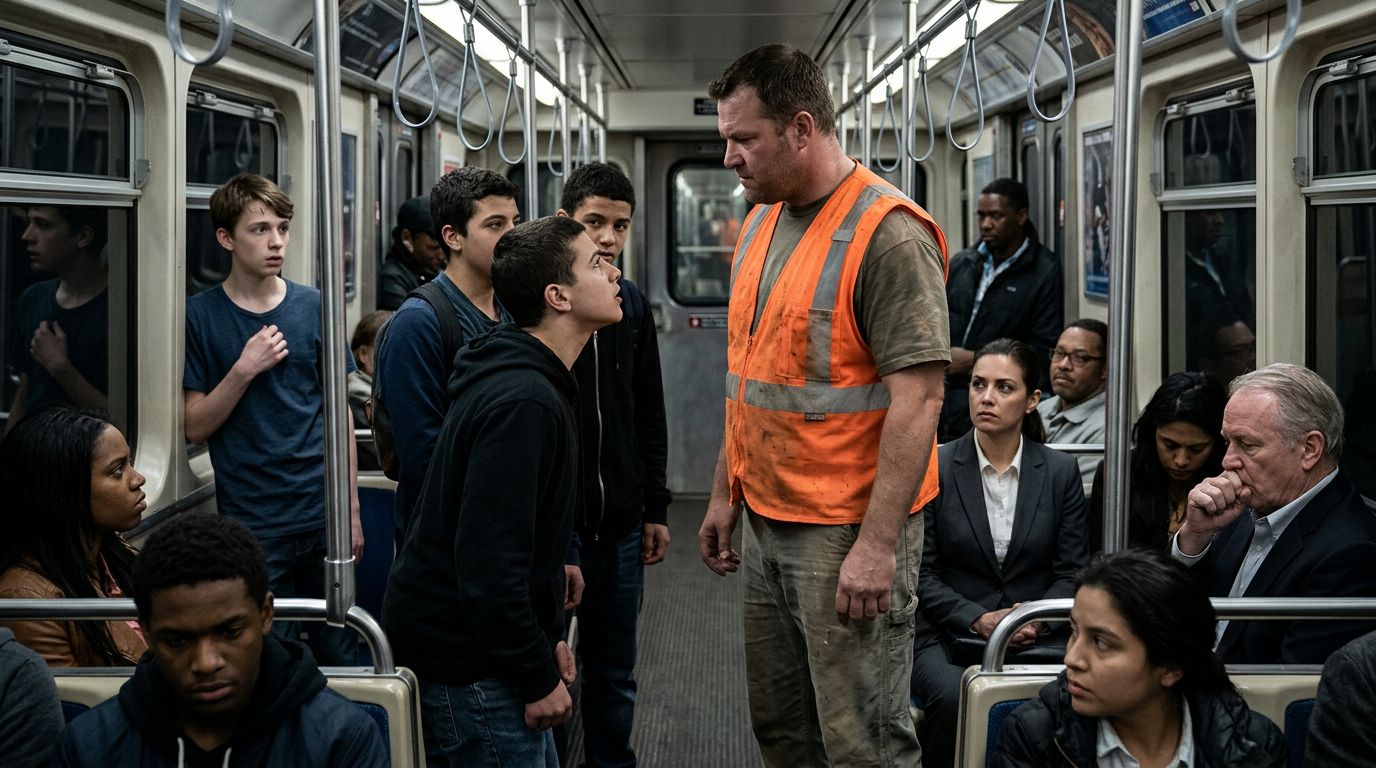
The subway car was full.
Not packed, but full enough that no one could pretend they didn’t hear it.
It was 4:42 p.m. on the Blue Line—end of school rush, beginning of evening exhaustion. Backpacks on laps. AirPods in. Screens glowing.
And in the corner seat by the pole sat Noah Kaplan.
Seventeen.
Thin shoulders. Crooked posture. One hand curled slightly inward against his chest.
His speech was slow—not because he didn’t know what to say, but because the muscles in his mouth didn’t always cooperate.
Cerebral palsy.
Visible.
Unavoidable.
And today, apparently, entertaining.
“C-c-can you m-m-move?” Noah asked softly, trying to get past a cluster of boys blocking the aisle.
One of them turned.
Smirked.
“Oh, sorry, bro,” he said loudly. “C-c-can you m-m-move?”
The others burst into laughter.
The subway car went very still.
Noah’s ears burned.
He tried again, quieter.
“I just n-need to get off at—”
“M-m-maybe he needs a t-t-translator,” another boy chimed in.
More laughter.
Phones lifted.
Recording.
The train rocked forward.
And no one said a word.
I. The Boy Who Practiced Alone
Noah had practiced ordering coffee in his bathroom mirror for months before he ever tried it in public.
“Large iced latte,” he would whisper to his reflection, jaw tightening on the consonants.
Sometimes he’d get it clean.
Sometimes he wouldn’t.
He had learned early that the world moved faster than he did.
Teachers who finished his sentences.
Cashiers who avoided eye contact.
Kids who laughed before he reached the end of a word.
His mother used to squeeze his hand and say, “You don’t owe anyone speed.”
But speed was currency in high school.
And he was broke.
II. The Silence
Back on the train, the boys weren’t done.
One leaned closer.
“Say something else,” he grinned. “C-c-call me ugly.”
The car filled with quiet tension.
A woman in a business suit stared at her phone harder.
An older man shifted uncomfortably but said nothing.
A teenage girl bit her lip, eyes wide, frozen.
Noah’s throat tightened.
“I j-just w-want to get off.”
The doors chimed.
Not his stop.
The boy imitated him again, louder.
The laughter echoed.
And the silence around them felt like permission.
Shame on you.
III. The Man in the Orange Vest
At the far end of the subway car, a man in a neon orange construction vest slowly stood up.
He was broad across the shoulders, dust still clinging to his boots. His forearms were thick, scarred, strong from years of lifting steel and concrete.
He had been staring out the window.
He had heard every word.
“Do that again,” he said calmly.
The laughter hiccupped.
The teens turned.
“You talking to us?” the leader asked.
The man stepped into the aisle.
“I said,” he repeated, voice lower now, “do that again.”
The boy smirked, trying to hold the performance together.
“C-c-can you—”
He didn’t get to finish.
The man closed the distance in three strides.
He didn’t shove.
Didn’t swing.
He just stood close enough that the boys had to look up.
And suddenly they didn’t look so tall.
“Say it,” the man murmured.
The leader swallowed.
The car was silent.
Noah’s heartbeat thundered in his ears.
One of the boys laughed nervously.
“It was just a joke.”
“Jokes are funny,” the man replied evenly. “What you’re doing isn’t.”
IV. The Turning
The train screeched into the next station.
Doors slid open.
The boys hesitated.
The construction worker didn’t move.
He didn’t raise his voice.
He didn’t touch them.
He just stood there—unflinching.
One by one, the boys stepped off the train.
Not running.
But not laughing either.
The doors shut behind them.
And the car exhaled.
V. Aftermath
Noah stood frozen.
The man turned to him, expression softening instantly.
“You okay, kid?”
Noah nodded once.
“T-thank you.”
The words came slow, but steady.
The man shrugged lightly.
“Don’t thank me.”
He glanced around the subway car.
At the suited woman.
At the older man.
At the girl who had looked away.
“Should’ve been someone else first.”
Shame on you.
The woman in the suit flushed.
The older man cleared his throat.
The teenage girl finally stood.
“I’m sorry,” she said to Noah quietly. “I should’ve said something.”
Noah looked at her.
Then at the man.
Then down at his own shoes.
“I’m u-used to it,” he said.
The construction worker’s jaw tightened.
“You shouldn’t be.”
VI. The Last Stop
When Noah’s stop came, the man stepped off with him.
Not because Noah needed an escort.
But because he wanted to make sure.
They stood on the platform together as the train pulled away.
“What’s your name?” the man asked.
“N-Noah.”
“Mike.”
They shook hands.
Noah’s grip was careful.
Mike’s was steady.
“You play sports?” Mike asked.
Noah shook his head.
“I d-draw.”
Mike nodded.
“Keep doing that.”
He paused.
“And next time?”
Noah met his eyes.
“Next time,” Mike said, “you look them right in the face and finish your sentence.”
Noah’s lips twitched.
“I t-try.”
“That’s enough.”
VII. The Viral Moment
By the time Noah got home, the video was already online.
The clip didn’t just show the mocking.
It showed the silence.
It showed the man standing up.
It showed the teens stepping back.
Comments flooded in:
Shame on those kids.
Shame on everyone who stayed silent.
That man is a hero.
Protect this boy at all costs.
The next morning at school, no one laughed.
No one mimicked.
They stared.
Some avoided eye contact.
A few nodded awkwardly.
One teacher pulled him aside.
“If anything like that ever happens here,” she said, “you tell me.”
Noah looked at her steadily.
“I t-told before.”
She didn’t have an answer for that.
Shame on you.
VIII. The Final Scene
That afternoon, Noah stood in front of his bathroom mirror again.
“Large iced latte,” he practiced.
It wasn’t perfect.
It didn’t have to be.
He remembered the way Mike had stood in that aisle—unmoving, unapologetic.
He lifted his chin slightly.
The next day on the subway, when a stranger bumped into him and muttered something impatient, Noah didn’t shrink.
He finished his sentence.
Slow.
Clear.
And this time, no one laughed.
Because sometimes courage doesn’t roar.
Sometimes it just stands up in an orange vest and refuses to sit back down.
And sometimes the loudest shame in a room belongs to the people who said nothing at all.

