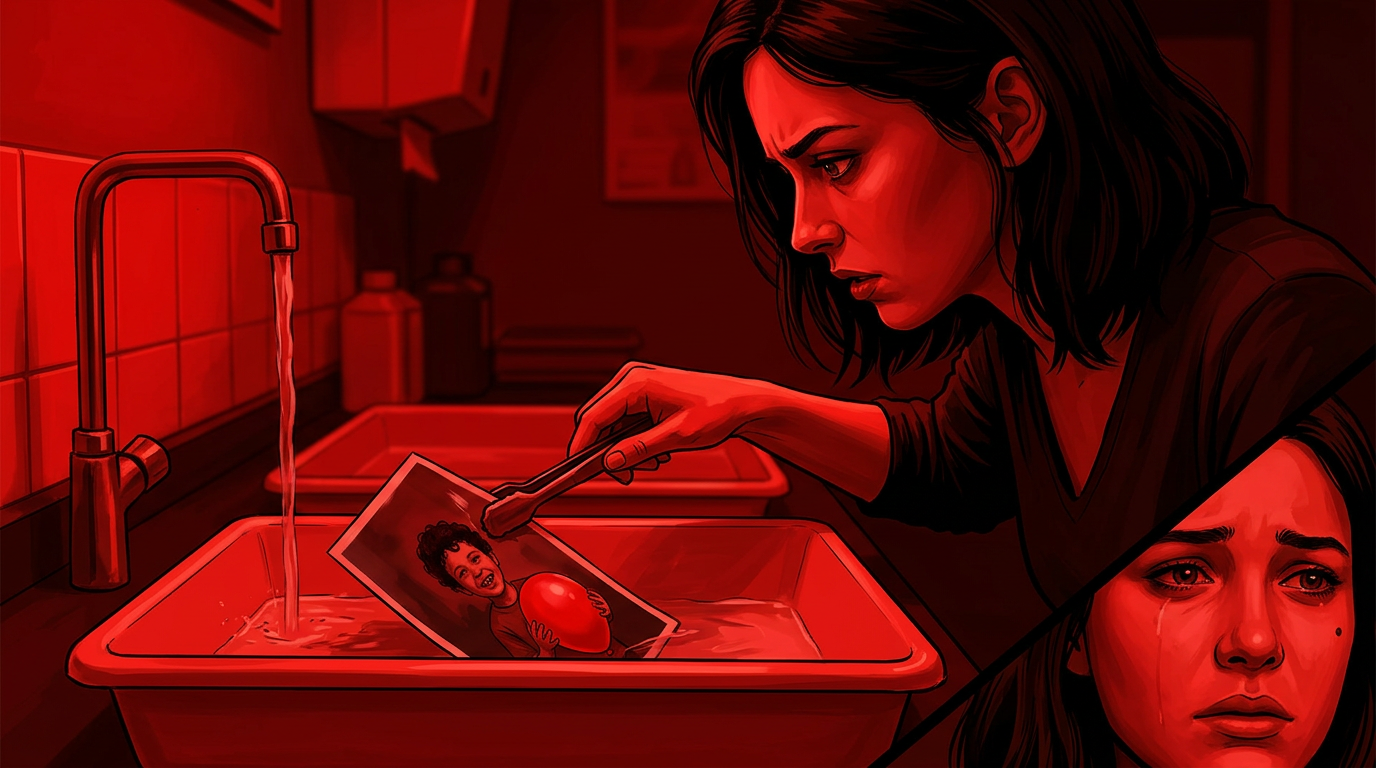
A darkroom glows red.
Water runs.
A photograph slides into the developing tray and slowly, like a secret choosing to appear, an image rises from blank paper—first shadows, then shapes.
A small boy comes into focus, laughing, holding a balloon.
And in the corner of the frame—half cut off, just enough to be undeniable—there is a young woman’s face.
It is her face.
Same eyes. Same mole near the cheekbone. Same mouth pulled tight with grief.
Only… she looks years younger.
And she is crying like she’s watching the world end.
Mara drops the wet photograph. It slaps the tile.
Her whisper is barely a sound.
“That’s… impossible.”
1. The envelope
Mara Quinn’s hands didn’t shake. Not usually.
She taught photography at a community art center, the kind that smelled like paint and coffee and second chances. She lived alone in a small apartment above a closed-down bakery. She paid her bills early. She remembered to water her plants. She kept life clean and manageable.
Which is why the envelope felt like an insult.
It was thick, yellowed at the edges, sealed with a strip of brittle tape that looked like it had survived a flood. No return address—just her name written in careful block letters:
MARA QUINN
Inside, she found three rolls of 35mm film in plastic canisters, a key on a cheap ring, and a folded piece of paper.
The paper read:
If you develop these, you will lose the life you think you have.
But you might get back the life you lost.
I’m sorry.
No signature.
Mara stared at the words until the letters blurred. Her first instinct was to throw it all away. Mystery belonged to other people. People with time and drama.
But the film—old, slightly scuffed, stored with a tenderness that felt deliberate—pulled at her like a thread.
And the key… the key made her stomach tighten with a knowing she couldn’t explain.
It was the kind of key used for storage units.
Mara didn’t sleep that night.
In the morning, she opened her closet, pulled out her film tank, chemicals, and trays. She told herself she was doing it out of curiosity. Professional interest. Nothing more.
She lied.
2. The photograph that shouldn’t exist
Her darkroom was really a bathroom with a blackout curtain and a stubborn sink. She taped the edges to keep light from bleeding in and turned on the safe red lamp.
The first roll developed cleanly.
Old images. Summer. A beach. A dog. A woman’s elbow. The corner of a kitchen table.
Nothing impossible.
The second roll was stranger—shots that felt like they were taken by someone who didn’t know how to hold a camera, blurry frames of trees, a playground, a boy’s shoes.
Mara frowned. The boy appeared more and more as the roll went on—small, maybe six or seven, dark curls, a gap-toothed grin that made her heart ache for no reason.
Then the last frame.
She printed it because she couldn’t stop herself.
She watched it surface in the tray, the image blooming slowly like the past was waking up.
The boy, laughing, holding a balloon.
And in the corner—
Her face.
Not just similar. Not “could be a cousin.” Not “family resemblance.”
It was her.
Only younger. Softer. The kind of youth that lives in old yearbooks and forgotten mirrors.
And she was crying.
Mara dropped the print.
Her palms went cold. Her mind tried to assemble options that didn’t involve reality splitting open. Double exposure. A prank. A weird coincidence.
But the face in the corner had her mole. Her scar at the edge of her eyebrow.
The scar she got when she was ten.
Mara sat on the floor of her bathroom, the red light painting her skin like an emergency.
She couldn’t breathe right.
Because there was only one way this was possible:
Either someone had photographed her when she was younger and she didn’t remember…
Or she had lived a life that had been cut out of her memory like a scene censored from a film.
And that boy—
That boy felt familiar in her bones, the way you recognize a song you haven’t heard in years.
Mara stared at his laughing face until tears hit her knees.
“I know you,” she whispered. “I just don’t know how.”
3. The storage key
The key sat on her table all day like it was watching her.
At 4:12 p.m. Mara finally grabbed her coat, the photograph, the rolls of film, and the note.
She drove across town with her heart behaving like it was trying to escape her ribs.
The storage facility was off the highway, behind a discount furniture store. A faded sign read HARBORLOCK STORAGE.
Inside, the office smelled like dust and old cardboard. A man with a mustache glanced up from a crossword.
“Can I help you?”
Mara slid the key ring across the counter. “I received this. I— I don’t know who rented the unit.”
The man frowned, took the key, examined it. “Unit number’s on the tag,” he said.
He flipped it.
Mara leaned in and saw: B-17
The man typed something into a computer. His expression shifted, subtle but immediate, like he’d just read a name that carried weight.
“Yeah,” he said slowly. “This unit hasn’t been accessed in… wow. Seven years.”
Mara’s throat tightened. “Who rented it?”
The man hesitated. “I can’t give out—”
“I think it’s related to me,” Mara said, voice cracking. “Please.”
He studied her face longer than was polite.
Then he sighed, lowered his voice. “Name on the lease is ‘R. Quinn.’ Same last name as you. Paid in full for ten years up front.”
Mara’s stomach dropped.
“My father’s name is Robert Quinn,” she whispered. “He died eight years ago.”
The man blinked. “Then… someone renewed after.”
Mara’s hands shook now.
The man pushed a clipboard toward her. “If you sign that you’re retrieving contents as next of kin…”
Mara signed like she was signing her name onto a different life.
4. B-17
Unit B-17 was at the back, where the lights flickered and the air felt older.
Mara inserted the key.
The lock clicked open with a sound that felt like a door unlatching in her mind.
She rolled up the metal door.
Inside was a single chair, a small table, and three plastic storage bins stacked neatly like someone had packed a secret with care.
Mara stepped in slowly. Dust rose in faint swirls, visible in the weak fluorescent light.
The first bin held photo albums—dozens of them, each labeled in the same careful block handwriting.
MARA — AGE 5
MARA — AGE 6
MARA — AGE 7
Mara’s breath caught.
Her childhood at home—her official childhood—wasn’t documented like this. Her father had never been sentimental. There were no albums, no labeled years.
She opened the first one with trembling fingers.
Pictures of her at five: missing teeth, scraped knees, smiling in a yard she didn’t recognize.
A woman held her in one photo—only the woman’s hands visible. A bracelet on her wrist.
Mara stared at that bracelet.
Something sparked faintly behind her forehead like a match trying to light.
Bracelet. Laughing. Warm hands.
Then it went out.
Mara flipped faster.
Different places. Different clothes. A boy appeared in the edges of frames—same curls, same grin.
In one photo, the boy had his arm around her shoulders like it was the most natural thing in the world.
The caption beneath it, handwritten:
Mara + Eli — best team.
Mara’s mouth went dry.
“Eli,” she whispered.
The name tasted familiar.
The second bin contained a stack of letters tied with ribbon.
Mara picked up the top one.
The handwriting was not her father’s.
It was elegant, slanted, feminine.
The letter began:
My sweet Mara,
If you are reading this, it means someone finally stopped protecting you from the truth.
Mara’s vision blurred instantly.
She sank onto the chair, letter shaking in her hands.
5. The first truth
She read for hours.
The letters were dated, spanning years.
They told a story Mara had never been told:
Mara wasn’t Robert Quinn’s biological child.
Mara’s mother—her real mother—had been named Selene Hart.
Selene had been young, poor, and terrified.
Selene had a son already.
A boy named Eli.
Mara’s hands went numb as she read.
The letters described a small apartment over a bakery. A woman humming while cooking. A little boy who loved dinosaurs and hated socks.
The letters described Mara, tiny and loud and stubborn, insisting she could climb anything.
And then the tone changed.
Selene wrote about someone dangerous.
A man who had found them.
A man who didn’t forgive leaving.
Selene wrote:
I have made a terrible choice, but it is the only choice I can make that keeps you alive.
Mara’s chest tightened.
The next letter was written with shaky ink.
Robert Quinn came into our lives like a wall. He offered to take you—legally, permanently—if I disappeared.
Mara’s head spun.
Her father—cold, distant Robert—had been a wall?
Selene wrote about protective orders that failed, police who shrugged, a system that moved too slowly.
She wrote about hiding.
She wrote about how one night, Eli was sleeping, and Selene held Mara and cried until her throat was raw.
You kept asking for your brother. You kept saying, ‘Where Eli? Where Eli?’
Mara’s whole body began to shake.
Because she did have a vague memory—one she’d always dismissed as a dream.
A boy’s laughter.
A balloon.
A woman crying.
And then—nothing.
Selene wrote:
I made myself the villain in your story so you could live long enough to hate me.
Mara dropped the letter and pressed her fist to her mouth to keep from making a sound that would break her.
6. The photograph explained
At the bottom of the third bin, wrapped in bubble paper like something fragile, was a camera.
An old film camera, scratched and beloved.
There was a sticky note on it:
The last photo before the split.
Mara’s hands trembled as she loaded the negatives onto the light table she’d brought, matching frames to prints.
That impossible photograph—the boy and balloon—was labeled on the back in the same handwriting:
Eli’s 7th birthday.
Mara cried because she didn’t understand goodbye.
Selene cried because she did.
Mara’s chest collapsed inward.
She stared at the picture until she couldn’t see.
“I had a brother,” she whispered.
Not “I might have.”
Not “Maybe.”
Had.
The air in the storage unit felt too thick to breathe. Mara pressed both palms to her temples like she could squeeze the truth into a shape she could live with.
Her phone buzzed.
A text from an unknown number.
You found it.
I’m sorry.
If you want to know where he is, don’t call the police.
Meet me at the old bakery on 9th street. 7 p.m.
Come alone.
Mara’s blood turned cold.
Old bakery on 9th street.
Her building had once been a bakery.
Mara’s apartment above it.
Mara stared at her ceiling later, heart pounding, feeling like she’d been living on top of a grave without knowing.
At 6:45, she walked downstairs and stood in front of the shuttered bakery door.
A neon sign still hung inside, dead and dusty.
Mara waited, breath fogging the glass.
At 7:02, someone knocked from the inside.
Mara’s pulse hammered.
The door opened.
A woman stood there.
Mid-fifties. Tired eyes. Silver threaded through dark hair. Hands clenched like she was holding herself together.
She wore a bracelet.
The same bracelet from the photos.
Mara’s mouth went dry.
The woman’s eyes filled immediately.
“Mara,” she whispered.
Mara’s vision blurred.
“Selene?” Mara choked.
Selene flinched like the name hurt.
“I didn’t want you to find me like this,” Selene said, voice shaking. “I didn’t want you to find me at all, if I’m honest.”
Mara’s laugh came out broken. “You succeeded for most of my life.”
Selene’s shoulders sagged. “I did.”
Mara’s hands balled into fists. Rage rose like fire.
“You let me think my whole life that I was unwanted,” Mara said, voice rising. “That my mother was nothing. That I was—”
Selene’s tears spilled. “No.”
Mara’s chest heaved. “Then why?”
Selene took a step forward, careful, like approaching a frightened animal.
“Because if I stayed,” Selene whispered, “he would have killed us.”
Mara froze.
“He?” Mara asked, voice thin.
Selene’s mouth trembled. “Your biological father.”
The words landed like a blow.
Selene swallowed hard. “Robert Quinn saved you. He took you and made himself the villain so you wouldn’t look for me. So you wouldn’t lead him back to Eli. He agreed to be hated if it meant you lived.”
Mara’s mind spun.
Her father—the distant man who never hugged her, who never spoke about her mother—had done it on purpose?
Mara’s throat tightened.
“And Eli?” she whispered. “Where is my brother?”
Selene’s face crumpled.
“He’s alive,” Selene said quickly, desperate. “He’s alive. He’s… he’s okay.”
Mara’s knees went weak with relief so intense it hurt.
“Why didn’t you tell me?” Mara cried.
Selene’s voice broke. “Because I promised Robert. Because I promised I’d keep you from the danger. Because once you knew Eli existed, you would have looked. You would have found him.”
Mara’s eyes narrowed. “And if I found him?”
Selene whispered, “You would have put a light on him.”
Mara’s chest tightened. “Is he still in danger?”
Selene hesitated—just a second too long.
Mara’s blood went cold.
“Selene,” Mara said, voice sharp. “Is he still in danger?”
Selene closed her eyes.
“Yes,” she whispered.
7. The rule of the past
Selene sat Mara down inside the bakery, under broken display shelves and old flour dust that felt like memories.
“I’ve lived in shadows,” Selene said. “Eli’s lived in them too.”
Mara’s voice shook. “Does he know about me?”
Selene nodded slowly. “He knows you existed. He remembers you. He… he used to talk about you like you were a story he didn’t want to forget.”
Mara’s tears fell hard. “What did he say?”
Selene’s face tightened. “He called you ‘Sunspot.’”
Mara blinked, stunned.
That word—sunspot—made something flare in her mind. A child’s voice saying it, laughing.
“Mara, my sunspot!” a boy’s voice echoed faintly in memory.
Mara grabbed the edge of the table. “He remembers me,” she whispered.
Selene nodded, sobbing quietly. “He never stopped.”
Mara’s anger shifted shape—less fire, more ache.
“Why now?” Mara asked. “Why send me the film?”
Selene looked away. “Because I’m sick,” she admitted.
Mara’s stomach dropped.
Selene touched her chest like it hurt. “Not today-dead, but… soon. And I couldn’t die without you knowing you were loved. I couldn’t die with you thinking you were discarded.”
Mara’s throat burned.
Selene continued, voice trembling. “And because… Eli is getting married.”
Mara’s breath caught. “He’s what?”
Selene smiled weakly through tears. “He’s happy. He has a life. He built something despite everything.”
Mara’s chest tightened with a strange jealousy—of years she didn’t get to see.
Selene’s smile faded. “But there’s a problem.”
Mara’s hands clenched. “What problem?”
Selene’s eyes filled again.
“Your biological father,” Selene whispered. “He’s back. He found a thread. He’s pulling.”
Mara’s heart dropped.
Selene leaned forward, urgent. “We’ve kept you invisible. But those films… that storage unit… if he finds out you exist as more than a name… he’ll use you.”
Mara’s stomach turned.
“You said don’t call the police,” Mara said. “Why?”
Selene’s jaw tightened. “Because he has friends. Because I tried once before and it got worse. Because safety isn’t always official.”
Mara’s hands shook. “So what do you want from me?”
Selene’s voice was small.
“I want you to meet Eli,” she whispered. “Before I’m gone. And before anything else happens.”
Mara’s heart pounded.
“Where is he?” Mara asked.
Selene swallowed. “He lives two hours north. Different last name. Different life.”
Mara stood abruptly, chair scraping. “Take me to him.”
Selene flinched. “Mara—”
“No,” Mara said, voice fierce. “You don’t get to give me half a truth again. Take me to him.”
Selene stared at her daughter—her grown daughter—like she was seeing what she had saved.
Then she nodded, trembling. “Okay,” she whispered. “Okay.”
8. The road to the missing years
They drove north in Selene’s old car that smelled like peppermint and grief.
The highway unspooled like a film strip.
Mara watched the landscape change and tried not to imagine all the times her brother had driven these roads without her.
Selene spoke in fragments, like telling the story hurt too much to say in full.
She told Mara about Eli’s childhood after the split—how he stopped smiling for a while. How he asked for Mara every night until the questions wore holes through Selene.
She told Mara about Robert Quinn, too.
“He wasn’t warm,” Selene admitted quietly, hands tight on the steering wheel. “But he was… good. In his own harsh way. He promised me he’d keep you safe even if it meant you’d never forgive him.”
Mara swallowed hard, thinking of her father’s awkward affection, his inability to say “I love you,” his discipline that felt like distance.
Had it been strategy? Protection?
Mara’s eyes burned.
Selene glanced at her. “I’m not asking you to forgive me quickly,” she said. “I’m not asking you to forgive me at all.”
Mara stared out the window. “What are you asking?”
Selene’s voice cracked. “I’m asking you not to let the lie steal the rest of your life.”
Mara’s throat tightened.
Two hours later, Selene turned off the highway onto a quieter road lined with bare winter trees. A small town appeared, warm lights in windows like someone had decided to keep living.
Selene parked outside a modest building.
A sign read: HART STUDIO — PHOTO & FILM
Mara’s heart slammed against her ribs.
“His last name is Hart,” Mara whispered.
Selene nodded. “He took mine. It was safer.”
Mara stared at the door, suddenly afraid that opening it would split her into a before and after she couldn’t stitch back together.
Selene placed a trembling hand over Mara’s. “He’s inside,” she whispered.
Mara’s voice shook. “Does he know I’m coming?”
Selene swallowed. “No.”
Mara looked at her sharply.
Selene flinched. “If I told him, he’d have driven to you,” she admitted. “And I couldn’t risk that… not yet.”
Mara’s chest tightened with anger and understanding all tangled together.
Then Mara opened the car door.
Cold air hit her face like a slap.
She walked to the studio.
She pushed the door open.
A bell chimed overhead.
Inside, the studio smelled like chemicals and paper and coffee—like her life had been echoing his without either of them knowing.
Behind the counter, a man lifted his head.
He was taller than the boy in the photograph, older, sharper jaw, but the same curls, now tamed. The same eyes, dark and expressive.
And when he looked at Mara, his expression shifted in an instant—like recognition hit him in the chest.
His mouth parted.
His voice came out like a whisper from a childhood Mara couldn’t remember but her body did.
“Sunspot?” he said.
Mara’s knees went weak.
She couldn’t speak.
He stepped out from behind the counter slowly, as if he was afraid she’d vanish if he moved too fast.
Mara stared at him, shaking.
“Eli,” she managed, voice cracking on the name.
His eyes filled immediately.
He let out a broken laugh and then—without hesitation—closed the distance.
He hugged her.
Hard.
Like he’d been holding his arms open for years.
Mara’s body went stiff for a second—not from rejection, but from shock at contact that felt like home.
Then she broke.
She sobbed into his shoulder like something inside her had finally found the right shape.
Eli’s voice shook against her hair.
“I knew it,” he whispered. “I knew you were real.”
Mara clung to him like she could make up for time with pressure.
“I’m sorry,” she gasped. “I’m sorry I didn’t— I didn’t know—”
Eli pulled back just enough to look at her.
His hands held her face gently, like he’d done it a thousand times in his mind.
“It’s not your fault,” he whispered fiercely. “It was never your fault.”
Mara’s tears fell.
Eli’s eyes flicked past her toward the door.
Selene stood there now, frozen, crying silently.
Eli’s face crumpled.
“Mama,” he whispered.
Selene nodded, shaking, unable to speak.
Eli’s jaw tightened with a decade of pain.
But then he opened his arms to her too.
Selene stepped forward like she was walking into fire.
Eli held her.
The three of them stood in the studio, tangled together, breathing through years that had been stolen.
And for a moment, Mara thought: This is what the truth feels like. It hurts. But it’s real.
9. The shadow returns
They sat in the back room of the studio, surrounded by framed photographs of strangers in love—weddings, babies, graduations.
Mara couldn’t stop staring at Eli’s hands. They were stained faintly with developer chemicals—his life shaped by the same art as hers.
Eli laughed softly when he noticed her watching.
“What?” he asked.
Mara swallowed. “We… we ended up doing the same thing.”
Eli’s smile was sad and sweet. “Like magnets.”
Mara’s throat tightened. “I lost you.”
Eli’s gaze held hers. “You didn’t lose me,” he said quietly. “They hid me.”
Selene flinched.
Eli softened, looked at his mother. “I know why,” he said, voice gentler. “I know you thought you were saving us.”
Selene cried harder.
Mara’s chest tightened. “Who is he?” Mara asked, voice low. “My biological father.”
A heaviness fell.
Eli’s eyes went dark.
Selene’s hands trembled.
Eli said quietly, “We don’t say his name.”
Mara’s stomach clenched. “But he’s back.”
Selene nodded. “He’s been asking questions.”
Eli leaned forward, elbows on knees. “Someone called the studio last week,” he said. “A man with a calm voice, asking about old clients. About Selene. About… a little girl.”
Mara’s blood went cold.
Eli’s jaw tightened. “He said he was family.”
Mara’s throat burned. “He’s not.”
Eli’s eyes flicked to her. “I know.”
Selene’s voice shook. “I should never have sent the film.”
Mara swallowed. “You sent it because you were dying.”
Selene looked down, ashamed. “Yes.”
Mara’s chest ached with anger and empathy.
Eli leaned closer, urgent. “We need to be smart,” he said. “No drama. No hero moves. We do it right.”
Mara nodded. “What does ‘right’ look like?”
Eli exhaled, then said something that made Mara’s heart twist:
“It looks like you staying out of sight until we know he can’t reach you.”
Mara’s chest tightened. “I’m not a child.”
Eli’s voice broke, suddenly fierce. “You’re my sister,” he said. “And I just got you back. Don’t ask me to risk losing you again.”
Mara swallowed hard.
A silence settled, thick and tender and terrified.
Then a bell chimed at the front of the studio.
Someone had walked in.
All three of them froze.
Eli stood slowly, eyes narrowed. “We’re closed,” he called out.
A man’s voice answered—calm, polite, wrong.
“Oh, I won’t take long.”
Mara’s blood turned to ice.
Selene’s face went white.
Eli’s jaw tightened hard enough to show pain.
Because they all recognized that voice.
Not from memory.
From fear.
Eli whispered, barely audible:
“He found us.”
10. The moment bravery becomes real
Eli motioned with his hand—stay back.
Mara’s heart hammered.
Eli stepped toward the front.
Mara followed quietly anyway, every nerve screaming.
She stopped behind a wall near the doorway, peering out.
A man stood at the counter.
Mid-fifties. Neat coat. Hands relaxed, like he had all the time in the world.
His eyes were cold in a way that didn’t show until you looked too long.
Eli’s voice was steady. “We’re closed.”
The man smiled politely. “I’m looking for Selene Hart.”
Eli’s eyes didn’t blink. “No one by that name here.”
The man’s gaze drifted over Eli like he was looking at property. “Are you sure?” he asked softly. “She has… unfinished business.”
Eli’s jaw clenched. “Leave.”
The man’s smile didn’t move his eyes.
Then, slowly, his gaze shifted—past Eli—toward the wall where Mara was hidden.
Mara’s breath stopped.
His eyes narrowed slightly, like he’d found something he’d been hunting.
Mara’s chest tightened with instinctive terror, ancient and immediate, like her body remembered danger even if her mind didn’t.
The man’s voice softened to something almost tender.
“There you are,” he said.
Mara stepped out.
Eli whipped around, furious and terrified. “Mara—!”
But Mara’s feet kept moving like she had no choice.
She stopped a few feet from the counter.
The man stared at her like he was seeing a ghost.
And in that stare, Mara saw something that made her stomach turn:
Not love.
Ownership.
His voice shook, not with emotion, but with certainty.
“You look like your mother,” he said.
Mara’s hands trembled. She forced her voice steady.
“I’m not yours,” she said.
The man smiled slightly. “That’s what she taught you to say.”
Mara’s heart slammed. “Leave.”
He tilted his head. “After all this time? I’ve waited.”
Eli moved beside Mara, protective. “Get out before I call the police.”
The man’s gaze slid to Eli. “Ah,” he said. “The boy.”
Eli’s face went tight.
The man sighed like he was disappointed in a movie.
“You’ve all made this so difficult,” he murmured. “And for what? I’m family.”
Mara’s skin crawled. “Family doesn’t hunt.”
The man’s smile sharpened. “Family doesn’t hide from each other either.”
Eli’s hand found Mara’s wrist, grounding her.
Mara realized something, sudden and clear:
This man’s power was fear.
He didn’t look strong. He looked ordinary.
What made him dangerous was that he believed he was entitled to them.
Mara lifted her chin.
“I remember something,” Mara said, surprising herself.
The man’s eyes narrowed. “Do you?”
Mara’s voice shook but held.
“I remember a balloon,” she whispered. “I remember crying. And I remember someone taking me away while my brother screamed.”
Eli’s breath hitched.
The man’s face didn’t change, but something in his gaze hardened.
Mara continued, louder. “You don’t get to rewrite what you are.”
Eli squeezed her wrist.
The man leaned forward slightly, voice low. “You were always mine.”
Mara’s stomach turned.
And then Selene walked into the front of the studio.
Her voice came out steady in a way Mara had never heard before.
“No,” Selene said. “She was never yours.”
The man’s eyes flicked to Selene like a knife turning.
Selene’s hands trembled—but she didn’t back away.
“You lost the right to claim anything the moment you made love unsafe,” Selene said.
The man’s smile faded.
“You’re still talking,” he said, voice cold.
Selene’s voice shook but didn’t break. “And I’ll keep talking,” she whispered. “Because I’m not afraid of you anymore.”
The man stared at them, calculating.
Then he smiled again—small and ugly.
“Call the police,” he said to Eli. “See what happens. I’ll be gone before they arrive.”
Eli’s jaw tightened, but his eyes flicked to Mara.
Mara understood.
This wasn’t a moment for threats.
It was a moment for proof.
Mara pulled the impossible photograph from her coat pocket and slapped it onto the counter.
It slid across the surface until it stopped in front of the man.
He looked down at it.
His eyes narrowed.
Mara’s voice was clear.
“This,” she said, “is evidence.”
Eli inhaled sharply.
Selene’s eyes widened—realizing what Mara was doing.
The man’s gaze lifted slowly back to Mara. “Cute,” he murmured.
Mara shook, but kept going.
“And those letters,” Mara said, “and that storage unit lease, and every record of you contacting us—those are evidence too.”
The man’s smile twitched. “You think paper will stop me?”
Mara stared into his cold eyes.
“No,” she said. “But light will.”
Then she reached into her pocket and hit record on her phone.
The man’s expression shifted—tiny, but real.
Mara held up the phone.
She spoke loud enough for the microphone to catch every word.
“My name is Mara Quinn,” she said. “This man just found me after years of hiding. If anything happens to me, this is who you look for.”
The man’s smile vanished completely.
For the first time, Mara saw something like uncertainty.
Because abusers thrive in shadows.
Mara was dragging him into daylight.
Eli quietly moved, locking the studio door.
Selene stood taller.
The man’s eyes flicked around—three of them, united, not scattered.
He exhaled, annoyed.
“This isn’t over,” he said softly.
Mara’s voice shook but stayed firm.
“It is for me,” she said.
The man held Mara’s gaze a moment longer, then turned and walked toward the door like he still controlled the world.
But his shoulders were tighter now.
Eli unlocked the door and let him out, watching until he disappeared down the sidewalk.
Then Eli turned back.
His hands were shaking.
Mara’s knees nearly buckled.
Selene sank onto a chair like her bones had finally remembered exhaustion.
Eli looked at Mara, eyes fierce and wet.
“That was reckless,” he whispered.
Mara’s throat tightened. “I know.”
Eli swallowed hard, then pulled her into a hug again—harder than before.
“But… God,” Eli whispered against her hair. “You’re brave.”
Mara clung to him.
“No,” she whispered. “I’m just done being stolen.”
11. The fight for the ending
They didn’t pretend one confrontation fixed everything.
They got smart.
They went to a lawyer. A real one. A quiet, precise woman who didn’t blink when they said the word stalking and didn’t ask why they waited.
They gathered evidence—letters, photos, lease records, call logs, the recording Mara took.
They filed for restraining orders.
They informed police—carefully, with documentation and a plan.
Eli installed cameras on the studio and Selene moved into a safe location.
Mara took leave from teaching and stayed nearby, refusing to disappear again.
It was terrifying.
But it was also the first time the three of them fought together instead of alone.
During the days, Mara and Eli worked in the studio side by side like they’d always belonged there.
At night, they sat with Selene, listening to her stories, letting the missing years become real.
Mara learned that Eli used to tuck her in when Selene worked late.
Eli learned Mara had become a photographer too, and cried quietly when he saw her work—because the world had tried to split them, and still they had grown in parallel.
Selene watched them with aching joy, like she was seeing her life stitched back together with trembling hands.
One evening, when the fear was quieter for a moment, Eli pulled out a box.
Inside was a balloon—deflated, carefully saved—its rubber dried with age.
Mara stared. “What is that?”
Eli’s smile was soft.
“Your balloon,” he whispered. “From my birthday.”
Mara’s breath caught.
“You kept it?” she whispered.
Eli nodded. “I kept it because it was the last day you were mine to protect.”
Mara’s chest cracked.
Eli took her hand.
“I don’t want to keep living like I have to hide who I am,” he said. “I’m getting married in two months.”
Mara blinked through tears. “Selene said.”
Eli squeezed her hand. “I want you there.”
Mara’s voice broke. “Me?”
Eli smiled through tears. “Sunspot,” he whispered. “You’re my sister. You’re not a secret anymore.”
Mara sobbed.
“I’ll be there,” she promised. “I’ll be there.”
12. The wedding
Two months later, under a canopy of lights in a backyard full of laughter, Mara stood beside Eli in a dress that felt like sunlight.
Eli’s fiancée—Rina—hugged Mara like she already belonged.
“I’ve heard about you for years,” Rina whispered. “I’m so glad you’re real.”
Mara laughed and cried at the same time. “Me too.”
Selene sat in the front row, wrapped in a shawl, thinner now, but her eyes bright.
When Eli walked down the aisle, he glanced at Mara as if to say: We made it.
Mara held her brother’s gaze and nodded.
We did.
As vows were spoken, Mara watched Selene’s face.
Selene wasn’t crying from guilt.
She was crying from relief.
From seeing her children together again.
From seeing a day that wasn’t ruled by fear.
After the ceremony, Eli pulled Mara into the center of the dance floor.
“We’re doing this,” he said.
Mara blinked. “Doing what?”
Eli grinned. “A sibling dance. Because I’ve waited my whole life to do one.”
Mara laughed through tears. “You’re ridiculous.”
Eli’s eyes softened.
“I know,” he said. “I get it from you.”
They danced—awkward at first, then easy, then like muscle memory had been waiting.
Around them, people clapped and smiled, unaware of the war that had led to this peace.
Mara leaned her head on Eli’s shoulder for a moment.
Eli whispered, “Do you remember now?”
Mara closed her eyes.
She saw flashes—balloons, laughter, a sticky diner table, a bracelet on a woman’s wrist, a boy’s voice calling her “Sunspot.”
Mara swallowed.
“Not all of it,” she admitted. “But… I remember the feeling.”
Eli squeezed her hand. “That’s enough.”
13. The happiest ending
The legal fight took time, but the truth held.
The man came close once more—circled, tested the edges.
But he no longer had shadows thick enough to hide in.
Cameras caught him. Records logged him. A restraining order became an arrest.
And after that, the fear began to loosen its grip, slowly, like fingers unclenching.
Selene’s health declined, but she didn’t decline alone.
Mara moved into a small place near Eli and Rina, and the studio became a shared space—a family business, a reclaimed inheritance.
One evening, weeks before Selene passed, she asked Mara to bring her the photo.
The impossible photo.
Mara sat beside her mother’s bed and placed it in her hands.
Selene traced the boy’s laughing face. Then the corner where her younger self cried.
“I hated that day,” Selene whispered. “I hated myself for it.”
Mara’s throat tightened.
Selene looked up at her, eyes watery.
“But you… you turned out kind,” Selene whispered. “You turned out brave. Robert was right. You lived.”
Mara took Selene’s hand.
“You could have told me sooner,” Mara whispered.
Selene nodded, tears slipping. “I know.”
Mara swallowed hard.
Then, quietly, she said the sentence that surprised even her:
“I forgive you.”
Selene’s whole body shook with a sob.
Mara leaned forward and rested her forehead against Selene’s.
“I can’t get back the years,” Mara whispered. “But I can have what’s left.”
Selene smiled through tears. “That’s all I ever wanted.”
The night Selene died, Eli and Mara sat together on the porch, wrapped in blankets, looking at the stars like they were evidence that the universe still held beauty.
Eli’s voice was hoarse. “She loved you so much,” he whispered.
Mara’s eyes burned.
“I know,” she said.
Eli looked at her.
Then, gentle as a vow, he said, “You’re not going anywhere again.”
Mara’s throat tightened.
She reached for his hand and held it.
“No,” Mara whispered. “I’m home.”
Final image
Months later, Mara hung the impossible photograph in the studio.
Not as proof of pain—
But as proof of survival.
Customers asked about it sometimes. Who the boy was. Why the girl in the corner was crying.
Mara would smile softly and say, “That’s the day my life split in two.”
Then she’d glance toward the back room, where Eli laughed with Rina over a set of wedding proofs, his laughter full and unhidden.
“And that’s the day it started finding its way back.”
And for the first time, Mara’s life felt like a story that didn’t end with a theft.
It ended with a return.
A brother.
A mother.
A truth.
And a future bright enough to develop.

