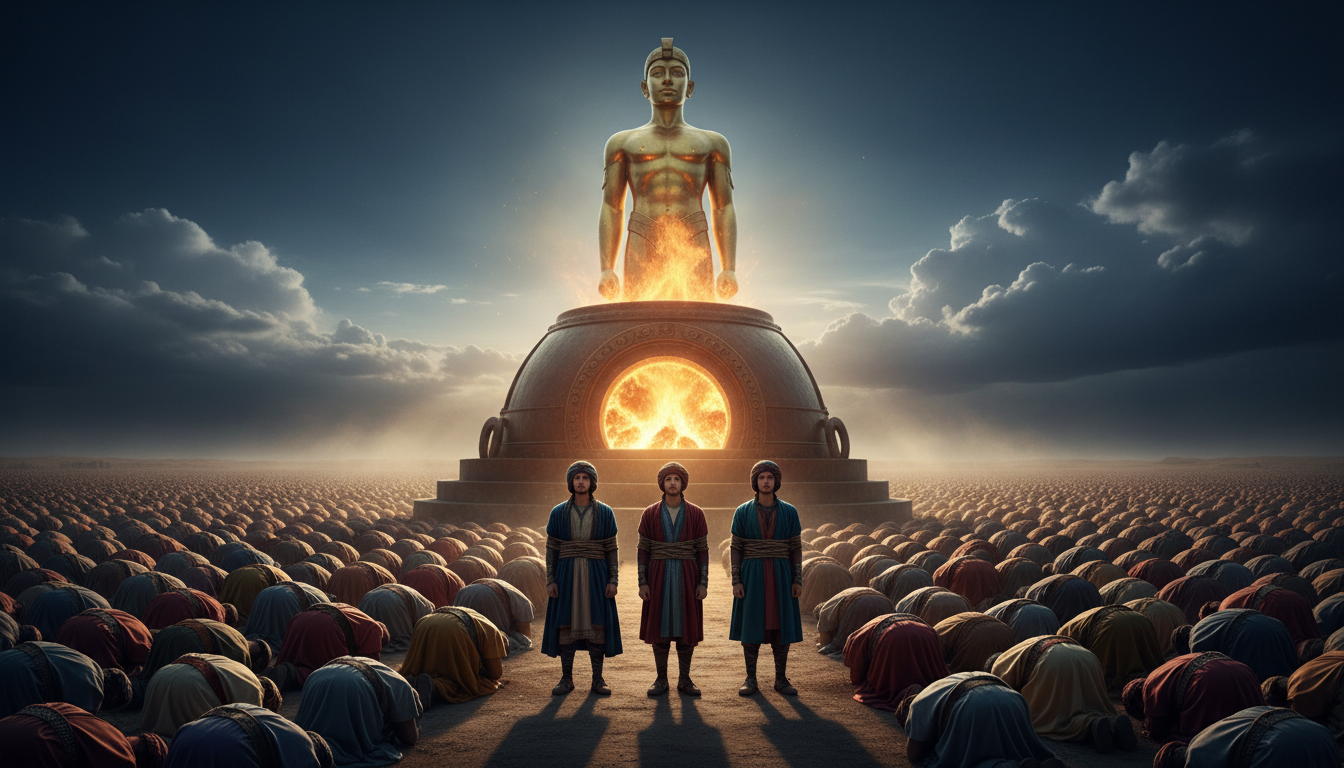
The furnace roared like a beast awakened.
Its mouth glowed white-hot at the center, orange and violent at the edges, fed by bellows that groaned under the strain. Heat rippled across the plain of Dura, bending the air so that the towering golden statue behind it shimmered like something unreal—man-made glory straining to look divine.
Thousands stood gathered: governors, judges, treasurers, military commanders, astrologers, nobles from every province of Babylon. Silk garments rustled. Bronze armor glinted. The sky itself seemed to hold its breath.
And in the center of it all stood three young men.
Bound.
Unbowed.
Shadrach. Meshach. Abednego.
The Sound That Demanded Worship
The decree had spread through the empire swiftly: when the horn sounded, followed by the flute, zither, lyre, harp, and every instrument of music, all peoples and nations were to fall down and worship the golden image King Nebuchadnezzar had set up. Whoever refused would be thrown into the blazing furnace.
It seemed simple enough. One gesture. One bend of the knee. A brief lowering of the head.
Survival.
After all, they were exiles. Taken from Jerusalem as youths when Babylon conquered Judah. They had seen their temple burned. Their city torn down. They had been marched across deserts and retrained in Babylonian language and wisdom. Even their names had been changed—names that once honored the God of Israel replaced with names honoring Babylonian gods.
They had adapted without surrendering their faith.
But this was different.
This was not about adapting.
This was about worship.
The Moment of Decision
The music began.
It rolled across the plain in waves—deep horns, sharp strings, rhythmic drums. A thunderous orchestration meant to overwhelm thought itself.
And as one body, thousands fell.
Dust rose in clouds as foreheads pressed into earth before the statue.
But three figures remained standing.
They did not protest.
They did not shout.
They did not make a spectacle.
They simply remained upright.
Against a sea of bent backs and lowered heads, they stood like pillars carved from conviction.
Some noticed immediately.
Others whispered.
And some—already envious of these Jewish officials whom the king had elevated—saw opportunity.
They hurried to Nebuchadnezzar.
“There are certain Jews,” they said carefully, “whom you have appointed over the affairs of Babylon. They pay no attention to you, O king. They neither serve your gods nor worship the image you have set up.”
The accusation was deliberate.
It struck at pride.
Face to Face With Power
Nebuchadnezzar’s fury ignited faster than the furnace.
He summoned them at once.
They were brought before him, still bound, though they stood tall. Around them, courtiers watched eagerly, sensing spectacle.
“Is it true?” the king demanded.
His voice echoed with authority built on conquest and bloodshed. He had defeated nations. Crushed rebellions. Reshaped the world through force of will.
He was not accustomed to defiance.
“I will give you one more chance,” he said, his tone shifting slightly—perhaps not mercy, but calculation. “When you hear the sound of the instruments again, fall down and worship the image. If you do, all will be well. But if you do not, you will be thrown immediately into the blazing furnace.”
He leaned forward.
“And what god will be able to rescue you from my hand?”
The question hung heavy.
It was not merely a challenge.
It was a claim.
A claim of supremacy.
The three men did not consult one another.
They did not tremble.
Their answer was steady.
“O king, we do not need to defend ourselves before you in this matter.”
Respectful. Calm.
“If we are thrown into the furnace, the God we serve is able to deliver us from it.”
A pause.
“But even if He does not, we want you to know—we will not serve your gods or worship the image you have set up.”
It was not defiance born of arrogance.
It was loyalty born of covenant.
They trusted God’s power.
But their obedience did not depend on outcome.
The Furnace Seven Times Hotter
Nebuchadnezzar’s face changed.
The king who once admired their wisdom now burned with humiliation. Public refusal threatened his image as much as their refusal threatened his decree.
He ordered the furnace heated seven times hotter than usual.
Bellows roared. Flames intensified. The very air became painful to breathe near its mouth.
The strongest soldiers in his army were commanded to bind the three men tightly—still clothed in their robes, trousers, turbans, and garments—and throw them into the fire.
The king wanted no delay.
No ceremony.
No doubt about the consequence.
The soldiers dragged them toward the furnace opening. Heat blasted outward violently. Sparks shot upward like a storm of embers.
The fire was so fierce that the soldiers who carried them were overcome by the flames and collapsed, consumed by the very heat they sought to wield.
And then—
Shadrach.
Meshach.
Abednego.
Were thrown in.
Inside the Fire
The crowd recoiled as flames surged upward.
Some turned away.
Others watched in grim fascination.
The furnace roared triumphantly, as if it had swallowed its offering.
But inside—
Something changed.
The ropes that bound their wrists burned away instantly.
Yet their clothing did not ignite.
Their skin did not blister.
They stood.
Breathing.
Alive.
And then they realized—
They were not alone.
A fourth figure stood among them.
Radiant, yet not consuming.
Calm within chaos.
The flames that devoured others seemed to bend around Him, restrained, as if recognizing authority greater than their own.
The fire that destroyed soldiers now behaved like a servant.
The three men walked freely within the furnace, no panic in their steps.
There was no screaming.
No desperate scrambling.
Only movement—steady and unharmed—within the blaze.
A King Who Could Not Believe His Eyes
Nebuchadnezzar had been watching.
At first in anger.
Then in expectation.
But now—
In confusion.
He rose abruptly from his throne.
“Did we not throw three men bound into the fire?” he asked his advisers.
“Yes, O king.”
He stared into the furnace again.
“Look! I see four men walking around in the fire, unbound and unharmed. And the fourth… looks like a son of the gods.”
The language came from his own understanding, but the awe was undeniable.
The fire obeyed someone greater than Babylon.
Nebuchadnezzar approached the furnace opening, no longer commanding—now calling.
“Shadrach, Meshach, Abednego, servants of the Most High God, come out! Come here!”
Servants of the Most High God.
He had once mocked their loyalty.
Now he named their allegiance.
And from the furnace mouth they stepped.
Alive.
Not Even the Smell of Smoke
Officials crowded around them.
Examining.
Touching.
Searching for evidence of damage.
But there was none.
No hair singed.
No garment scorched.
Not even the smell of smoke clung to them.
The furnace had burned ropes.
It had killed soldiers.
But it had not consumed what belonged to God.
A Public Declaration
Nebuchadnezzar spoke again—this time not in rage.
“Praise be to the God of Shadrach, Meshach, and Abednego, who sent His messenger and rescued His servants. They trusted in Him and defied the king’s command and were willing to give up their lives rather than serve or worship any god except their own.”
It was not full conversion.
But it was recognition.
He decreed that no one in Babylon was to speak against their God.
And the three men were promoted.
Not because they sought power.
But because they refused to surrender worship.
The Lesson in the Flames
The fire had not been removed.
The trial had not been avoided.
God had not prevented them from being thrown in.
He had met them there.
Their faith was not built on guaranteed rescue.
It was built on covenant loyalty.
“Even if He does not.”
That was the courage.
Not certainty of miracle—
But certainty of devotion.
The furnace proved something greater than survival.
It revealed that earthly power cannot overpower divine presence.
And sometimes the greatest testimony is not escape from the fire—
But walking faithfully within it.
Have you ever faced a moment where obedience could cost you everything?
Would your faith stand… even if deliverance did not come the way you expected?

