When Daniel told her it was “just practical,” Margaret didn’t realize the sentence would divide her life into two parts.
Before practical.
And after.
She was seventy-one years old when the word was used against her.
The house had been theirs for forty-two years.
Not perfect.
Not large.
But layered with fingerprints of a shared life.
The oak dining table Daniel sanded himself when they couldn’t afford a new one.
The faint burn mark on the kitchen counter from a pot she forgot while helping their daughter with algebra homework.
The small crack in the hallway ceiling where a leak had once threatened to undo them—and didn’t.
Margaret knew every inch of that house.
Not as property.
As memory.
As proof.
Daniel had suffered a mild stroke in the spring.
Not devastating.
Not catastrophic.
Just enough to scare the children.
Enough to spark meetings without her.
Enough to produce careful tones and lowered voices in the kitchen when she entered the room.
Their son, Peter, flew in first.
Their daughter, Elaine, came the following weekend.
They hugged their father longer than usual.
They looked at Margaret as if she were suddenly fragile too.
She hated that look.
“We need to think long term,” Peter said one afternoon, standing by the living room window.
Margaret was in the kitchen, but she could hear every word.
“You can’t manage this house alone if something else happens.”
Alone.
The word lodged somewhere behind her ribs.
She had managed alone before.
When Daniel lost his job in the eighties.
When their daughter had surgery at nine.
When Peter wrecked the car at seventeen and Daniel refused to speak to him for a week.
She had always managed.
But she did not interrupt.
She rarely did.
They sat her down at the dining table.
The oak one.
The one that had survived their arguments and anniversaries and silent dinners.
“Mom,” Elaine began gently, “it’s not about independence. It’s about safety.”
Safety.
Peter added, “We found a place nearby. It’s beautiful. Maintenance-free. You’d have community.”
Community.
Daniel said nothing.
He stared at his hands.
Margaret watched him carefully.
She had spent five decades reading the smallest movements of that man’s face.
He was tired.
He was afraid.
He was ashamed of being afraid.
“It’s too much house,” Peter continued. “Too many stairs.”
Margaret looked toward the staircase.
She had climbed those stairs while pregnant.
While carrying laundry.
While crying.
While laughing.
She had climbed them the night Daniel’s mother died.
She had climbed them the morning after their last big fight, when neither of them spoke but both understood.
Too many stairs.
She almost smiled.
“Just think about it,” Elaine said.
Margaret nodded.
She always nodded first.
Then she processed later.
That was her way.
That night, she walked through each room slowly.
The living room.
The hallway.
The kitchen.
She ran her fingers along the walls as if they were skin.
The bedroom she shared with Daniel.
The indentation on his side of the mattress was deeper now.
She lay down and stared at the ceiling.
Before practical.
After practical.
The line had already been drawn.
The house went on the market within three weeks.
It happened faster than she expected.
Daniel told her it was “for the best.”
He did not look at her when he said it.
Margaret smiled.
She had learned that smile over decades.
It was the smile that prevented escalation.
The smile that kept things calm.
Inside, something was unraveling quietly.
The first viewing was on a Thursday.
A young couple arrived with a real estate agent.
They walked through her kitchen.
Opened her cabinets.
Touched her countertops.
“This could be knocked down,” the woman said, gesturing to the wall between the kitchen and dining room.
Knocked down.
Margaret imagined the oak table exposed under brighter, harsher light.
Imagined strangers eating where her children once spilled milk.
She excused herself and went upstairs.
Closed the bedroom door.
Sat on the edge of the bed.
And for the first time since the stroke, she allowed herself to cry.
Not loudly.
Not dramatically.
Just enough to acknowledge that something was being dismantled.
The offer came quickly.
Above asking.
Peter sounded relieved.
Elaine called it “a blessing.”
Daniel signed the paperwork with a shaky hand.
Margaret signed last.
Her signature looked smaller than usual.
As if it too was retreating.
They moved into a two-bedroom apartment in a clean, well-lit complex with identical doors and identical balconies.
The elevator worked perfectly.
The hallways smelled faintly of disinfectant and air freshener.
“It’s easier,” Daniel said.
Margaret nodded.
Yes.
It was easier.
It was also thinner.
The apartment had a spare room.
Peter suggested it could be “a guest room.”
Elaine suggested it could be “an office.”
Margaret stood in the doorway and saw something else.
It was the last room in the house.
Not literally.
Symbolically.
The last place where she could decide something without consulting anyone.
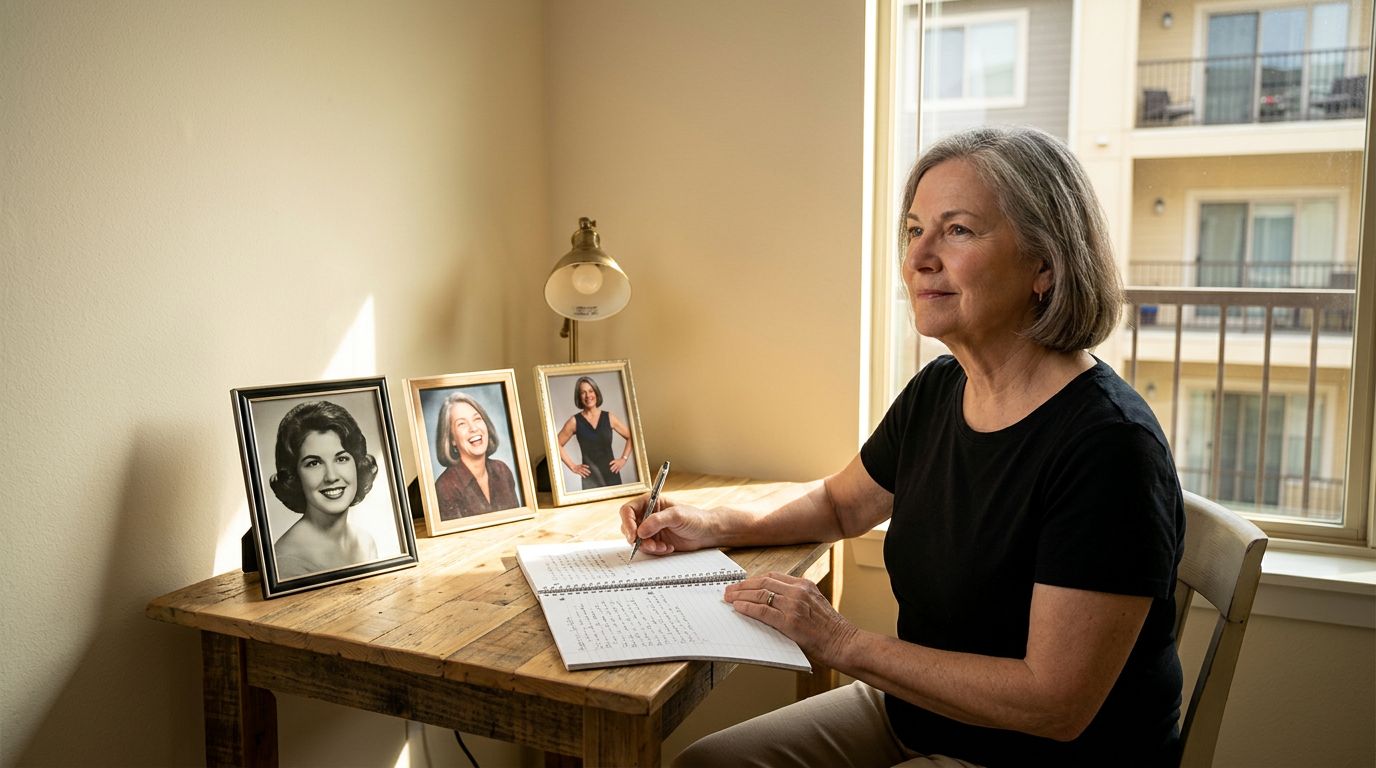
She moved a small desk inside.
Placed a lamp near the window.
Hung three framed photographs.
Not of the children.
Not of Daniel.
Of herself.
At twenty.
At forty.
At sixty.
Three versions of a woman who had once occupied space fully.
Daniel noticed.
“What are you doing with this room?” he asked.
Margaret replied calmly, “I’m keeping it.”
“For what?”
“For me.”
He blinked.
He wasn’t used to that answer.
In the weeks that followed, Margaret began closing that door for a few hours each afternoon.
She sat at the desk.
She wrote.
At first, just lists.
Groceries.
Appointments.
Things to remember.
Then memories.
The night Daniel proposed.
The day Peter was born.
The afternoon she almost left during a terrible fight in 1993 but stayed because she believed in repair.
She wrote about the house.
About the staircase.
About the oak table.
She wrote about practical.
And how practical had always been code for quiet sacrifice.
Daniel grew restless.
“You’re in there a lot,” he said one evening.
“Yes.”
“What do you do?”
“I remember.”
He frowned.
“Remembering doesn’t change anything.”
Margaret looked at him carefully.
“It changes me.”
He didn’t respond.
He didn’t know how.
One afternoon, Elaine stopped by unexpectedly.
She walked past the closed door and hesitated.
“Mom?”
“Yes?”
“Can I come in?”
Margaret opened the door slowly.
Elaine looked around.
The photographs.
The notebook.
The lamp.
“It’s nice,” she said.
Margaret smiled faintly.
“It’s mine.”
Elaine swallowed.
“I didn’t realize you felt pushed.”
Margaret didn’t accuse.
She didn’t dramatize.
She simply said, “You decided for me before asking what I wanted.”
Elaine looked down.
“We were scared.”
“So was I,” Margaret replied softly.
Silence filled the room.
Not hostile.
Heavy.
Truthful.
That evening, Daniel entered the room without knocking.
Margaret closed her notebook.
He stood awkwardly by the desk.
“I didn’t ask you either,” he admitted.
She waited.
“I thought I was protecting you.”
She held his gaze.
“You were protecting yourself from feeling weak.”
The words landed gently but precisely.
Daniel’s shoulders dropped.
He had never been good at vulnerability.
Margaret had carried that weight for him.
Until now.
Weeks turned into months.
Margaret’s writing deepened.
She joined a small local memoir group.
She read excerpts aloud.
Her voice trembled the first time.
By the third session, it steadied.
People listened.
Not as mother.
Not as wife.
As writer.
As woman.
One night, Daniel stood at the doorway again.
“You’re different,” he said.
Margaret nodded.
“I stopped disappearing.”
He looked confused.
“I never asked you to disappear.”
“No,” she said gently. “You just grew comfortable when I did.”
He sat on the edge of the chair.
“I don’t want you to leave me,” he admitted.
Margaret felt the old instinct to reassure him immediately.
To smooth the fear.
Instead, she paused.
“I’m not leaving,” she said. “But I won’t shrink.”
Daniel closed his eyes.
For the first time in years, he reached for her hand not out of habit—but out of need.
Months later, Margaret published a small collection of essays.
Nothing grand.
Nothing commercial.
Just printed copies shared with friends and family.
At the small gathering in the community room, Peter approached her with red eyes.
“I didn’t know you felt erased,” he whispered.
Margaret placed her hand on his cheek.
“You didn’t look.”
He nodded.
Ashamed.
She did not scold.
She did not punish.
She had learned something in the last room.
Visibility cannot be begged for.
It must be claimed.
One evening, sitting on the balcony of their apartment, Daniel said quietly, “Do you miss the house?”
Margaret considered the question carefully.
“Yes,” she said.
He waited.
“But I don’t miss being silent in it.”
He nodded slowly.
The sun dipped behind identical rooftops.
The air cooled.
Daniel squeezed her hand.
Not out of ownership.
Not out of obligation.
But out of recognition.
The house was gone.
The staircase belonged to someone else.
The oak table sat under different light.
But the last room remained.
In the apartment.
In her mind.
In the boundary she had drawn.
Before practical.
After practical.
And in the after, Margaret was no longer just a caretaker of everyone else’s comfort.
She was the keeper of her own space.
The woman who closed a door.
Sat down.
And chose, finally, not to disappear.

