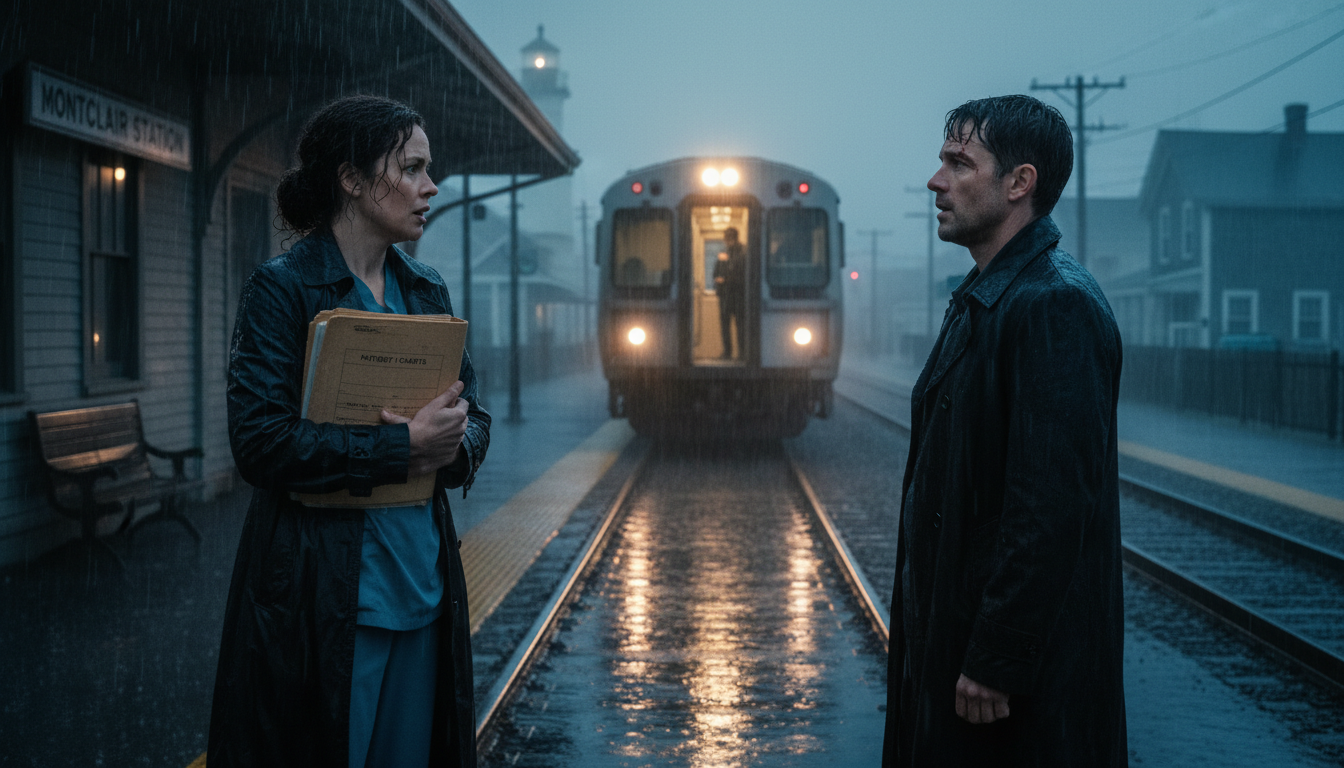
The first time Lila Bennett saw him again, he was standing on the wrong side of the tracks.
It was raining, the kind of steady, unrelenting rain that blurred headlights and turned the station platform into a mirror. She stood beneath the narrow awning of Montclair Station, clutching a folder of patient charts against her chest, when the 7:42 from the city screeched in.
The doors opened.
And there he was.
Ethan Cole.
Older. Thinner. His hair cut shorter than she remembered. A faint scar slicing through his left eyebrow.
For a moment, she thought her mind had conjured him—some cruel trick of memory in the rain.
Then he looked up.
And he saw her.
The years between them collapsed like wet paper.
I. The Girl Who Stayed Behind
Montclair was the kind of coastal town where everything smelled faintly of salt and diesel. Fishing boats lined the docks like tired animals. The lighthouse blinked steadily through fog as if reassuring the sea it hadn’t forgotten its job.
Lila Bennett had grown up here, had memorized the rhythm of tides and train schedules and gossip cycles. She had once planned to leave. Medical school in Boston. A research fellowship in Chicago. A life that wasn’t bordered by the same three streets.
But plans had a way of breaking apart.
Her younger brother, Noah, had been sixteen when the accident happened. A drunk driver on Route 8. A call at midnight. A hospital room that smelled too clean.
He survived.
But not fully.
The brain injury changed him. Changed everything. Their father folded inward under medical bills and shame. Their mother began to age in dog years.
Lila stayed.
She deferred her fellowship. Took a nursing position at Montclair Community Hospital. Learned to read Noah’s moods the way she once read textbooks.
And somewhere along the way, she told herself that staying was love.
She stopped asking whether it was also fear.
II. The Boy Who Ran Toward Fire
Ethan Cole had always burned too bright for Montclair.
He sketched in the margins of math homework. He talked about New York like it was a planet he’d already claimed. At seventeen, he told Lila he would become an architect and build things that would outlive him.
“You can’t outlive everything,” she’d teased, sitting beside him on the hood of his rusted pickup.
“Watch me,” he’d replied.
They had loved each other the way young people do—with reckless certainty and no understanding of consequence.
On the night before he left for Columbia University, they lay on the cold sand beneath the lighthouse.
“Come with me,” he whispered against her hair.
“I can’t,” she said.
“You won’t.”
There had been a difference. Even then.
When Noah’s accident happened months later, Ethan was already gone. He called. He offered to come back.
She told him not to.
They broke quietly. No screaming. No betrayal.
Just distance stretched too thin.
III. Rain on Platform Three
Now he stood across the tracks, rain soaking through his coat.
For a second, neither moved.
Then the station loudspeaker crackled to life, announcing the departing train.
Lila stepped forward without thinking.
“Ethan?”
Her voice was almost swallowed by the rain.
He crossed the footbridge in three long strides.
“Lila.”
Her name sounded different in his mouth—less certain, more fragile.
“What are you doing here?” she asked.
He glanced toward the town behind her. “I could ask you the same thing.”
“I never left.”
“I know.”
Silence.
The rain drummed harder.
“I’m here for a project,” he said. “Coastal redevelopment. Flood-resistant housing.”
“You design cities now?”
“I try.”
She nodded, unsure what to do with her hands, her heartbeat, the sudden awareness of him so close.
“You look…” he began, then stopped.
“Older?” she supplied dryly.
“Stronger,” he corrected.
The word lodged somewhere deep.
“And you?” she asked. “Did you outlive everything?”
His smile didn’t reach his eyes.
“Not quite.”
IV. The Tension of Familiarity
They began seeing each other by accident.
At the café near the harbor. At the hospital when Ethan came to review structural plans. On the sidewalk outside the pharmacy where Noah worked part-time stacking shelves, determined to reclaim fragments of independence.
Noah recognized him instantly.
“Ethan,” he said slowly, as if testing a memory.
Ethan crouched slightly, meeting his gaze. “Hey, man.”
There was no pity in his voice. Only warmth.
Later that night, Lila confronted him outside the pharmacy.
“You don’t get to come back and be gentle,” she said.
His brow furrowed. “What does that mean?”
“It means you don’t get to act like you didn’t leave.”
“I left because you told me to.”
“I told you not to give up your life.”
“And you?” he shot back. “You gave up yours.”
The words struck like a slap.
“You don’t know that,” she said tightly.
“I know you were supposed to be in Boston.”
“You don’t know what I was supposed to be.”
He stepped closer, lowering his voice.
“I know you wanted more.”
“And you think this isn’t more?” she demanded. “You think taking care of my family isn’t enough?”
“That’s not what I said.”
“It’s what you meant.”
They stood inches apart, breath mingling in cold air.
“I never stopped loving you,” he said quietly.
Her chest constricted.
“That doesn’t fix anything,” she whispered.
“No,” he agreed. “But it explains everything.”
V. The Symbol
The lighthouse had always been theirs.
When they were teenagers, Ethan had carved their initials into the underside of the wooden railing that circled the lantern room.
E + L.
Hidden. Private. Almost erased by time.
One evening, after weeks of near-collisions and unfinished conversations, Ethan texted her.
Meet me at the lighthouse.
She shouldn’t have gone.
She went anyway.
The wind whipped her hair as she climbed the narrow spiral stairs. At the top, he stood beside the railing, holding something small in his hand.
“I found this,” he said.
It was a brass compass.
Old. Worn. The glass cracked.
“My dad’s,” he explained. “He carried it when he fished offshore.”
He placed it in her palm.
“I kept thinking direction was the same as escape,” he said. “It’s not.”
She swallowed. “Why give this to me?”
“Because you’re the only direction that ever made sense.”
The line should have felt cliché.
It didn’t.
It felt like confession.
VI. The Choice Between Love and Legacy
Two months into Ethan’s project, the city council made an announcement.
The redevelopment would require relocating several small businesses—including the pharmacy where Noah worked.
The funding was contingent on clearing the waterfront block.
Lila confronted Ethan in his temporary office overlooking the docks.
“You knew,” she said.
His face tightened. “I knew it was possible.”
“You’re displacing families.”
“We’re protecting the town from flooding.”
“At what cost?”
He ran a hand through his hair.
“This project could change how coastal towns survive climate shifts. It matters.”
“So does my brother.”
“It’s not about one building.”
“It’s not just a building!” she snapped. “It’s his independence. His routine. His dignity.”
Silence vibrated between them.
“If I walk away,” Ethan said carefully, “someone else takes over. Someone who won’t care about Montclair at all.”
“And if you stay?”
He met her eyes.
“I lose you.”
The truth hung there.
He had to choose between the career-defining project he’d fought for—or the woman who anchored him to something human.
She had to choose between protecting her brother’s fragile world—or trusting Ethan’s vision of a larger one.
VII. The Devastation
The council voted in favor of the redevelopment.
Noah’s pharmacy would close within six months.
Lila didn’t speak to Ethan for weeks.
When he showed up at her door one night, she didn’t invite him in.
“I resigned,” he said.
Her breath caught.
“You what?”
“I turned down the final contract.”
“Why?”
“Because I realized I was designing buildings and losing people.”
Anger flashed in her eyes.
“You don’t get to martyr yourself for me.”
“I’m not.”
“You think this makes you noble?” she demanded. “Now the project will move forward without you—and you’ve thrown away everything.”
He flinched.
“Maybe I don’t want to outlive everything,” he said hoarsely. “Maybe I just want to live.”
Tears burned her eyes.
“I didn’t ask you to choose me.”
“I know.”
“Then why did you?”
His voice broke.
“Because I still love you. And I’m tired of loving you from somewhere else.”
Her defenses cracked.
But fear rushed in.
“You’ll resent me,” she whispered.
“Maybe,” he admitted. “But I’ll resent losing you more.”
VIII. The Twist
Three weeks later, a developer from New York arrived.
He had reviewed Ethan’s preliminary designs.
He wanted Ethan back.
But not for the waterfront demolition.
For a revised plan—one that preserved local businesses by elevating structures instead of replacing them.
It would cost more.
It would take longer.
But it could work.
The catch?
Ethan had to lead it.
Lila found him at the docks, staring out at the tide.
“You knew this was possible,” she said.
“I hoped.”
“And you resigned anyway.”
“I needed them to see I wasn’t just chasing prestige.”
She studied him carefully.
“You were willing to lose everything.”
“Yes.”
“Even architecture?”
He smiled faintly.
“Architecture was never the point.”
She stepped closer.
“What was?”
“You.”
IX. The Accident
The night before the final proposal presentation, a storm tore through Montclair.
Waves slammed against the seawall. Wind shattered windows along Harbor Street.
Lila received a call just after midnight.
Ethan had been hit by falling debris near the docks.
When she arrived at the hospital, her hands shook so violently she had to steady them against the wall.
He lay on the gurney, blood matting his hair.
“Hey,” he murmured weakly when he saw her. “Guess I should’ve stayed inside.”
She pressed her forehead to his.
“You don’t get to leave,” she whispered fiercely.
Not again.
Surgery lasted hours.
She waited through every one.
When the surgeon finally emerged and said, “He’s going to be okay,” her knees nearly gave out.
X. Where We Stand
Months later, the revised redevelopment broke ground.
The pharmacy remained.
Noah kept his job.
The lighthouse still blinked faithfully against the horizon.
On a warm summer evening, Lila and Ethan stood beneath it again.
The brass compass rested in her hand.
“I was wrong,” she said quietly.
“About what?”
“Staying isn’t the same as being trapped.”
He nodded. “And leaving isn’t the same as abandoning.”
She slipped the compass back into his pocket.
“I don’t want you smaller,” she said. “I want you brave.”
He cupped her face gently.
“And I don’t want you afraid,” he replied. “I want you choosing.”
She chose him.
Not because she was afraid to lose him.
But because she finally understood that love wasn’t a shoreline you clung to.
It was the tide.
And this time, instead of pulling them apart, it carried them forward.

