On the morning she agreed to sell the house, Elena Markovic found a child’s marble in the garden.
It was lodged in the dirt beneath the lilac bush, half-buried and clouded with soil. Blue glass with a thin white spiral inside—like a tiny storm trapped at its center.
She hadn’t seen that marble in twenty-three years.
Her son used to carry them in his pockets. Used to kneel in this same patch of earth and whisper rules to himself before shooting them across the walkway.
She crouched, fingers pressing into cold soil, and held the marble in her palm.
Inside the house, the realtor was walking a prospective buyer through the kitchen.
“Elena?” the woman called gently. “They’re ready for you.”
Elena stood, brushing dirt from her knees.
She had promised herself she would not cry today.
She did not expect him to be standing in her driveway.
I. The Widow on Hawthorn Street
At fifty-six, Elena Markovic had learned the art of folding grief into smaller shapes.
Her husband, Viktor, had died of pancreatic cancer eight years ago. The illness had been swift and merciless, stripping him down to bones and apologies.
Her son, Luka, had died much earlier.
Car accident. Snowstorm. Twenty-three years old.
The house on Hawthorn Street had held both their laughter and their last breaths.
For years, she told herself she could not leave it.
But the roof leaked. The stairs creaked. The silence had grown too loud.
So she listed it.
She did not expect the buyer to be Daniel Kovacs.
II. The Man Who Left First
Daniel had lived across the street from Elena for most of his childhood.
He was two years older than Luka. The boys were inseparable once—mud-streaked knees, broken windows, shared secrets whispered in garages.
Daniel’s father drank. His mother worked double shifts. The Markovic house had been a refuge.
Elena fed him when there wasn’t enough at home. Patched his scraped elbows. Scolded him gently when he swore.
She had loved him, in the quiet way adults love children who are not theirs but might as well be.
When Daniel turned eighteen, he left town with a scholarship and a promise to return.
He did not.
He missed Luka’s funeral.
Elena never forgave him for that.
III. The Driveway
Now he stood beside a black sedan that didn’t belong on Hawthorn Street.
He looked different—broader in the shoulders, lines at the corners of his eyes. But there was something in his stance she recognized: hesitation disguised as confidence.
“Elena,” he said softly.
She did not smile.
“Daniel.”
The realtor looked between them, confused.
“You two know each other?”
“Yes,” Daniel said.
“No,” Elena replied at the same time.
Silence tightened the air.
“You’re buying this house?” she asked.
“If you’ll sell it to me.”
Her grip tightened around the marble in her pocket.
“Why?” she demanded.
He glanced at the house.
“Because some places matter.”
The answer felt insufficient.
IV. The Absence That Stayed
That night, Elena walked through the house alone.
The buyers had left. Daniel had not pushed for conversation beyond what was necessary.
She paused at the hallway where Luka used to measure his height against pencil marks on the wall.
The marks were still there.
So was the dent in the banister from when Viktor dropped a toolbox.
Grief had not faded.
It had simply settled into corners.
A knock sounded at the door.
She almost didn’t answer.
Daniel stood on the porch, hands in his coat pockets.
“I shouldn’t have come,” he said.
“Then don’t,” she replied.
He nodded.
“I didn’t know how to explain why I’m buying it.”
“I don’t need explanations.”
“I think you do.”
She held the door open but did not invite him in.
“You weren’t here,” she said quietly.
His jaw tightened.
“I know.”
“He asked for you.”
Daniel flinched.
“I know.”
V. The Truth He Carried
They sat in the living room where Luka used to sprawl on the carpet with blueprints and dreams.
“I was in Berlin,” Daniel said, staring at his hands. “Final interviews. Everything I’d worked for.”
“And?”
“And I got the call. About the accident.”
Elena waited.
“I booked a flight,” he continued. “But I missed the connection in Frankfurt. Snowstorm.”
She stared at him.
“I told myself I’d come after the funeral. That I’d see you then.”
“You didn’t.”
“No.”
“Why?”
He looked up at her, eyes raw.
“Because I didn’t know how to stand in this house without him.”
The confession landed heavy.
“I thought if I didn’t come back,” he said, “it wouldn’t be real.”
Elena felt anger rise, sharp and familiar.
“So you left me alone with it instead.”
His voice broke.
“Yes.”
VI. The Symbol
Elena pulled the marble from her pocket and placed it on the coffee table between them.
“Do you remember these?” she asked.
He nodded slowly.
“He used to cheat,” Daniel said faintly. “Palmed the good ones.”
A small, involuntary smile touched her mouth.
“He thought I didn’t see.”
They stared at the marble.
“I found it in the garden today,” she said. “Buried.”
Daniel reached out but didn’t touch it.
“He used to say they were maps,” he murmured. “That the swirl showed you how to win.”
Elena’s throat tightened.
“He wanted to design cities,” she whispered. “Do you remember?”
“I remember,” Daniel said.
“I still see him on that floor sometimes.”
Silence filled the room.
“Why this house?” she asked again, softer now.
Daniel exhaled slowly.
“Because it’s the only place I ever felt safe.”
The admission startled her.
“My father hit walls,” he continued. “Threw bottles. But here… you made noise mean something else.”
Elena’s anger faltered.
“I couldn’t save him,” he said. “I couldn’t save Luka.”
“You were a boy,” she replied.
“I left.”
“You survived,” she corrected.
VII. The Choice
The sale contract sat unsigned on the kitchen counter.
Daniel’s offer was fair. More than fair.
But selling the house to him felt like surrendering something she wasn’t ready to release.
“I don’t want it to become unrecognizable,” she said.
“It won’t,” he replied immediately.
“You can’t promise that.”
“No,” he admitted. “But I can promise I won’t erase him.”
Her breath caught.
“You don’t get to keep him alive for me.”
“I’m not trying to.”
“Then what are you trying to do?”
He met her gaze steadily.
“I’m trying to stop running.”
VIII. Devastation
Two days later, Elena found herself standing in Luka’s old bedroom.
The wallpaper still faintly marked with tape outlines where posters once hung.
She sat on the edge of the bed and let herself cry for the first time in months.
Not because she was selling the house.
But because she realized she had been guarding it like a tomb.
Viktor had once told her, during his final weeks, “Don’t make our grief your address.”
She had.
The house had become a monument to loss rather than a container for memory.
That realization shattered something inside her.
IX. The Unexpected Turn
When Daniel returned with revised paperwork, Elena surprised him.
“I’ll sell,” she said.
His shoulders sagged in relief.
“But,” she added, “with conditions.”
He straightened.
“The height marks stay.”
He nodded.
“The banister dent stays.”
“Yes.”
“And the lilac bush stays.”
He smiled faintly.
“It’s yours as much as mine,” he said.
She shook her head gently.
“No,” she replied. “It’s just soil. We’re the ones who carry it.”
X. The Final Scene
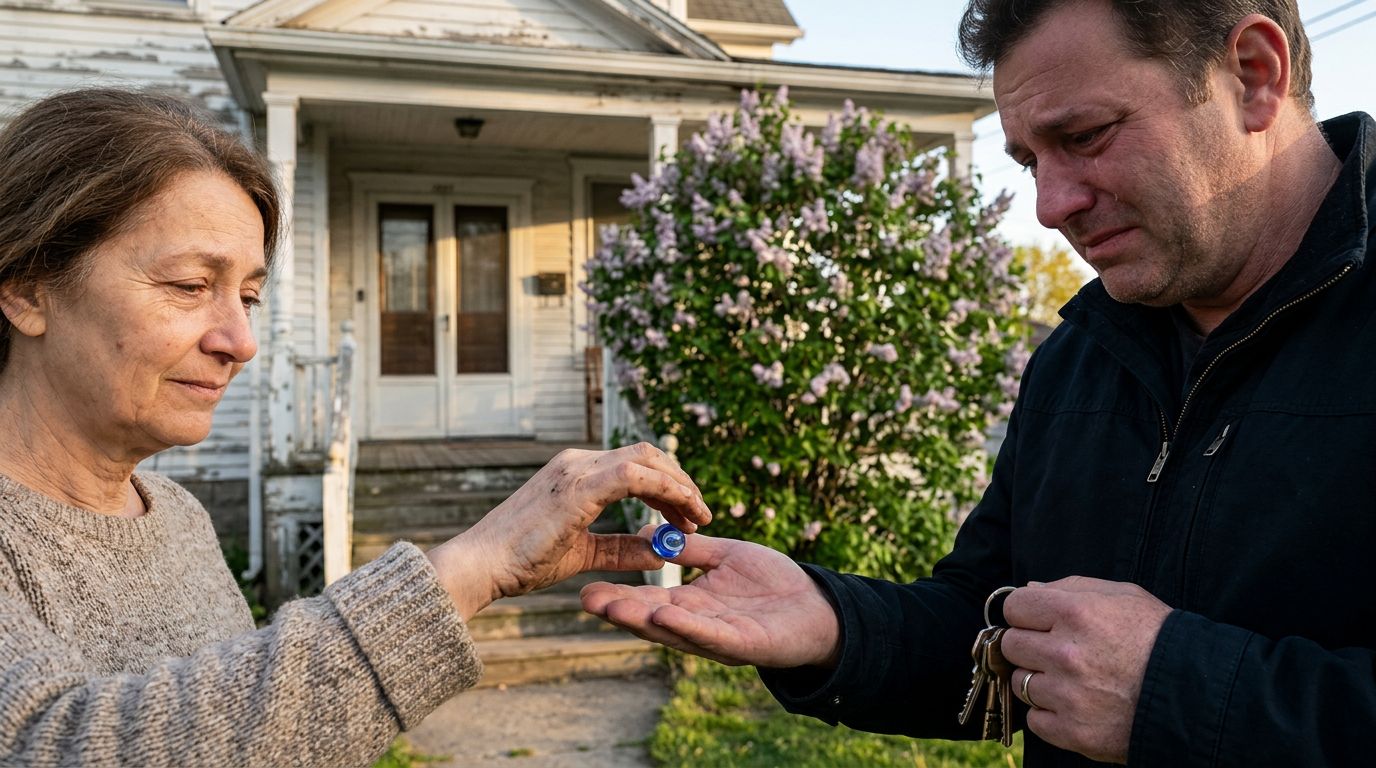
On the day she handed over the keys, the sky was bright and mercilessly clear.
Daniel stood on the porch, holding the small ring of metal like something fragile.
Elena stepped down from the front door slowly.
“You know,” she said, “he would have forgiven you.”
Daniel’s throat tightened.
“I know.”
She placed the marble in his hand.
“For the garden,” she said.
He looked at her, startled.
“Why?”
“So he can be part of what grows next.”
Tears gathered in his eyes.
“You’re coming by for dinner,” he said softly. “Whenever you want.”
She nodded.
As she walked down Hawthorn Street for the last time, she expected to feel hollow.
Instead, she felt lighter.
The house was never the thing she was holding onto.
It was the love inside it.
And love, she finally understood, does not live in walls.
It lives in the hands willing to open the door.

