The Night the Words Shattered Everything
David Miller already knew.
That was the worst part.
It wasn’t the sentence that would detonate in the center of his kitchen. It wasn’t the tears or the confession or even the name that would follow. It was the slow, creeping awareness that had been building inside his chest for days — that instinct parents develop when something invisible shifts in their child and no one has said it out loud yet.
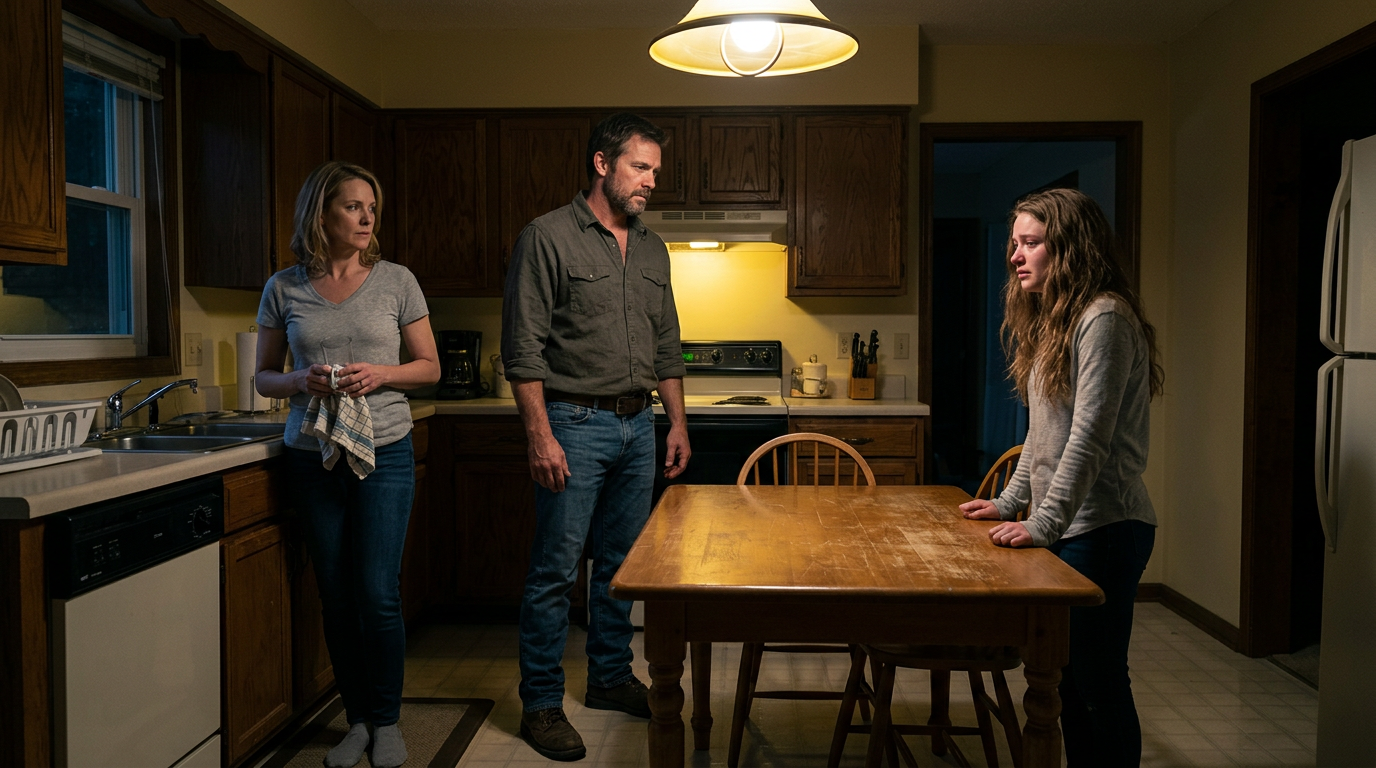
The kitchen light hummed faintly above them, casting a yellow glow over the scratched wooden table. Beyond that circle of light, the house felt dim and distant. The television in the living room murmured laughter from some late-night sitcom, the artificial sound painfully out of place against the tension thickening in this room.
Emma stood near the table.
Sixteen years old.
Her fingers curled tightly around the edge of the wood, knuckles pale. Her shoulders were rigid, as if she were bracing for impact. Her hair, usually brushed neatly, hung loose around her face. Her eyes were red — not from dramatic crying, but from hours of holding something in.
Sarah Miller stood near the sink, a dish towel limp in her hand. She had been drying the same glass for nearly a minute without realizing she wasn’t moving anymore. Her chest rose and fell in shallow breaths.
David stepped forward.
He didn’t rush. He didn’t shout.
His boots scraped softly against the tile floor.
“Say it.”
His voice was low. Controlled. Too controlled.
Emma swallowed. Her throat burned.
For a split second, she considered lying.
She could say she failed a test.
She could say she’d gotten into a fight.
She could invent something small enough to survive.
But the truth was already pressing against her ribs, heavy and unmovable.
“I’m pregnant.”
Three words.
The world tilted.
The air changed.
Sarah’s hand flew to her mouth. The glass slipped slightly in her fingers but didn’t fall.
David blinked once.
He hadn’t realized he was holding Emma’s wrist until he felt his fingers release it. He stepped back half an inch as if something had physically struck him.
“You’re sixteen…”
The sentence fractured in his throat.
Sixteen meant driver’s permits.
Sixteen meant college brochures on the dining table.
Sixteen meant curfew negotiations and borrowed sweaters and group photos at football games.
Not this.
Emma’s lips trembled.
“He said he loves me.”
The words sounded fragile in the heavy room.
And something deep inside David ignited — not violence, not hatred — terror.
His fist slammed down onto the table.
The plates rattled violently. A fork skidded across the surface and clattered onto the tile. The sound echoed too loudly in the small kitchen.
“Who?”
The question came out sharp.
Emma’s tears finally broke free.
“Ethan.”
The name landed like a second explosion.
The Weight of a Boy’s Name
Ethan Calloway.
David knew him.
Seventeen. Football team. Clean-cut. Respectful handshake at school events. The kind of boy adults described as “a good kid.”
But good kids don’t change your daughter’s life in irreversible ways.
Sarah found her voice first.
“How far along?”
“About eight weeks.”
Eight weeks.
Two months.
Two months of Emma carrying this alone.
David’s mind moved backward automatically — October. While he had been repairing the fence. While he had been reminding Emma about scholarship deadlines. While he had been assuming that childhood still protected her.
“Does he know?” David asked.
Emma nodded.
“Does he… is he going to stand by you?”
Silence.
Emma’s eyes dropped.
That silence spoke louder than anything she could have said.
Before the Confession
Emma hadn’t meant for this to happen.
She met Ethan in American History. He sat two rows behind her, quiet but attentive. He wasn’t loud. He wasn’t reckless. He wasn’t the type her parents warned her about.
He asked her questions about art school. About what she wanted beyond their small suburban town. He noticed when she cut her hair. He remembered her favorite coffee order.
At sixteen, attention feels like oxygen.
He made her feel seen — not as someone’s daughter, not as the responsible honor-roll student — but as Emma.
Their relationship didn’t explode into existence. It unfolded.
Study sessions.
Long walks home.
Text messages past midnight about dreams and fears.
There were no wild parties.
No drinking.
No chaos.
Just a basement. A movie playing quietly in the background. His parents upstairs. Suburban safety wrapping around them like insulation.
“I love you,” he whispered.
And she believed him.
Because he sounded certain.
Because she wanted to believe him.
Because at sixteen, forever feels logical.
Afterward, she lay awake staring at the ceiling. Not regretful. Just changed.
Two weeks later, her period didn’t come.
She ignored it.
The second week, she panicked.
The Bathroom Stall
She bought the test twenty minutes away at a pharmacy where no one knew her name. She paid in cash and avoided eye contact with the cashier.
At school, she locked herself in the farthest bathroom stall between classes.
Her hands shook.
The fluorescent lights buzzed overhead.
She set the plastic stick on the toilet paper dispenser and stared at it like it might change its mind.
Two pink lines.
Clear.
Unforgiving.
She slid down against the cold tile wall and pressed her hand against her mouth to stop the sound rising in her throat.
The bell rang.
Students laughed in the hallway.
And Emma Miller’s childhood ended quietly between second and third period.
Telling Him
When she told Ethan, he went pale.
“Are you sure?”
She nodded.
He ran his hands through his hair.
“We’ll figure it out.”
But something in his voice had shifted.
The certainty was gone.
Over the next few days, his messages grew shorter. His responses slower. Practices ran longer. Homework took more time.
Emma felt it — the subtle retreat of someone who didn’t know how to hold this weight.
She didn’t tell her parents.
Not at first.
She carried it alone.
Eight weeks alone.
Back in the Kitchen
David paced now, running a hand through his hair.
“You used protection?” he asked bluntly.
Emma nodded, tears still falling.
“It broke.”
The room fell silent again.
Sarah finally stepped forward.
“We don’t have to decide anything tonight,” she said gently. “We breathe first.”
But breathing felt impossible.
David looked at his daughter — really looked at her — and saw both the child she had been and the adult she was being forced to become.
Fear disguised itself as anger in his chest.
“I trusted you,” he said, quieter now.
Emma flinched.
“I know.”
The words barely escaped her.
And that admission — that small, fragile acknowledgment — hurt more than any argument.
The Father’s History
David had grown up without a father.
His mother worked double shifts. He learned early that the world did not cushion mistakes. It amplified them.
When Emma was born, he stood over her hospital crib and made a silent vow: she will never feel alone.
He worked overtime.
He skipped vacations.
He saved relentlessly.
He believed providing meant protecting.
Now he wondered if protection required something else — listening more closely, asking harder questions, noticing sooner.
“You should have told us,” Sarah whispered.
“I was scared,” Emma said.
And that word cut through everything.
Scared.
Not rebellious.
Not reckless.
Scared.
The Cracks Widen
The conversation stretched long into the night.
About school.
About options.
About Ethan’s parents.
About consequences.
At one point Emma whispered, “I didn’t think it would happen.”
David almost laughed — not because it was funny, but because that sentence summarized youth perfectly.
None of us think it will happen.
Until it does.
The clock ticked loudly on the wall.
The dishwasher stopped humming.
The house felt like it was holding its breath.
Finally, David sat down across from her.
“How do you feel?” he asked.
Emma blinked.
No one had asked her that yet.
“I don’t know,” she admitted. “I’m scared. I’m embarrassed. I’m… I don’t know.”
Sarah reached for her hand.
And for the first time that night, the room softened by half a degree.
The Realization
The slam of David’s fist earlier had not been about rage.
It had been about the collapse of control.
Parents imagine they can manage risk.
Guide choices.
Steer outcomes.
But children are separate people.
And sometimes love doesn’t prevent consequences — it just determines how you face them.
Emma sat in that kitchen feeling both exposed and strangely relieved.
The secret was out.
The worst words had been spoken.
“I didn’t mean to ruin everything,” she whispered.
David’s head snapped up.
“You didn’t ruin everything.”
He said it firmly.
Because despite the fear, despite the shock, despite the uncertainty — she was still his daughter.
And this kitchen, this family, would either fracture under the weight or learn how to carry it together.
The overhead light continued to hum.
The clock continued to tick.
And in that small suburban kitchen, under one tired yellow bulb, three people sat in the wreckage of a sentence that would change every year that followed.
The night was far from over.
But the truth had finally been spoken.
And there was no going back.
After the Slam — What Happens When the Secret Becomes a Life
The night after the confession, the house did not return to normal.
It couldn’t.
Normal was a fragile illusion that only exists until something breaks it.
Emma lay in bed staring at the ceiling, listening to the familiar sounds of her home — the refrigerator motor clicking on, the faint rattle of the heater, the distant, muted voices of her parents in their bedroom. Those sounds used to mean safety. Tonight they felt like witnesses.
She had expected shouting. Punishment. Doors slamming. Maybe even the kind of cold silence that lasts for years.
Instead, the house held a different kind of tension: the quiet of people trying not to collapse.
Downstairs, David sat at the kitchen table long after Sarah had gone to bed. The overhead light was off now, the room lit only by the dim glow of the microwave clock and the streetlight bleeding through the blinds. He stared at the wood grain in the table as if it contained a solution.
He kept hearing his own voice.
Say it.
Kept hearing hers.
I’m pregnant.
And then, like a punchline to a nightmare:
Ethan.
He imagined the name in different contexts — on legal forms, on hospital paperwork, on whispered gossip at the grocery store. He imagined Ethan’s face, polite and young, and felt a wave of helpless fury rise and fall like nausea.
But beneath all of it was something worse than anger.
Fear.
Fear for Emma.
Fear for the baby.
Fear that this would be the moment her future began shrinking.
He had built his life around making sure his family never had to panic about money, safety, stability.
Now the thing threatening them wasn’t a bill or an illness or an accident.
It was time.
Because pregnancy doesn’t pause.
It moves forward no matter what anyone thinks.
The Morning After
When Emma came into the kitchen the next morning, she looked like she hadn’t slept. Her eyes were puffy. Her sweatshirt sleeves covered her hands as if she wanted to be smaller.
Sarah stood at the counter with a cup of coffee she wasn’t drinking. Her face was tight, but her movements were deliberate — setting a bowl down, placing a spoon, doing normal tasks as if routine could keep them from falling apart.
David sat at the table.
He looked up when Emma entered, and for a second the air in the room sharpened.
Emma stopped near the doorway like she wasn’t sure she was allowed to cross into the space she had detonated.
Sarah spoke first.
“Do you feel sick this morning?”
Emma blinked, surprised by the question.
“A little,” she said. “Mostly… tired.”
Sarah nodded slowly, absorbing the reality like a list of symptoms.
David cleared his throat.
“We’re going to the doctor,” he said. Not a question. Not a debate. A declaration.
Emma’s fingers tightened on her sleeves.
“I—I don’t want everyone to know.”
Sarah stepped forward gently.
“They won’t,” she said. “We’ll go somewhere private. We’ll handle it.”
Handle it.
Emma hated that phrase because it made her feel like an object being carried, but she also clung to it because it meant she wasn’t alone anymore.
David watched her carefully.
“You’re still going to school today,” he said.
Emma’s eyes widened. “What?”
“You’re not hiding in your room,” David continued, his voice steadier now. “You’re not disappearing. You go to school. You come home. We talk tonight.”
Emma swallowed.
She expected punishment. Instead she got structure.
And oddly, structure felt like the first form of mercy.
Ethan’s Silence
Ethan didn’t text her that morning.
He hadn’t texted her much all week.
Emma sat in the backseat of her mother’s car on the way to school, staring at her phone like it might change its mind.
She had told him she was telling her parents.
His response had been:
Okay.
Just that.
No I’m sorry.
No I’ll be there.
No don’t worry.
Okay.
It was the kind of word that can mean anything — acceptance, fear, detachment. Emma couldn’t tell which, and that uncertainty scraped at her nerves all day.
At school, the world looked the same but felt different.
Lockers slammed.
Teachers lectured.
Friends laughed at lunch.
Emma sat through classes with her heart hammering, convinced everyone could see it on her face.
Every time someone glanced at her, she wondered if they knew.
Every time someone whispered, she imagined it was about her.
By the time the last bell rang, she felt hollowed out.
Ethan finally approached her near the parking lot, hands shoved in his hoodie pocket.
He looked tired too.
He didn’t hug her.
He didn’t touch her.
He stood a foot too far away, like closeness was dangerous now.
“So… you told them?” he asked.
Emma nodded.
“What did they say?”
The question landed wrong.
Not Are you okay?
Not How did you feel?
What did they say.
Emma stared at him.
“My dad’s mad,” she admitted. “My mom’s… I don’t know. Scared.”
Ethan nodded, looking past her shoulder toward the football field.
“We’ll… figure it out,” he said again.
The phrase sounded smaller the second time.
Emma felt her throat tighten.
“Are you going to be there?” she asked.
He hesitated.
Just a fraction.
But she saw it.
“I mean… yeah,” he said. “I’ll help.”
Help.
That word again.
Emma wanted to scream.
She wanted him to say: I’m with you. I’m staying. I love you enough to stand in the fire with you.
Instead he said help like he was talking about moving furniture.
Emma nodded anyway because she didn’t know what else to do.
The First Appointment
Two days later, Sarah took Emma to a clinic two towns over.
David insisted on coming too.
Emma wanted him not to — wanted to keep at least one part of this separate from him — but Sarah’s quiet certainty overruled her.
“If he’s going to be part of your life,” Sarah said softly, “he’s going to see the hard parts too.”
The waiting room smelled like disinfectant and cheap air freshener. The chairs were filled with women of all ages, some alone, some with partners, some with mothers.
Emma felt exposed just sitting there.
David sat stiffly beside her, knees bouncing. He stared at a spot on the wall as if eye contact might make this real.
Sarah held Emma’s hand.
When the nurse called Emma’s name, Emma stood too quickly and nearly stumbled.
Sarah rose with her.
David started to rise.
The nurse looked at him. “Only one visitor,” she said gently.
David froze, anger flickering — not at her, but at the idea of being kept out.
Sarah squeezed his shoulder.
“I’ll go,” she whispered.
Emma looked at her father for a second.
His face was tight.
But there was something else there too — something almost pleading, like he wanted to protect her from the very existence of the room she was walking into.
“Text me,” he said, voice rough.
Emma nodded.
Inside the exam room, the doctor spoke in calm, practiced phrases.
Emma listened, nodding, but the words felt like they were happening to someone else.
Eight weeks.
Heartbeat.
Due date.
Options.
The word heartbeat made Emma’s stomach twist. It turned the pregnancy from a concept into a presence.
Sarah asked questions. Emma barely spoke.
When the ultrasound screen flickered on, Emma stared at the grainy image, trying to understand how something could exist inside her without her permission.
She didn’t cry.
She didn’t smile.
She just stared, feeling a strange mix of terror and awe.
Afterward, in the car, Sarah drove in silence until they were halfway home.
Then she said quietly, “How are you feeling?”
Emma finally let out a shaky breath.
“I don’t know,” she whispered. “It feels like… like my life isn’t mine anymore.”
Sarah’s grip tightened on the steering wheel.
“It’s still yours,” she said. “But it’s going to be different. And different isn’t always… the end.”
Emma looked out the window at passing trees.
Different.
That word felt too small for what was coming.
David’s Rage Finds a Target
That evening, David drove to Ethan’s house.
He didn’t tell Emma.
He didn’t tell Sarah until he was already pulling out of the driveway.
“I need to talk to his parents,” he said.
Sarah’s face tightened.
“David—”
“I’m not asking.”
He left.
Ethan’s neighborhood was slightly nicer than theirs — bigger lawns, newer cars, more space. David noticed everything he hadn’t noticed before.
He knocked.
Ethan’s father opened the door, surprised.
David introduced himself with forced calm.
“I need to talk,” he said.
Within minutes, they were seated in the Calloways’ living room — a room decorated with football trophies, family photos, and the kind of comfort David suddenly resented.
Ethan sat on the couch, shoulders hunched.
His mother looked pale.
David didn’t waste words.
“Emma is pregnant,” he said.
Ethan’s mother gasped softly, hand flying to her mouth.
Ethan’s father’s face hardened.
He turned to his son.
“Is this true?” he demanded.
Ethan’s voice was barely audible.
“Yes.”
The room filled with a different kind of silence — the kind created when adults realize their children have stepped into irreversible territory.
Ethan’s father looked back at David.
“What do you want?” he asked sharply.
David’s hands clenched on his knees.
“I want him to take responsibility,” David said. “I want him to show up. I want him to stop acting like this is something he can… help with from a distance.”
Ethan flinched.
His father snapped at him. “Say something.”
Ethan swallowed hard.
“I’ll help,” he said again.
David felt something hot rise in his throat.
“You keep saying that word,” he said, voice trembling now. “Help. Like you’re talking about a flat tire. She’s sixteen. She’s terrified. This is going to change her body, her life, her future. And you’re saying help.”
Ethan’s eyes glistened.
“I don’t know what to say,” he whispered.
Ethan’s mother started crying quietly.
David looked at them all and realized something that made his anger shift shape:
They were scared too.
Not ashamed. Not plotting. Just terrified.
And fear makes people small.
Even adults.
Ethan’s father took a long breath.
“We will pay for half of the medical bills,” he said finally. “Whatever… needs to happen. We’ll support—”
David cut him off.
“This isn’t about money,” he said.
But he knew it was partly about money.
He knew everything was about money when reality hit.
He stood abruptly, chair legs scraping.
“Tell your son to be a man,” he said, voice low and dangerous. “Because my daughter is about to be forced to be a woman.”
He walked out before he did something he couldn’t undo.
The School Whispers Begin
Emma tried to keep going like nothing had changed.
But secrets have a smell.
They leak through cracks in behavior.
Emma stopped eating lunch.
Emma threw up in the bathroom once.
Emma missed gym class repeatedly.
A girl in her English class noticed.
A teacher asked if she was okay.
Then someone saw the clinic paperwork in her backpack when she bent down to pick up a pencil.
By the following week, whispers began.
Emma would walk down the hallway and hear her name in half-voices, followed by quick silence when she turned.
At lunch, her best friend Lily stared at her for a long moment, then blurted:
“Is it true?”
Emma’s stomach dropped.
“What?”
Lily’s eyes were wide, worried, and too curious.
“People are saying… you know. That you’re… pregnant.”
Emma’s mouth went dry.
She could lie.
She could laugh.
But she was exhausted.
She looked down at her tray.
“Yes,” she whispered.
Lily covered her mouth.
“Oh my God.”
Emma waited for disgust.
For judgment.
For abandonment.
Instead Lily reached across the table and grabbed her hand.
“Are you okay?” she asked softly.
Emma’s throat tightened.
“No,” she admitted. “I’m not.”
Lily squeezed her hand.
“Okay,” she said. “Then I’m coming over after school. And we’re going to cry. And then we’re going to figure out what you need.”
Emma’s eyes filled again.
That was the first time since the kitchen that she felt something warm break through the fear.
Not relief.
Not happiness.
But support.
Sarah Becomes the Anchor
At home, Sarah shifted into a version of herself Emma had never seen.
Not the gentle mom who reminded her to pack snacks.
Not the tired woman who collapsed on the couch after work.
This Sarah was focused. Organized. Protective in a way that was quiet but immovable.
She made lists.
She called doctors.
She researched programs and counseling options.
She didn’t talk much about feelings.
She created structure.
And in the chaos, structure was oxygen.
One night Emma sat at the kitchen table while Sarah sorted through paperwork.
“What if everyone hates me?” Emma whispered.
Sarah didn’t look up.
“Then everyone isn’t worth your time,” she said plainly.
Emma stared at her mother.
Sarah finally looked up then, eyes shining with a controlled emotion.
“You’re not a bad person,” Sarah said. “You’re not ruined. You made a choice. Now we deal with the consequences. But you are still you. Do you understand me?”
Emma nodded, tears sliding down her face.
Sarah reached across the table and wiped one tear away with her thumb like she had when Emma was little.
“I understand you,” Sarah whispered. “Even if your dad doesn’t know how to show it yet.”
David Tries to Fix the Unfixable
David, meanwhile, moved through the house like a man trying to repair a crack in the foundation with his bare hands.
He checked locks twice.
He watched Emma’s face constantly.
He asked questions that sounded like accusations even when he didn’t mean them to.
When Emma walked in late from school one afternoon, David’s voice snapped.
“Where were you?”
Emma flinched.
“With Lily,” she said, trying to stay calm. “I told Mom.”
“I’m asking you,” David said.
“I’m not lying!” Emma burst out.
Her voice rose, and instantly she regretted it. Fear spiked in her chest. She hadn’t yelled at him like that in years.
David’s face tightened.
“I’m not accusing you of lying,” he said, but his tone said otherwise. “I’m trying to make sure you’re safe.”
Emma’s eyes filled.
“I don’t feel safe,” she whispered. “Not in the world. Not in my body. Not—”
Her voice broke.
David’s expression flickered, pain cutting through the hardness.
He stepped forward, then stopped, like he wasn’t sure he was allowed to touch her anymore.
“I don’t know how to do this,” he admitted finally, voice rough. “I don’t know how to… be your dad in this.”
Emma stared at him.
That confession was the first crack in his armor.
“You just… be here,” she whispered. “That’s all I need.”
David swallowed hard.
He nodded once, sharply, as if nodding could keep him from crying.
Ethan Shows Up — Awkwardly, Imperfectly
Ethan came over for the first time after David confronted his parents.
He stood on the porch with his hands in his hoodie pocket, looking smaller than Emma had ever seen him.
Sarah opened the door.
Emma stood behind her, heart hammering.
David was in the living room, watching.
Ethan cleared his throat.
“Hi,” he said.
Emma waited for some grand statement.
An apology.
A promise.
Instead Ethan looked at his shoes.
“I’m… sorry,” he said quietly. “For… everything.”
Emma’s chest tightened.
David’s voice came from the living room, low and controlled.
“Come in.”
Ethan stepped inside like he was walking into a courtroom.
They sat at the kitchen table — the same table where David had slammed his fist.
The same table that now felt like a scar.
Ethan fidgeted with his sleeve.
“I got a job,” he said quickly. “At the grocery store. My dad— my dad made me. I’m going to… help pay for things.”
Emma stared at him.
“That’s not what I need,” she said before she could stop herself.
Ethan blinked, startled.
“What do you mean?”
Emma’s voice shook.
“I need to know if you’re going to be here,” she said. “Not just… money. Not just… help.”
Ethan’s face tightened with panic.
“I don’t know,” he admitted, voice cracking. “I’m scared too.”
The words hung in the air.
David’s jaw clenched.
Sarah’s eyes softened.
Emma stared at Ethan.
Part of her wanted to scream at him for being scared when she was the one carrying it.
Another part of her understood that fear doesn’t follow fairness.
Ethan looked up, eyes wet.
“I don’t want to leave you,” he whispered. “I just… I don’t know how to be what you need.”
Emma’s throat burned.
David spoke then, voice like steel.
“You learn,” he said. “Because she doesn’t get the option not to.”
Ethan nodded quickly, tears spilling.
“I’ll try,” he whispered.
Try.
It wasn’t a promise.
It wasn’t enough.
But it was real.
And real was all they had.
The First Public Humiliation
Two weeks later, Emma went to the grocery store with Sarah.
Her hoodie was oversized, hiding the beginnings of a bump no one else would notice yet but she felt constantly.
At the checkout line, Emma heard two women behind her.
“So that’s her.”
“Sixteen, can you believe it?”
“What kind of parents let that happen?”
Emma’s stomach dropped.
Sarah stiffened, hearing it too.
Emma’s face burned. She wanted to disappear into the floor.
The women didn’t lower their voices.
They didn’t care.
Sarah turned slowly.
Her expression was calm in a way that was terrifying.
“Excuse me,” Sarah said.
The women froze, startled.
Sarah looked them directly in the eyes.
“If you want to talk about my daughter,” she said softly, “you can do it to my face.”
One woman stammered, “We didn’t—”
Sarah held up a hand.
“No,” she said. “You did. And you should be ashamed.”
The word ashamed landed like a slap.
The women looked away, faces flushed.
Emma stood trembling.
Sarah turned back to her daughter and took her hand.
“You don’t bow to them,” Sarah whispered. “You understand? You don’t bow.”
Emma’s eyes filled again.
She nodded.
And for the first time, she felt something solid inside her.
Not confidence.
Defiance.
David’s Shift
That night, David found Emma in the kitchen, staring at the table.
The overhead light was on, buzzing faintly like it always had, like it hadn’t witnessed destruction and confession and fear.
Emma didn’t look up when David entered.
“I heard what happened at the store,” David said quietly.
Emma’s shoulders tensed.
“Mom told you?”
David nodded.
He sat across from her, hands clasped tightly.
For a moment, neither spoke.
Then David said something Emma didn’t expect.
“I’m sorry.”
Emma looked up sharply.
David’s eyes were tired.
Not angry.
Tired.
“I’m sorry I made it worse that night,” he continued. “I was scared. And I… I turned it into anger because anger feels like control.”
Emma swallowed, stunned.
David’s throat bobbed as he forced the next words out.
“You didn’t ruin your life,” he said. “You changed it. And that scares me because I can’t change it back for you.”
Emma’s eyes filled.
David leaned forward slightly.
“But I can stand with you in it,” he said. “If you’ll let me.”
Emma’s breath shook.
She nodded.
And David reached across the table, not grabbing her wrist this time, but placing his hand over hers gently.
His hand was warm.
Steady.
It felt like something returning.
Not normal.
But family.
The Decision Begins to Form
The next weeks became a blur of appointments, school days, whispered conversations, and nights where Emma lay awake feeling the strange presence inside her — both terrifying and undeniable.
Sarah and David didn’t force decisions immediately.
They talked.
They listened.
They argued quietly behind closed doors, then came out calmer.
Emma learned that adulthood is often just exhausted people trying to do the right thing.
Ethan came over more often. Sometimes he sat silently on the couch like a ghost. Sometimes he tried awkward jokes that fell flat. Sometimes he looked at Emma with fear and tenderness mixed together.
One evening, Emma stood in front of the bathroom mirror, shirt lifted, staring at the slight swelling that only she would notice.
Her body was changing.
Not dramatically yet.
But permanently.
She pressed a hand gently against her lower stomach and felt a surge of emotion so sharp it made her knees weak.
She didn’t know what she wanted.
She didn’t know what she could handle.
She only knew this:
Time was moving forward.
No matter what.
The Kitchen Remains the Center
And always, the kitchen remained.
The table where it began.
The overhead light.
The place where fear had been spoken out loud.
Some nights, Emma would sit there alone, listening to the house.
Other nights, Sarah would sit with her, flipping through paperwork, speaking softly about practical things like vitamins and insurance.
And sometimes David would join them, silent but present, his presence itself becoming an apology.
One night, Emma whispered into the quiet, “I’m sorry.”
Sarah looked up immediately.
“For what?” she asked.
Emma stared at the table.
“For being… a problem.”
David’s chair scraped as he moved suddenly.
Emma looked up, startled.
David’s face was tight.
“You are not a problem,” he said firmly.
Emma’s lips trembled.
“This situation is hard,” David continued. “But you are not hard to love.”
Emma’s tears fell quietly.
Sarah reached for her hand.
And in that moment, the kitchen became something else.
Not the site of disaster.
The site of truth.
The Last Calm Before the Real Storm
The due date sat on the calendar like a countdown.
Emma’s classmates began to look at her differently.
Teachers spoke to her with careful kindness.
Strangers watched her body as if it belonged to public opinion.
Ethan’s friends stopped inviting him places.
His coach pulled him aside and spoke in stern disappointment.
His father spoke less at home.
The world started squeezing them from all sides.
And yet, inside the Miller house, something strange began to happen.
Not forgiveness.
Not resolution.
But unity.
A family realizing that shame doesn’t help.
Anger doesn’t undo.
And love isn’t about preventing pain — it’s about refusing to abandon someone when pain arrives.
Emma still had nights where she sobbed into her pillow.
David still had moments where his fear sharpened into harsh words.
Sarah still cried in the shower so no one could hear.
But they kept showing up.
And showing up was everything.
Because the hardest part wasn’t the confession anymore.
The hardest part was what came after.
The long, relentless unfolding of consequences.
The slow transformation of fear into responsibility.
The constant question that hovered like a shadow over every day:
What now?
And the answer hadn’t come yet.
Not fully.
But it was forming — in appointments, in arguments, in quiet hand squeezes across the table.
In a father learning that control is not love.
In a mother learning that softness can be fierce.
In a sixteen-year-old girl learning that strength is not something you’re born with.
It’s something you’re forced to build.
And the kitchen light kept humming.
The clock kept ticking.
And somewhere inside Emma, life kept moving forward — silent, unstoppable, real.

