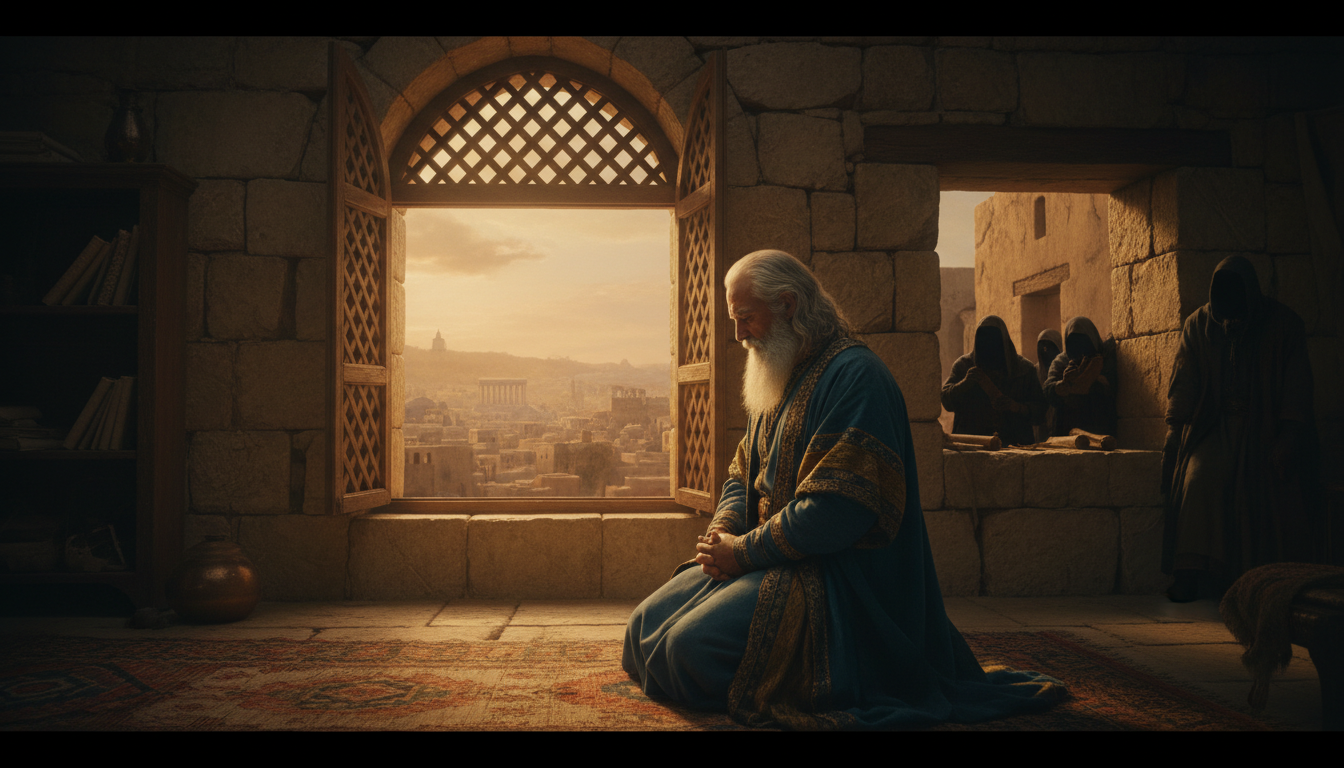
The decree was signed before sunset.
It bore the royal seal of King Darius, pressed deep into warm wax—a law unchangeable under the customs of the Medes and Persians. For thirty days, no one in the empire was to pray to any god or man except the king himself.
The law had been carefully crafted.
It had nothing to do with loyalty.
Nothing to do with order.
It had everything to do with jealousy.
Daniel had served under kings before Darius ever rose to power. He had interpreted dreams for Nebuchadnezzar. He had read the writing on the wall when Belshazzar trembled before a prophecy fulfilled in a single night. Kingdoms shifted; rulers rose and fell.
But Daniel remained.
Not because he sought influence.
Because he was faithful.
Even now, in his late sixties, his integrity outshone younger officials. Darius had planned to place him over the entire kingdom—an exile elevated above princes.
That was what stirred resentment.
The governors searched for corruption.
They found none.
They searched for dishonesty.
There was none.
They searched for weakness.
They found only one thing that could be used against him:
His devotion.
“If we are to trap him,” they said among themselves, “it must be in connection with the law of his God.”
And so they flattered Darius.
They appealed to pride.
“Establish a decree,” they urged, “that anyone who petitions any god or man besides you for thirty days shall be thrown into the lions’ den.”
It sounded like unity.
It sounded like loyalty.
The king signed it.
And with that, a righteous man was marked.
The Window Still Open
Daniel heard the decree.
He did not protest.
He did not argue policy.
He did not hide.
He went home.
The upper room window faced Jerusalem, as it always had. Though the city lay in ruins far away, it remained the direction of promise—the place where the temple once stood, where covenant had been sealed.
He opened the window.
As he had done three times a day for decades, he knelt.
He gave thanks.
Not hurried.
Not whispering in panic.
He prayed as usual.
The sound of his voice was steady.
He was not praying for rescue.
He was honoring the God who had carried him through empires.
Outside, shadows moved.
The officials were watching.
They did not need to wait long.
They burst in, triumphant.
Caught.
But Daniel did not resist them.
A King’s Regret
When Daniel was brought before Darius, the king’s expression changed from authority to dread.
He knew what had happened.
He had been manipulated.
“You have signed the decree,” the officials reminded him coldly. “The law cannot be changed.”
Darius tried.
All day he searched for a legal loophole.
None existed.
At sunset, with heavy steps, he gave the order.
Daniel would be thrown into the lions’ den.
But before it was done, Darius leaned close and spoke quietly to him.
“May your God, whom you serve continually, deliver you.”
It was not mockery.
It was hope.
Into the Pit
The lions’ den was carved into rock—a deep chamber beneath the earth, accessed by a sloped passage and sealed by a massive stone.
The air inside was thick with the scent of animal breath and old blood.
The lions had not been fed.
Their low growls echoed against stone.
Daniel’s hands were loosely bound.
He did not fight as soldiers lowered him down.
The moon hung overhead.
Torches flickered along the rim.
For a moment, the crowd leaned forward, expecting violence.
Daniel landed on the cold stone floor.
The ropes brushed against rock.
The lions stirred.
Massive shapes moved in the shadows.
Muscles rippled.
Claws scraped.
One lion stepped forward, golden eyes fixed upon him.
Daniel did not scramble backward.
He did not scream.
He knelt.
The growl deepened.
The lion lunged—
And stopped.
Mid-motion.
Its jaws parted—but no roar followed.
The beast’s body stiffened, as if restrained by a presence unseen.
Another lion approached.
Then another.
Yet none struck.
Instead, one by one, the animals lowered themselves to the ground.
Their breathing slowed.
The chamber, moments before filled with tension, settled into unnatural stillness.
Daniel remained kneeling.
The air felt different now.
Not empty.
Not silent.
But protected.
Though no chains bound the lions, something greater held them back.
Daniel’s face, illuminated by faint moonlight from above, reflected no fear.
Only trust.
The Longest Night
Above the pit, the stone was rolled into place and sealed with the king’s signet and the signets of his nobles.
It could not be disturbed without consequence.
Darius returned to his palace.
He refused entertainment.
He refused food.
Sleep would not come.
The hours stretched.
The law he had signed replayed in his mind.
Pride had blinded him.
In the darkness, a pagan king waited to see if the God of Israel would act.
Below, in the den, Daniel did not shout for help.
He did not pace.
He rested.
The lions lay around him—massive, breathing guardians rather than executioners.
Time passed.
The moon crossed the sky.
The pit remained still.
Dawn at the Stone
At first light, Darius hurried to the den.
His royal dignity forgotten, he ran.
When he reached the sealed stone, his voice broke as he called down.
“Daniel, servant of the living God—has your God, whom you serve continually, been able to deliver you from the lions?”
Silence followed.
Then—
A voice rose from below.
Steady.
Alive.
“O king, live forever. My God sent His angel and shut the mouths of the lions. They have not harmed me, because I was found innocent before Him—and before you.”
The king’s face transformed from anguish to relief.
The stone was rolled away.
Daniel was lifted out.
The officials examined him carefully.
No wound.
No torn garment.
Not even a scratch.
The lions had done nothing.
Not because they were tame.
But because heaven had intervened.
The Aftermath
Justice followed swiftly.
Those who had conspired against Daniel were thrown into the den they had prepared for another.
This time, the lions did not wait.
The power of the miracle became unmistakable.
Darius issued a new decree—not of pride, but of recognition.
Throughout the empire he proclaimed that all were to revere the God of Daniel.
“For He is the living God,” the decree declared, “enduring forever. His kingdom shall not be destroyed.”
The king had seen what could not be explained by politics or power.
A law of men had been overturned by divine authority.
Faith That Cannot Be Devoured
Daniel’s deliverance was not born from rebellion.
He did not defy the king in arrogance.
He simply continued in obedience.
He did not know if rescue would come.
He only knew his loyalty would not bend.
The lions’ den was meant to be a grave.
Instead, it became testimony.
Darkness was meant to silence him.
Instead, it amplified his God.
Empires fall.
Kings are replaced.
Decrees crumble.
But faith rooted in the living God stands unmoved—even in a pit surrounded by death.
The lions were strong.
The stone was heavy.
The law was binding.
But none of them could devour what God chose to preserve.
When obedience costs you everything…
Would you still open the window and kneel?

