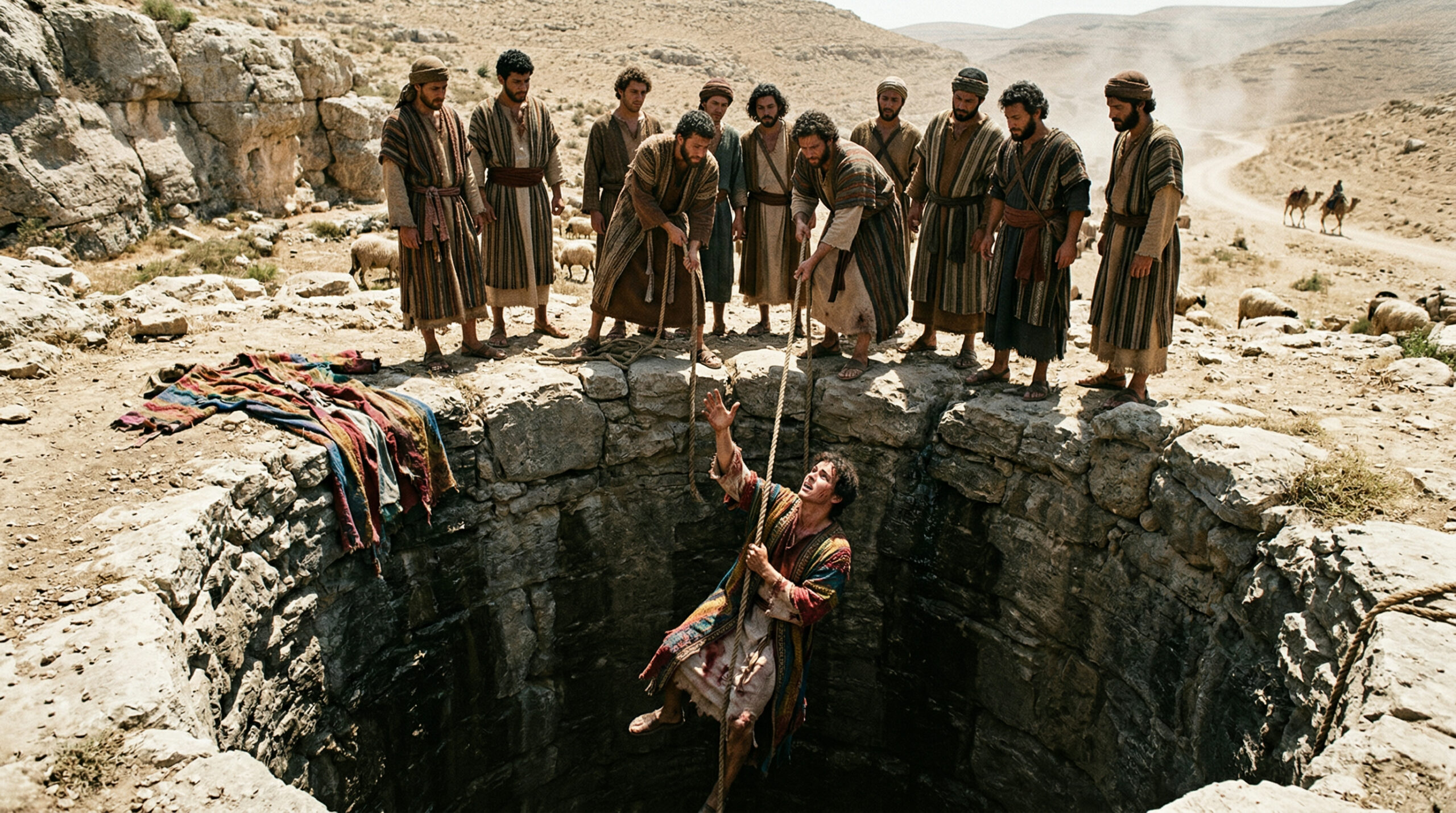
(Based on Genesis 37)
Joseph was seventeen when the distance between him and his brothers became impossible to ignore.
He was not weak.
He was not foolish.
But he was favored.
Jacob loved him differently. It was visible in the way he listened longer when Joseph spoke. It was visible in the garment he gave him—a richly ornamented robe that marked him as distinct, set apart.
In a family already fractured by rivalry between mothers, such visible favor was dangerous.
His brothers saw it.
They felt it.
And they hated him for it.
The Dreams That Deepened the Divide
Joseph began having dreams.
Not ordinary dreams of fields or flocks, but vivid visions that felt heavy with meaning.
In one, he and his brothers were binding sheaves of grain in the field. Suddenly, his sheaf rose upright, while the sheaves of his brothers gathered around and bowed to it.
He told them.
Perhaps he did not yet understand how to hold revelation quietly.
Perhaps youth gave him boldness without caution.
“Do you intend to reign over us?” they demanded.
The resentment sharpened.
Later, another dream came—this time of the sun, moon, and eleven stars bowing before him.
When he told it again, even his father rebuked him.
“Will your mother and I and your brothers actually come and bow down to the ground before you?”
But Jacob remembered the dream.
His brothers did not.
They remembered only how it made them feel.
Small.
Overshadowed.
Threatened.
Jealousy rarely announces itself as insecurity.
It disguises itself as anger.
Sent Into the Field
One day Jacob sent Joseph to check on his brothers, who were grazing flocks near Shechem.
Joseph obeyed.
He wore the robe.
The symbol.
He walked miles to find them.
From a distance, they saw him coming.
The bright garment caught the sun.
And with it, their anger reignited.
“Here comes that dreamer,” one said.
The bitterness had matured.
“Come now, let’s kill him and throw him into one of these cisterns. Then we’ll say a ferocious animal devoured him. We’ll see what comes of his dreams.”
The plan formed quickly.
Violence often does.
But Reuben, the eldest, intervened—not from righteousness alone, but from responsibility.
“Don’t take his life,” he said. “Throw him into the cistern here in the wilderness, but don’t lay a hand on him.”
His intention was to rescue Joseph later.
But intentions delayed can become irrelevant.
When Joseph arrived, he did not expect attack.
He expected conversation.
Instead, hands grabbed him.
His robe was stripped from him.
The garment of favor torn away.
He shouted.
They did not answer.
They dragged him to a dry cistern—an empty pit carved into rock.
And they threw him in.
The fall was sudden.
The impact hard.
Above him, their faces hovered at the rim.
His own brothers.
Looking down.
Then they walked away.
Silence Above the Pit
Joseph called up to them.
Pleading.
Confused.
Hurt.
The pit was deep enough to trap him, but not deep enough to muffle his voice.
He could hear them sitting down to eat.
Bread tearing.
Water poured.
Conversation continuing.
As if he were not there.
There are betrayals from strangers.
And there are betrayals from blood.
The latter cut deeper.
From inside the pit, Joseph could not see the horizon.
He could only see a circle of sky.
Blue.
Indifferent.
He did not know that his life had just shifted permanently.
Sold, Not Slain
While they ate, a caravan approached—traders traveling toward Egypt.
Ishmaelites.
Merchants of goods.
Judah’s mind turned quickly.
“What will we gain if we kill our brother and cover up his blood?” he said. “Come, let’s sell him.”
Profit was cleaner than murder.
They pulled Joseph from the pit.
Bound him.
And sold him for twenty pieces of silver.
The traders led him away.
His brothers kept the robe.
They slaughtered a goat and dipped it in blood.
They would tell their father a wild animal had devoured him.
The lie would work.
Jacob would weep for years.
And Joseph would disappear into Egypt.
What He Could Not See
From the road, Joseph looked back once.
The land of his childhood shrinking behind him.
He had lost his home.
His position.
His family.
His freedom.
But what he could not see from the caravan was the unfolding of something larger than betrayal.
In Egypt, he would be sold again.
Falsely accused.
Imprisoned.
Forgotten.
Years would pass.
Years of isolation and waiting.
Yet in each stage, something remained consistent:
The Lord was with Joseph.
The text repeats it quietly.
The Lord was with him in the house of Potiphar.
The Lord was with him in prison.
Even when abandoned by men.
Even when misunderstood.
Even when betrayed.
The Long Arc of Providence
The dreams that once provoked jealousy would not die in a pit.
They would mature.
Years later, famine would strike the land—including Canaan.
And Joseph’s brothers would travel to Egypt seeking grain.
They would stand before an Egyptian official—powerful, authoritative, unrecognizable to them.
They would bow.
Just as in the dream.
The moment would not be triumphant.
It would be heavy.
Joseph would recognize them.
They would not recognize him.
The pit they had thrown him into had become the pathway to a throne.
But Joseph would not respond with vengeance.
When the time came and he revealed himself, he wept.
“You intended to harm me,” he told them, “but God intended it for good—to accomplish what is now being done, the saving of many lives.”
He did not deny their betrayal.
He did not minimize the wound.
He reframed it through providence.
The pit had not been the end.
It had been the beginning.
The Truth About the Pit
Joseph did not choose betrayal.
He did not orchestrate suffering.
But when he was lowered into darkness by those closest to him, God did not abandon him there.
The pit felt final.
It was not.
The silver exchanged hands.
But heaven did not lose track of him.
Jealousy sent him down.
Purpose raised him up.
Sometimes your own blood sends you into the pit.
But the pit is not proof of God’s absence.
It may be the place where His larger plan quietly begins.

