On the day she decided to tell him the truth, the baby kicked for the first time.
It was subtle—more flutter than force—like a whisper from inside her body.
Amara Bennett froze in the middle of the hospital corridor, one hand pressed instinctively to her abdomen.
“Not now,” she murmured under her breath.
But timing had never been something life asked her permission about.
Across the hall, through the glass of ICU Room 312, Dr. Lucas Hale stood beside a patient’s bed, his posture rigid with concentration. The overhead lights caught in his dark hair, the same way they used to catch in it when he leaned across café tables arguing about literature and fate and whether love was ever enough.
He looked older now. Sharper around the edges.
She hadn’t meant to come back to Chicago.
She definitely hadn’t meant to come back pregnant.
I. The Woman Who Left Quietly
Three years earlier, Amara had walked out of Lucas’s apartment with a suitcase and a lie.
The lie had been simple.
“I need space,” she had said.
The truth had been heavier.
She had just received an offer to join an international humanitarian medical program in South Sudan. A two-year commitment in a region that didn’t guarantee safety or return tickets.
Lucas had just accepted a lead trauma surgeon position at Lakeshore General—a promotion he had worked toward since residency.
“You’re asking me to leave everything,” he had said that night, pacing in their narrow kitchen.
“I’m asking you to choose with me,” she replied.
“And what if I choose here?”
She had looked at him for a long moment.
“Then I choose there.”
They had loved each other ferociously.
But they had never loved the same future.
She left before dawn.
He didn’t come to the airport.
II. The Man Who Stayed
Lucas had not expected heartbreak to feel so physical.
He had seen ribs cracked open, arteries severed, lungs collapsing under pressure.
But losing Amara felt like something had been removed from his chest without anesthesia.
He told himself she would come back.
She didn’t.
He buried himself in work instead.
Sixteen-hour shifts. Complex cases. A reputation for precision under impossible pressure.
Colleagues called him brilliant.
Patients called him miracle-worker.
At night, in his empty apartment, he called her voicemail just to hear her recorded voice.
He never left a message.
III. The Return
Amara returned to Chicago because her mother had fallen ill.
A mild stroke, doctors said. Manageable. But it required presence.
She had been back in the city for two months before she worked up the courage to apply for a temporary contract at Lakeshore General.
She didn’t know Lucas still worked there.
The first time they saw each other again, it was in the trauma bay.
A car accident victim. Blood everywhere. Nurses moving fast.
“Clamp,” Lucas barked without looking up.
Amara placed the instrument in his hand automatically.
Their fingers brushed.
He looked up.
Time faltered.
“Amara.”
Her name on his tongue was not accusation.
It was memory.
“Lucas.”
The patient groaned, pulling them back to the present.
They finished the procedure without another word.
Afterward, in the scrub room, silence hung between them like a third person.
“You’re back,” he said finally.
“For a while.”
“Of course.”
His tone was neutral.
Careful.
It hurt more than anger would have.
IV. The Things Unsaid
They worked overlapping shifts for weeks.
Professional. Polite. Distant.
Until one evening, when a storm knocked out part of the hospital’s power grid and they found themselves trapped in the stairwell between floors.
Emergency lights cast everything in amber.
“This feels familiar,” Lucas said dryly.
“Being stuck?” she asked.
“Being left in the dark.”
The words landed.
She exhaled slowly.
“I didn’t want you to follow me.”
“I might have,” he said.
“That’s why I didn’t tell you the whole truth.”
His jaw tightened.
“You didn’t tell me any truth.”
Silence pressed in.
“I was scared,” she admitted.
“Of what?”
“That if I asked you to come, and you said no, I’d resent you.”
“And if I said yes?”
“I’d resent myself for taking you away from your dream.”
He stared at her.
“You decided for both of us.”
“Yes.”
Lightning cracked outside.
“And you think that was love?” he asked quietly.
She didn’t answer.
V. The Life Inside Her
She began wearing looser scrubs.
Skipped coffee in the break room.
Left early when nausea hit.
She told no one at work.
The father was not Lucas.
It had been a colleague overseas—a brief, unexpected connection born out of exhaustion and proximity.
They had cared for each other.
It had not been love.
He died in a clinic bombing two months later.
She found out she was pregnant a week after his funeral.
Grief and life intertwined in ways she still didn’t understand.
Now, standing in the hospital corridor with Lucas just meters away, she realized she couldn’t hide much longer.
VI. The Choice
He noticed first.
“You’re not just tired,” he said one evening in the on-call room.
She froze.
“What do you mean?”
He gestured vaguely toward her.
“You’re different.”
She swallowed.
“There’s something I need to tell you.”
He stiffened slightly.
“I’m pregnant.”
The word seemed to absorb all sound in the room.
His eyes searched her face.
“How far?”
“Four months.”
He nodded once, controlled.
“Is he—”
“No,” she said quickly. “It’s not yours.”
The clarification felt like a wound.
He leaned back against the lockers.
“Congratulations,” he said quietly.
She flinched.
“That’s not fair.”
“What isn’t?”
“You congratulating me like I’m a colleague.”
“What would you prefer?” he asked, voice tightening. “That I fall apart?”
She looked at him helplessly.
“I didn’t plan this.”
“I know you didn’t plan me leaving either,” he said.
The words were sharp.
Unintended.
But honest.
VII. Devastation
Weeks later, a patient crashed during surgery.
Lucas’s hands trembled for the first time in years.
Amara stepped in seamlessly, steadying the situation.
Afterward, in the empty OR, he leaned against the wall.
“I almost lost him,” he whispered.
“You didn’t.”
“I can’t lose anything else.”
The confession slipped out.
She stepped closer instinctively.
“Lucas—”
He shook his head.
“I spent three years telling myself I was fine. That I didn’t need what we had.”
“And?”
“I was wrong.”
Her chest tightened painfully.
“But you’re building a life with someone else now,” he continued. “And I don’t know where I fit in that.”
Tears burned her eyes.
“You fit where you always did,” she whispered.
“Which was?”
“Everywhere.”
Silence shattered between them.
VIII. The Unexpected Turn
Her mother’s condition worsened unexpectedly.
Complications. ICU admission.
Amara found herself standing on the other side of the glass this time.
Lucas stood beside her without being asked.
When doctors discussed treatment options, he translated medical jargon into language she could breathe through.
He drove her home when exhaustion blurred her vision.
He held her when she finally cried in the hospital parking garage.
“I don’t know how to do this alone,” she said.
“You don’t have to,” he replied.
The simplicity of it broke her.
IX. The Final Scene
Her mother stabilized.
The baby kicked harder now—insistent, undeniable.
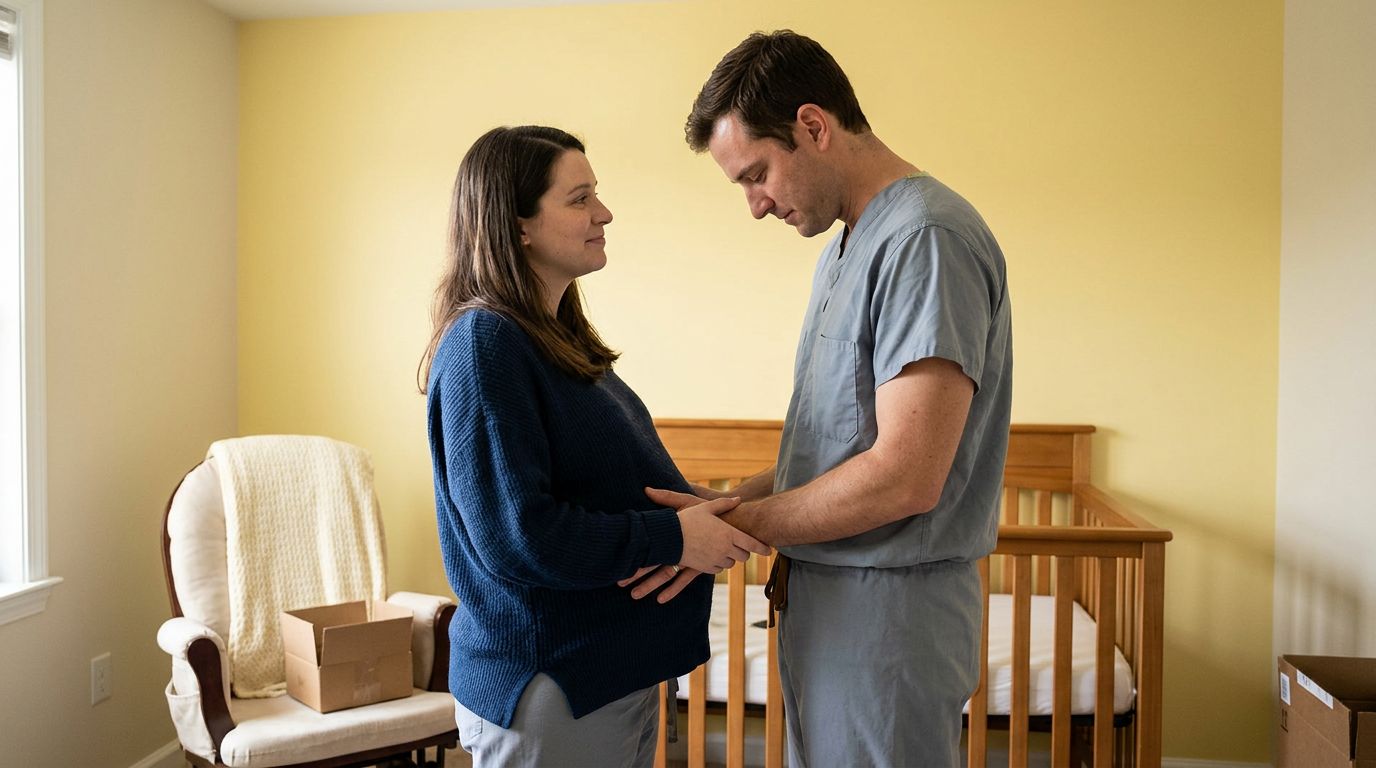
One evening, Amara stood in the nursery she had begun setting up in her small apartment.
Lucas stood in the doorway, hesitant.
“I don’t know what this looks like,” he said.
“Neither do I.”
He stepped closer.
“I don’t need it to be mine,” he said quietly. “I just need to know there’s space for me.”
She took his hand and placed it over her stomach.
The baby shifted beneath his palm.
His breath caught.
“There’s space,” she whispered.
Not the life they once imagined.
Not the future they once fought over.
Something new.
Unmapped.
Fragile.
He leaned his forehead against hers.
“This time,” he said softly, “we choose together.”
Outside, the city moved without pause.
Inside the small room with pale yellow walls, love did not roar.
It settled.
And for the first time in years, neither of them felt like they were standing in the dark.

