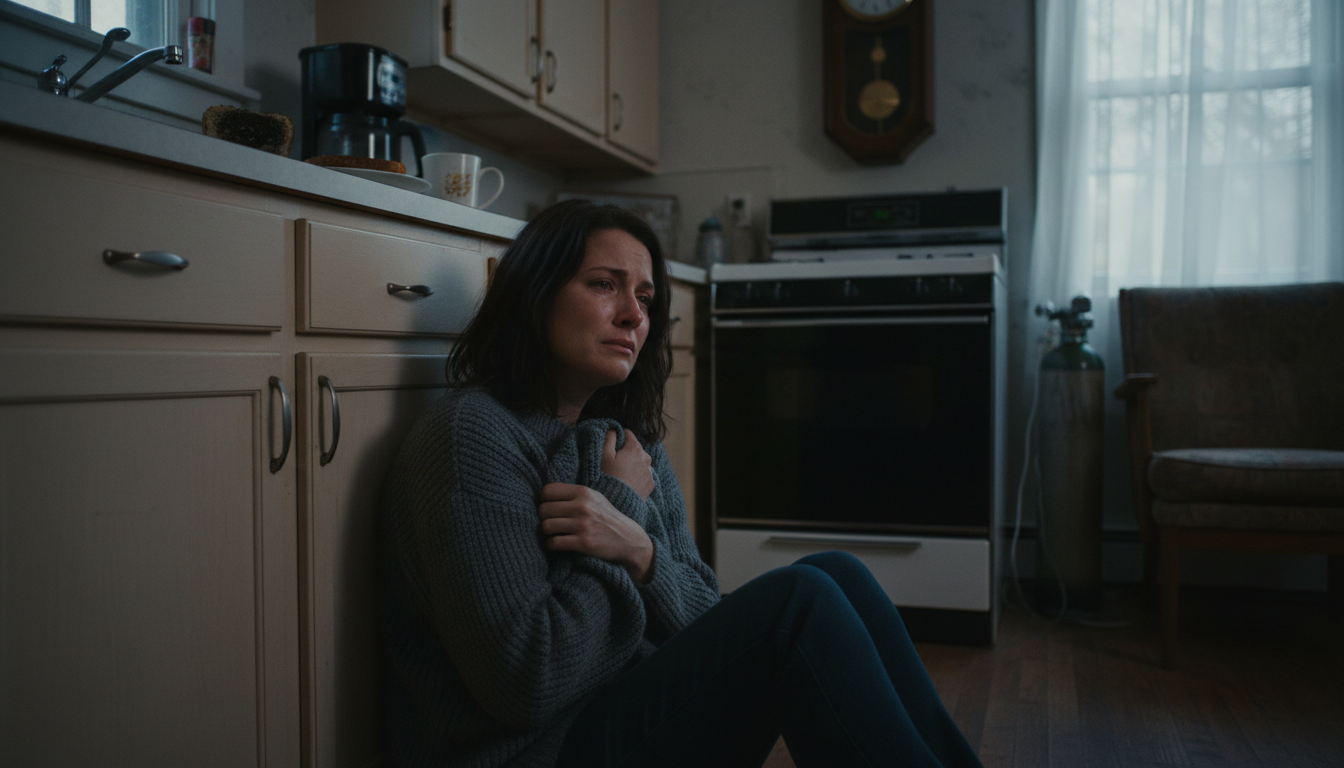
The last thing Mara Ellis expected to hear the night her father died was a knock at the door.
Not the careful, apologetic knock of a neighbor. Not the brisk authority of a police officer. It was hesitant. Almost reverent. As if whoever stood outside understood that grief was already in the room and did not wish to disturb it.
Mara sat on the kitchen floor with her back against the cabinets, her father’s old wool sweater twisted in her hands. The house smelled like antiseptic and burnt toast. The clock over the stove ticked too loudly, counting down a future she had not planned for.
The knock came again.
She wiped her face with the sleeve of the sweater and stood. Her body felt hollowed out, like something had been scooped from inside her chest and left a ringing emptiness in its place.
When she opened the door, a stranger stood on her porch holding a leather satchel against his chest as if it were a shield.
“I’m sorry,” he said before she could speak. His voice was low, roughened by cold air. “I was told… I’m looking for Mr. Thomas Ellis.”
Mara stared at him. Dark hair, wind-tangled. A week’s worth of stubble. Eyes that looked like they had known long nights. He wore a gray coat too thin for November.
“You’re too late,” she said.
The words landed between them like a door closing.
He inhaled sharply, as if she had struck him. “I— I just came from Chicago. He asked me to come.”
Mara felt something inside her stiffen. “My father didn’t ask anyone to come.”
The stranger hesitated. His fingers tightened on the strap of the satchel.
“He wrote to me,” he said quietly. “Three weeks ago.”
I. The House by the River
The town of Hawthorne sat along a narrow river that smelled of damp leaves and iron. In autumn, the trees burned gold and red, and the sidewalks filled with the quiet crunch of change. It was the kind of place people left at eighteen and returned to at forty when life had worn them down.
Mara had never left.
She taught literature at the local high school, lived in the house she grew up in, and had spent the last six years caring for her father as his lungs failed him slowly, indignantly. She told herself she stayed because someone had to. She did not admit that leaving terrified her.
The stranger introduced himself as Julian Reyes.
He stood awkwardly in her living room that night while the kettle screamed in the kitchen. Her father’s oxygen tank still stood beside the recliner. The indentation in the cushions was fresh.
“He was my professor,” Julian said, looking at the bookshelf lined with battered classics. “At Northwestern. Ten years ago.”
“My father never mentioned teaching at Northwestern.”
“He didn’t. Not publicly.” Julian gave a humorless smile. “He came in as a visiting lecturer. Temporary. But he changed my life.”
Mara folded her arms. “He was sick. For a long time. He didn’t talk about Chicago.”
Julian reached into his satchel and pulled out a stack of envelopes, bound with twine. The top one was addressed in her father’s slanted handwriting.
J. Reyes.
“He wrote to me after he retired,” Julian said. “We kept in touch. He—” His voice faltered. “He asked me to come help him organize his papers. Said there were things he hadn’t finished.”
Mara’s throat tightened. “He couldn’t even climb the stairs.”
Julian looked at her then, really looked at her, as if seeing the exhaustion beneath her composure. “I didn’t know how bad it was.”
Silence stretched between them, filled only by the ticking clock.
“Why you?” she asked finally.
Julian glanced toward the oxygen tank, then back to her. “He once told me that regret calcifies if you let it sit too long. That you either carve it into something useful or it hardens inside you.”
Mara felt the sting of tears again, sudden and unwanted.
“He was very good at telling other people what to do with their regrets,” she said. “Not so good at his own.”
Julian stayed.
At first, it was practical. He had nowhere else to go, and the next train out wasn’t until morning. But the house felt unbearably silent after the funeral, and when he offered to help sort through the stacks of notebooks in her father’s study, Mara did not tell him to leave.
The study smelled of dust and ink. Sunlight slanted through the window, catching on floating motes like suspended time.
Julian moved carefully among the piles, as if afraid to disturb something sacred. He treated her father’s papers with reverence. Mara watched him from the doorway, arms crossed, uncertain whether she resented or appreciated his presence.
“You can go back to Chicago,” she said one afternoon. “You’ve done enough.”
Julian didn’t look up. “He asked me to help catalog his drafts. There’s a manuscript here.” He tapped a stack of pages. “He wanted it sent to a publisher.”
Mara frowned. “He stopped writing years ago.”
“He didn’t stop,” Julian said gently. “He just stopped showing anyone.”
That night, Mara lay in bed staring at the ceiling. The idea that her father had a secret life—letters, manuscripts, a former student who traveled across states at a summons—unsettled her.
She had given up a fellowship in Boston to stay here when his diagnosis came. She had folded her ambitions into the shape of obligation. And now she discovered that he had been writing again, planning something beyond her.
The next morning, she found Julian in the kitchen, sleeves rolled up, making coffee.
“You don’t have to do that,” she said.
“I know.” He poured her a cup anyway.
They stood in the small kitchen, steam rising between them.
“Why did you really come?” she asked.
He met her gaze steadily. “Because I owed him.”
“For what?”
“For believing in me when I didn’t believe in myself.”
Something in his voice carried weight. Not gratitude alone. Something closer to debt.
Mara looked down at her mug. “He was better at believing in strangers than in me.”
Julian’s brow furrowed. “I doubt that.”
“You didn’t live with him.”
Julian hesitated. “No,” he said quietly. “I didn’t.”
II. The Slow Unraveling
Weeks passed.
Julian rented a small room above the town’s only bookstore while he worked on organizing the manuscript. He and Mara fell into a rhythm—mornings in the study, afternoons walking by the river, evenings spent arguing over sentences.
He had sharp instincts for narrative, for structure. She had a teacher’s precision, a respect for language that bordered on stubbornness.
“You can’t cut this paragraph,” she said one evening, leaning over the desk. “It’s the emotional center of the chapter.”
“It’s indulgent,” Julian countered. “He’s circling the same idea three times.”
“He’s building tension.”
“He’s avoiding it.”
They glared at each other across the desk, the air thick with something that felt less like anger and more like friction.
“Why do you care so much?” he asked suddenly.
“Because he was my father.”
“That’s not what I meant.”
Mara straightened. “Then what did you mean?”
Julian ran a hand through his hair. “You talk about him like he disappointed you. But you’re fighting for his words like they’re sacred.”
Her throat tightened. “Both can be true.”
He held her gaze for a long moment.
“I know,” he said softly.
Their first real fracture came in December.
Snow fell in heavy, deliberate flakes. The river slowed, thickening at the edges with ice. Mara found Julian in the study late one night, reading one of her father’s old journals.
“You shouldn’t go through those,” she said sharply.
He looked up, startled. “They’re part of the archive.”
“They’re private.”
“So was the manuscript.”
“That’s different.”
“How?”
“Because he meant for that to be seen.”
Julian closed the journal slowly. “There are entries about you.”
Mara’s stomach dropped. “What about me?”
He hesitated, then read aloud:
I worry that I have mistaken protection for love. That in shielding her from failure, I have also shielded her from flight.
Mara felt heat rush to her face. “Give me that.”
Julian handed it over without resistance.
“He was proud of you,” he said quietly. “He wrote about your writing. About the fellowship in Boston.”
She looked up, stunned. “He hated that I wanted to leave.”
“He wrote that he was afraid of losing you. Not that he wanted to keep you.”
Mara turned away, gripping the journal. “You didn’t know him.”
Julian stood. “No. I didn’t. But I knew the part of him that wanted to be braver than he was.”
She faced him then, anger sharp in her voice.
“And what part of you did he know?”
The question hung there, dangerous.
Julian’s jaw tightened. “Enough.”
III. The Bracelet
The symbolic object came to them by accident.
They were cleaning out a drawer in the study when Mara found a small velvet box tucked beneath a stack of old lecture notes.
Inside was a thin silver bracelet, simple except for a tiny charm shaped like a compass.
Mara frowned. “This isn’t my mother’s.”
Julian turned it over in his hands. The compass face was scratched, worn.
“There’s an engraving,” he said.
On the inside, in delicate script: Find your own true north.
Mara felt a strange ache in her chest.
“He never gave this to anyone,” she murmured.
Julian looked at her carefully. “Maybe he meant to.”
She closed the box and set it aside. But later that night, she slipped the bracelet onto her wrist.
It felt cool and unfamiliar against her skin.
Their attraction was not sudden. It built like winter—slow, inevitable.
It was in the way Julian listened when she spoke about her students. In the way he stood too close when they argued over syntax. In the way her pulse quickened when his hand brushed hers reaching for the same page.
One evening in January, the power went out during a storm.
They lit candles in the living room. Wind rattled the windows, and the house felt smaller, more intimate.
Julian sat on the floor, back against the couch. Mara sat opposite him, knees almost touching.
“Why didn’t you stay in Chicago?” she asked, voice soft in the dark.
He stared into the candle flame. “I had a job at a publishing house. Assistant editor.”
“Had?”
“I left.”
“Why?”
He was quiet for a long time.
“Because I published something I shouldn’t have.”
She waited.
“It was a memoir. By a former professor.” His mouth tightened. “He trusted me with the draft. I saw potential. I pushed it forward. It made noise. Good noise. Then the backlash came.”
“What kind of backlash?”
“He had fabricated parts of it. I didn’t catch it. Or maybe I didn’t look closely enough.” Julian’s voice hardened. “He lost his position. His reputation. I lost my job.”
Mara studied him in the flickering light. “You think you ruined him.”
“I did.”
“And coming here fixes that?”
“No.” He met her gaze. “But your father believed I was more than my worst mistake.”
Silence settled between them, heavy but not uncomfortable.
Mara’s fingers toyed with the compass charm on her wrist.
“What if you’re not?” she asked softly. “More than your worst mistake?”
Julian’s eyes searched hers. “Then I suppose I deserve to be alone.”
Something inside her shifted.
“You don’t,” she said.
The words felt like stepping off a ledge.
He leaned forward slightly. “Mara—”
She closed the distance.
The kiss was not cinematic. It was tentative, uncertain, like two people testing whether the ground would hold. His hand came up to her cheek, warm and steady. Her breath caught in her throat.
When they pulled apart, the storm outside felt distant.
“This complicates things,” he murmured.
“Everything is already complicated,” she said.
IV. The Choice
By spring, the manuscript was complete.
Julian had secured a meeting with a reputable publisher in Chicago who was willing to review it. He would need to return there, at least temporarily.
“You should come,” he said one afternoon by the river.
Mara shook her head. “I have my job.”
“You could take a leave.”
“And then what? Move to Chicago? Start over at thirty-four?”
He smiled faintly. “That’s not old.”
“It feels old to start from scratch.”
Julian crouched beside her on the riverbank. “You once wanted to.”
“That was before.”
“Before what?”
She met his eyes. “Before I became necessary.”
He touched the bracelet on her wrist. “You’re not necessary here anymore.”
The truth of it cut.
She had spent so long defining herself by caretaking that she did not know who she was without it.
“You’re asking me to leave everything I’ve known,” she said.
“I’m asking you to consider what you might become.”
“And what if I fail?”
“Then you fail,” he said simply. “But at least it’s your failure.”
She looked away, watching the river move steadily forward.
“And if I stay?” she asked.
Julian hesitated. “Then I don’t know if I can.”
The words landed like a blow.
“You’d leave?”
“I have to try to rebuild my career,” he said, voice strained. “I can’t do that here.”
“And I can’t abandon this place like it never mattered.”
He stood abruptly. “I’m not asking you to pretend it didn’t.”
“It sounds like you are.”
They faced each other, the space between them charged.
“Choose me,” he said, the plea barely concealed.
She felt something fracture inside her.
“I don’t know how,” she whispered.
V. The Devastation
The unexpected twist came in a letter.
Two days before Julian was set to leave for Chicago, a registered envelope arrived addressed to Mara.
Inside was a contract.
Her father’s manuscript had been accepted—on one condition.
The publisher wanted Julian as co-editor, officially credited. His name attached to the project would lend credibility. It was an opportunity to restore his reputation in a public, undeniable way.
There was also a handwritten note from the editor:
Your father spoke highly of Mr. Reyes. He believed this collaboration would be meaningful for both of you.
Mara felt the room tilt.
Her father had orchestrated this.
He had known about Julian’s scandal. He had planned a redemption through his own work.
And she had stood between them, resisting the very future he had envisioned.
When Julian returned from town that evening, she was waiting in the study.
“You knew,” she said.
He froze. “Knew what?”
“That he was setting this up.”
Julian’s face drained of color. “No.”
“He wrote to you. He asked you here.”
“To help with the manuscript.”
“He knew about your career.”
Julian swallowed. “I told him.”
“And he offered you this,” she said, holding up the contract.
Julian stared at it, shock flickering across his features. “I didn’t know about this.”
“You expect me to believe that?”
He stepped closer. “Mara, I swear—”
“You came here because you needed saving,” she snapped.
His expression hardened. “That’s not fair.”
“Isn’t it? You said you owed him. Maybe this was how you meant to pay the debt.”
“I didn’t manipulate this.”
“But you benefited from it,” she shot back.
Pain flashed in his eyes. “So did you.”
The words hung between them, cruel and unintentional.
Mara felt something inside her collapse.
“You should go,” she said.
“Mara—”
“Go.”
He reached for her, but she stepped back.
“I loved you,” he said hoarsely.
The past tense gutted her.
“You shouldn’t have,” she replied.
He left before dawn.
The house felt emptier than it had the night her father died.
Mara stood in the study, the contract trembling in her hands. The bracelet on her wrist felt suddenly heavy.
Weeks passed. She signed the contract.
The manuscript moved forward without Julian’s name.
It was a quiet act of defiance. Or perhaps self-sabotage.
She told herself she was protecting something—her father’s legacy, her own pride. But at night, she lay awake wondering if she had mistaken fear for principle.
The book was published that fall.
It received modest acclaim. Reviewers praised its emotional depth, its unflinching honesty about regret and love.
Mara attended the launch event alone.
When she returned home, she found a package on her doorstep.
Inside was the velvet box.
And a note.
You once asked what part of me your father knew. He knew the part that wanted to be brave. I’m trying to find him again. —J
Her hands shook.
VI. Redemption
A year passed.
Mara did not see Julian.
She left Hawthorne the following summer.
The fellowship in Boston had long expired, but she found a position at a small college in Massachusetts. It was not glamorous. It was hers.
On her first day, she wore the bracelet.
One evening in October, after a lecture on narrative ethics, she heard a familiar voice from the back of the auditorium.
“You still defend indulgent paragraphs.”
Her breath caught.
Julian stood near the door, older somehow. Leaner. His eyes carried less restlessness.
“What are you doing here?” she asked.
“I’m working with a nonprofit press in the city,” he said. “We publish writers who’ve been silenced. Or who silenced themselves.”
She studied him carefully. “Is that what you did?”
“Yes.”
They stood awkwardly as students filtered past.
“I read your book,” he said. “It was beautiful.”
“It was ours,” she replied before she could stop herself.
He took a step closer. “Why didn’t you let them credit me?”
She swallowed. “Because I didn’t want to owe you.”
He nodded slowly. “And now?”
“Now I know love isn’t a debt.”
Silence settled between them, charged and fragile.
“I was angry,” she said. “I thought you used my father.”
“I didn’t.”
“I know.”
He searched her face. “Do you?”
“Yes.”
Emotion thickened the air.
“I never stopped loving you,” he said.
She felt the truth of her own heart rise in response.
“You once asked me to choose you,” she said softly. “I didn’t know how.”
“And now?”
She stepped closer, close enough to see the faint scar along his jaw she had once traced with her fingers.
“Now I know choosing you doesn’t mean losing myself.”
He exhaled, as if he had been holding his breath for a year.
The kiss this time was not tentative. It was certain. It carried the weight of what they had lost and the fragile hope of what they might rebuild.
VII. The Final Scene
Years later, they stood together on the riverbank in Hawthorne.
They had returned for the dedication of a small literary scholarship in Thomas Ellis’s name.
The river moved as it always had, steady and indifferent.
Mara’s hand rested in Julian’s. The bracelet gleamed softly in the late afternoon light.
“Do you ever think about what would have happened if I’d stayed?” she asked.
He smiled faintly. “We might have loved each other badly.”
“And now?”
“Now we love each other honestly.”
She leaned her head against his shoulder.
The town had not changed much. But they had.
Regret had not calcified inside them. It had carved something new.
As the sun dipped below the trees, casting the river in molten gold, Mara felt the compass charm warm against her skin.
For the first time in her life, she did not feel anchored to a place or a past.
She felt oriented.
As the light faded and their shadows stretched long across the grass, she realized that love had never been about choosing between north and south.
It had been about daring to move at all.

