The last voicemail Clara Whitmore ever received from her husband began with laughter.
Not a heavy, forced laugh. Not the polite kind people give strangers. It was the unguarded, breathless laugh he only let out when something delighted him unexpectedly.
“Clara,” Michael’s voice crackled through the speaker, wind rushing behind him, “you would not believe this place. I swear the sky here looks bigger than it should. I’ll show you when I get back. I love—”
The message cut off.
The call timestamp read 2:17 a.m.
At 6:42 a.m., there was a knock on her door.
I. The Widow at Thirty-Five
Clara did not cry when the officers told her.
She did not scream.
She did not collapse in cinematic despair.
She stared at the pattern in the rug beneath her bare feet and thought, absurdly, that she had meant to vacuum that morning.
Michael Whitmore, humanitarian engineer, had been working on a water filtration project overseas. A transport vehicle. A roadside accident. No survivors.
They used words like impact and instantaneous.
She nodded as if they were discussing weather.
After they left, she walked into the kitchen and played the voicemail again.
And again.
And again.
The laugh became a relic.
The unfinished sentence became a wound.
II. Before the Silence
Before grief hollowed out the edges of her days, Clara had been a sound engineer.
She recorded life.
Birdsong for documentaries. Footsteps in snow for film sets. The quiet hum of distant cities at dawn.
She met Michael at a conference in Seattle. He had spilled coffee on her equipment case and apologized like he had committed a federal offense.
“You build worlds,” he had said, watching her adjust a microphone.
“You try to fix them,” she had replied.
They had married within two years.
He was restless. Driven. He believed clean water could change entire futures.
She believed love could anchor even the most restless people.
They were both right.
Until they weren’t.
III. The Man in Apartment 4B
Three months after Michael’s death, a new tenant moved into 4B.
Clara knew because the hallway carried the sound of dragging furniture and muffled swearing.
She ignored it at first.
Grief had turned her world narrow. She worked freelance from home, rarely leaving except to buy groceries. She stopped recording. Sound felt intrusive. Everything was too loud.
Then one evening, as she sat on the floor beside her recording equipment, she heard it.
A cello.
Low. Hesitant. Searching.
The notes floated through the thin walls like a question.
She closed her eyes.
The melody was unfinished, circling itself. The bow trembled on sustained notes, as if the player didn’t trust his own hands.
She stood before she realized she was moving.
And knocked on 4B.
The music stopped abruptly.
Footsteps.
The door opened.
He looked about her age. Dark hair tied loosely at the nape of his neck. Sleeves rolled up, exposing forearms dusted faintly with rosin.
“Sorry,” he said immediately. “Was I too loud?”
Clara swallowed.
“No,” she said softly. “You were… almost right.”
His brow furrowed. “Almost?”
“You stopped before resolving it.”
A slow smile touched his mouth.
“Most people just complain about noise.”
“I work with sound,” she said.
“Ah.” He stepped back slightly. “Then I suppose I’ve been judged.”
She noticed the cello resting against the couch behind him.
“What’s it called?” she asked.
“It doesn’t have a name.”
“The piece.”
“Oh.” His expression shifted. “It’s something I’ve been trying to finish.”
“For how long?”
He hesitated.
“A year.”
IV. The Weight of Names
His name was Adrian Kessler.
He had once played in a touring chamber orchestra. Carnegie Hall. Vienna. Tokyo.
Then, one year ago, during a winter performance in Chicago, his younger sister collapsed backstage from an undiagnosed heart condition.
She died before the ambulance arrived.
He had been playing when it happened.
The applause had drowned out the sound of her falling.
After that night, he couldn’t finish a piece.
Every melody fractured halfway through.
“I keep hearing the last note she never got to hear,” he admitted one evening, sitting across from Clara on her living room floor.
“And what does it sound like?” Clara asked.
He looked at her.
“Like something that should have continued.”
The words landed heavily.
Clara’s throat tightened.
“I know that sound,” she said.
V. Attraction in Echoes
They began meeting most evenings.
At first, it was technical.
She offered suggestions about acoustics in his apartment. He adjusted bow pressure based on her feedback.
Then it became personal.
He would play a phrase. She would close her eyes and describe the color it felt like.
“Deep blue,” she’d murmur.
“Storm gray.”
“Gold, but distant.”
He watched her as much as he listened to her.
She noticed the scar near his wrist from where a string had snapped mid-performance. The way his shoulders stiffened whenever he reached a certain progression.
“You’re afraid of the end,” she said quietly one night.
He looked startled.
“Aren’t you?” he asked.
She thought of the voicemail.
The unfinished sentence.
“Yes,” she whispered.
Their connection wasn’t explosive.
It was incremental.
A hand brushing while adjusting sheet music.
Shared wine on the fire escape.
Laughter that felt guilty at first—like betrayal.
One evening, he reached for her face.
She froze.
“Clara,” he said gently, “if this is too much—”
“I’m still married,” she blurted.
He withdrew instantly.
“I’m sorry.”
“He’s dead,” she said, voice breaking. “But I still talk to him. I still sleep on my side of the bed.”
Adrian didn’t move closer again that night.
But he didn’t leave.
VI. The Symbol
Michael had given Clara a small portable recorder as a wedding gift.
“Because you forget to capture your own life,” he’d teased.
She had used it to record their vows.
After his death, she kept it in a drawer.
Untouched.
One night, Adrian found it on the table.
“You don’t record anymore?” he asked.
She shook her head.
“It feels wrong.”
“Why?”
“Because I can’t fix what’s missing.”
He picked up the recorder gently.
“Maybe you’re not meant to fix it,” he said. “Maybe you’re meant to witness it.”
He pressed it into her hand.
“Record me,” he said quietly. “Even if I can’t finish.”
Her heart pounded.
She turned it on.
The red light blinked alive.
He played.
And for the first time in a year, he did not stop halfway.
The melody resolved.
Not perfectly.
But honestly.
She began to cry.
VII. The Choice
Six months into whatever they were becoming, Adrian received an offer.
A prestigious orchestra in Berlin wanted him for a two-year contract.
International recognition. A return to the world stage.
He stared at the email for a long time before telling Clara.
“You’re going to take it,” she said immediately.
He studied her carefully.
“Do you want me to?”
The question felt like a trap.
“I don’t want to be the reason you shrink,” she said.
“And I don’t want to be the reason you stay broken,” he replied.
They stood in her kitchen, tension coiling tight.
“If you go,” she said, voice trembling, “I don’t know if I can survive another ending.”
“It wouldn’t be an ending.”
“Distance becomes one.”
He stepped closer.
“Come with me.”
The words echoed.
She shook her head instinctively.
“My work is here.”
“You can record anywhere.”
“And what happens when you tour again? When the applause drowns out everything?”
“I won’t let it.”
“You don’t control that,” she snapped.
Silence fell heavy.
“Are you choosing him over me?” Adrian asked softly.
Her breath caught.
“Don’t,” she whispered.
“You still live like he’s coming back.”
“I live like he mattered.”
“So do I,” Adrian said fiercely. “But he’s not here.”
The words shattered something fragile between them.
VIII. Devastation
Adrian accepted the Berlin contract.
They did not fight at the airport.
That would have been easier.
Instead, they stood too still.
“I love you,” he said.
She closed her eyes.
“I love you too.”
He waited.
“For how long?” he asked quietly.
She didn’t answer.
When he boarded, she felt the old void open again—familiar, merciless.
That night, she played Michael’s voicemail.
Then she played Adrian’s recording.
The two sounds layered over each other—past and present colliding.
She broke.
Sobs tore through her body until she slid to the floor.
She couldn’t keep living between unfinished sentences.
IX. The Twist
Three months later, Clara received a package from Berlin.
Inside was a vinyl record.
No return note.
She placed it on her player with shaking hands.
The cello began.
It was the piece.
But this time, it carried something new—ambient sound beneath it.
The faint click of a recorder turning on.
A woman’s breath.
Her breath.
Adrian had woven her original recording into the orchestral arrangement.
At the very end, just before the final note, there was silence.
Then her voice.
Soft. Almost broken.
“Keep going.”
The last note rang clear.
Complete.
She sank into the couch, heart splitting open.
He had not replaced Michael.
He had built something with her grief instead of around it.
X. The Sound of After
Clara boarded a flight to Berlin two days later.
When Adrian saw her standing at the edge of the rehearsal hall, he nearly dropped his bow.
“You’re here,” he breathed.
She walked toward him slowly.
“I don’t want to live in before,” she said. “Or during.”
He stepped closer.
“Where, then?”
She took his hand.
“In after.”
He searched her face.
“Is that enough?”
She nodded.
“It has to be.”
That night, he played the piece again.
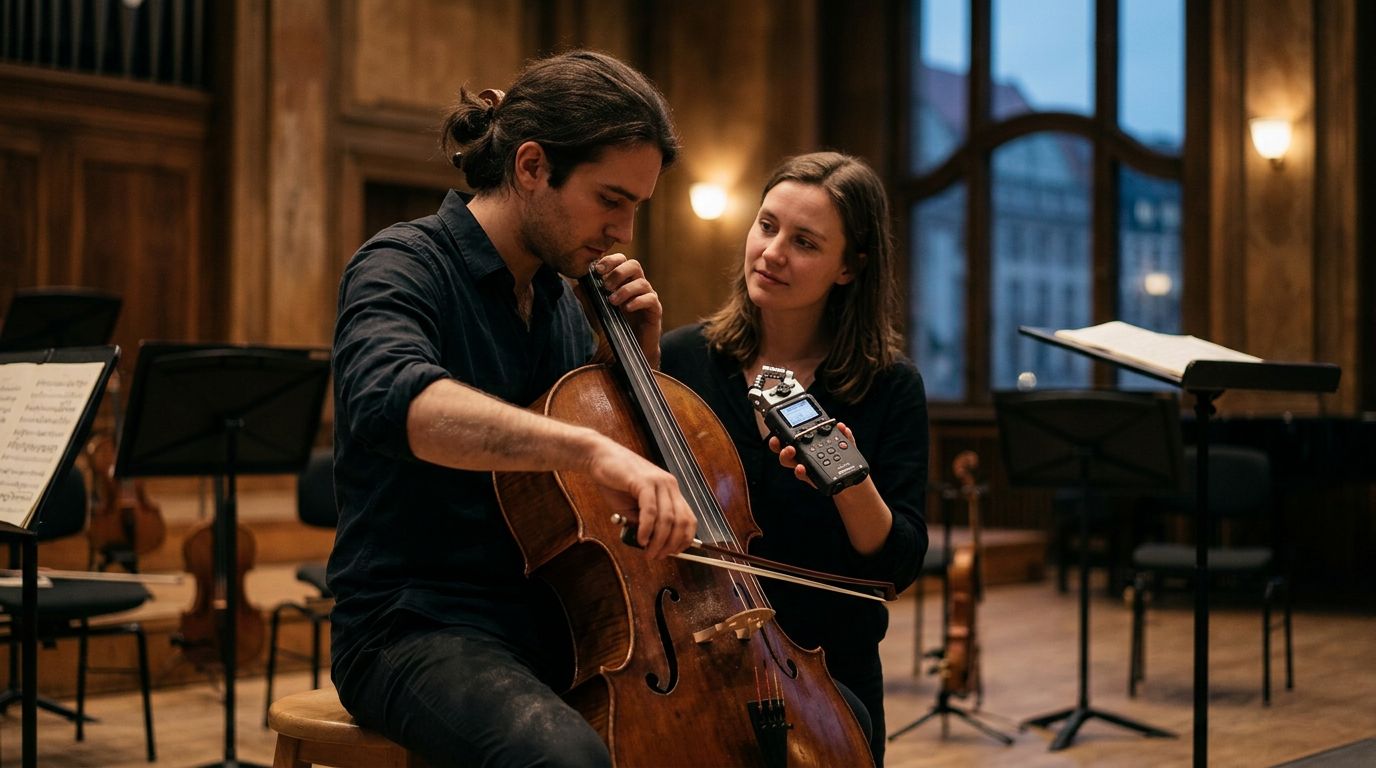
This time, she stood beside him, recorder in hand.
The melody rose.
Resolved.
And when the final note faded, she did not fear the silence that followed.
Because she had learned something grief never tells you at the beginning:
Silence isn’t the absence of love.
It’s the space where love changes shape.
And this time, when the sound of after settled around them, it felt like home.

