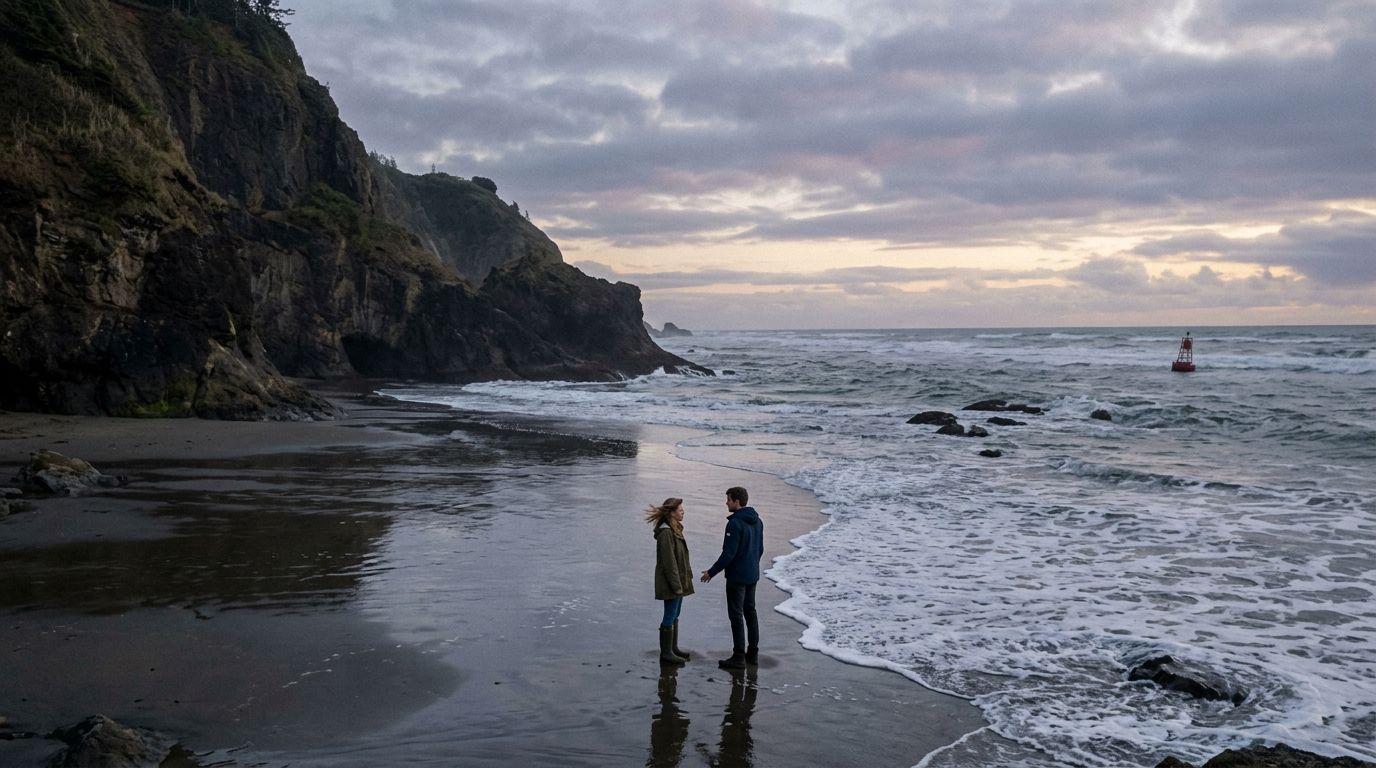
The night the ocean tried to take her, he was the one who pulled her back.
Clara Whitfield had always believed she understood the sea.
She had grown up in Harbor’s End, a narrow strip of land on the Oregon coast where cliffs dropped into restless gray water and the air tasted perpetually of salt and unfinished conversations.
She had mapped the shoreline since she was twelve. Studied marine biology. Tracked tidal shifts like other people tracked stock markets.
The ocean made sense to her.
It rose.
It fell.
It returned.
Love, she had learned, did not.
That night, the tide was wrong.
And so was she.
I. The Woman Who Stayed
At thirty-six, Clara ran the Harbor’s End Marine Research Station—three weather-beaten buildings perched dangerously close to erosion lines.
Funding was thin. Equipment outdated. But she kept it alive the way some people keep old houses standing—through stubbornness and memory.
She had once planned to leave.
She had once been engaged.
Matthew Ellis had loved her with a gentleness that felt like morning light. He had wanted a house inland. Children. Stability.
She had wanted open water.
The argument that ended them had been quiet.
“I can’t live beside something that might take you,” he had said, standing on the bluff overlooking the cliffs.
“The ocean doesn’t take,” she replied. “It changes.”
“It drowns,” he said.
She chose the sea.
He chose distance.
He married someone else within two years.
Clara stayed.
II. The Man Who Returned
Evan Reyes left Harbor’s End at eighteen with a duffel bag and an anger he never explained.
He had been the son of fishermen, raised on boats that smelled of diesel and old rope. He swore he would never spend his life at the mercy of tides.
He became a coastal engineer instead—designing sea walls, studying erosion, fighting the ocean from boardrooms.
When the state approved a massive shoreline stabilization project for Harbor’s End, Evan was assigned as lead engineer.
He hadn’t been back in fifteen years.
He saw Clara before she saw him.
She stood near the waterline, hair pulled back, boots half-submerged in foam, arguing with two interns about sediment displacement.
She looked exactly the same.
And nothing like the girl he’d once loved.
III. Collision
They met in the research station’s conference room.
“You’re building a wall,” Clara said flatly, scanning the blueprints.
“I’m preventing collapse,” Evan replied.
“You’re disrupting tidal ecosystems.”
“I’m protecting homes.”
“From a problem you’re amplifying.”
His jaw tightened.
“You still think emotion beats data.”
“And you still think control equals safety.”
The air between them crackled.
Fifteen years ago, they had kissed in that same room after a summer storm, water dripping from their clothes, adrenaline still in their veins.
Now they stood on opposite sides of a table, armed with studies and resentment.
“You left,” she said quietly.
“You pushed,” he replied.
Silence fell heavy.
IV. The Past They Buried
They had been inseparable at seventeen.
Late nights on the docks. Stolen beer. Dreams whispered into wind.
“You’ll outgrow this place,” she had once told him.
“You won’t,” he replied.
He had been right.
The night before he left, they sat on the hood of his truck overlooking the dark water.
“Come with me,” he said.
“I can’t.”
“You won’t.”
The distinction had destroyed them.
He left before dawn.
She watched from her bedroom window.
V. The Symbol
There was a buoy just offshore—faded red, half-submerged, anchored stubbornly against shifting currents.
They used to swim out to it in the summer.
Carved their initials into its metal base.
C + E.
The buoy was still there.
Weathered. Rusted. Refusing to sink.
One evening, after another heated meeting about environmental impact assessments, Clara found Evan standing on the cliff above it.
“You’re still fighting the tide,” he said without turning.
“You’re still afraid of it,” she replied.
He glanced at her.
“My father drowned out there,” he said quietly.
The admission stunned her.
“You never told me.”
“You never asked.”
The grief in his voice was raw, unguarded.
“I thought if I could build something strong enough,” he continued, “I could stop it from taking anyone else.”
She softened.
“And I thought if I understood it well enough,” she said, “I could live with it.”
They stood in silence, watching the buoy rock gently.
VI. The Choice
The state’s deadline loomed.
If Evan approved the current plan, construction would begin within weeks.
If he delayed for Clara’s alternative ecosystem-based proposal, funding might evaporate.
One night, during a violent storm, Clara drove out to secure equipment near the cliffs.
The wind howled. Rain lashed sideways.
The ground beneath her boots shifted.
She didn’t see the crack forming along the bluff’s edge.
Evan did.
He had come looking for her after realizing she hadn’t returned his calls.
“Clara!” he shouted over the wind.
The earth gave way.
For one heart-stopping second, she slipped.
His hand caught hers.
Mud. Rain. Terror.
“Don’t let go!” she screamed.
“I won’t!”
He pulled with everything he had.
When she finally collapsed onto solid ground, shaking and breathless, he held her tighter than he had any right to.
“I can’t lose you to this,” he said hoarsely.
The words were no longer about cliffs.
VII. Devastation
The next morning, soaked and sleepless, they faced each other in the research station.
“You can’t keep choosing the ocean over people,” he said.
“And you can’t keep choosing fear over trust,” she shot back.
“I almost watched you die.”
“I almost lost myself trying to be someone safer once,” she replied.
Silence.
“I loved you,” he said quietly.
“I know.”
“And I never stopped.”
Her breath faltered.
“That doesn’t fix what happened.”
“No,” he agreed. “But it explains why I’m still here.”
VIII. The Unexpected Turn
Evan made a decision.
He delayed the state’s approval.
Officially citing “insufficient environmental modeling.”
Unofficially, betting his career on Clara’s proposal.
His superiors were furious.
“You’re risking everything,” she said.
“So are you.”
Construction halted.
Funding wavered.
But public support grew after Clara presented data at a town hall, her voice steady and unafraid.
The project shifted.
Not a wall.
A restoration.
Living shorelines. Marsh reinforcements. Adaptive barriers.
It would take longer.
It might fail.
But it respected both protection and tide.
IX. The Space Between
Weeks later, at low tide, they swam out to the buoy.
The water was freezing.
They laughed like they used to—breathless and reckless.
Up close, the carved initials were barely visible beneath rust.
Evan traced them gently.
“We were idiots,” he said.
“We were young,” she replied.
He looked at her seriously.
“I don’t want to fight you anymore.”
“You won’t,” she said softly. “Not if you stand with me.”
He hesitated.
“And if the ocean still takes something?”
She met his gaze.
“Then we grieve. Together.”
That was braver than any wall.
X. The Final Scene
Months later, the first stretch of restored shoreline held against a winter storm.
The town gathered on the cliffs, watching waves crash and recede without swallowing homes.
Evan stood beside Clara, wind whipping at their jackets.
“You were right,” he said quietly.
“So were you,” she replied.
He slipped his hand into hers.
No grand declarations.
No desperate pleas.
Just fingers interlaced against cold air.
Below them, the buoy rocked steadily in the shifting tide.
Love, Clara realized, wasn’t about conquering the sea or surrendering to it.
It was about standing in the space between fear and faith—and choosing, again and again, not to let go.

