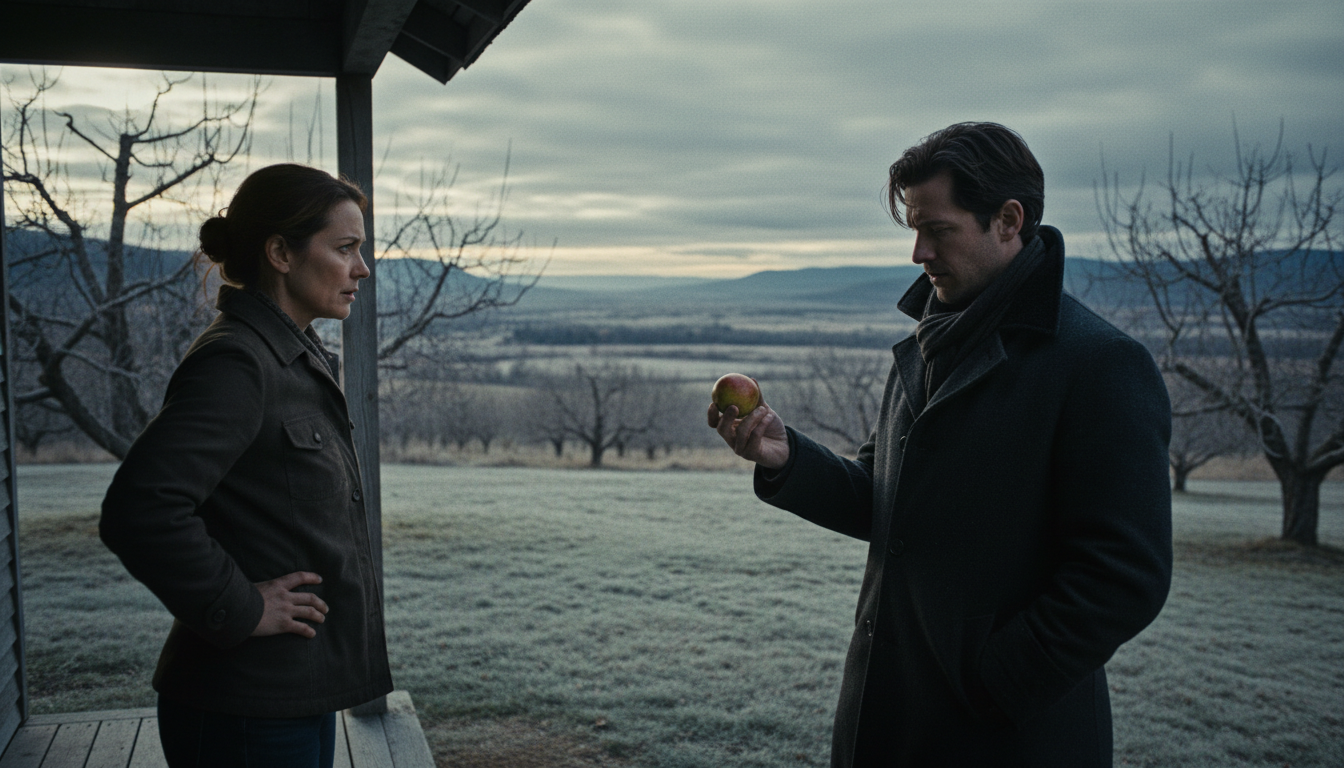
The first time Nora Alden saw him again, he was standing in the middle of her orchard, holding one of her apples like it had betrayed him.
It was late October. Frost still clung to the grass. The sky hung low and silver over the valley. From the porch of the farmhouse, Nora could see him clearly—tall, coat collar turned up against the cold, staring at the fruit in his palm with quiet concentration.
She knew that stance.
She had once loved the way he studied things, as if the world were a puzzle only he could solve.
“Put that down,” she called out, her voice sharper than she intended.
He looked up.
Eight years fell away and then rushed back all at once.
“Morning, Nora,” Elias Grant said.
I. The Orchard
The Alden orchard sat at the edge of a small Vermont town called Brookhaven, where winters were long and merciless and everyone knew the exact shape of your mistakes.
Nora had grown up among these trees.
Her father used to say apples were stubborn—too much rain, they split; too little, they shriveled. They required patience and faith in equal measure.
After her father’s stroke three years ago, Nora took over the farm.
She was thirty-four. Unmarried. Capable. Tired.
The orchard had been struggling. A fungal blight had spread through the southern rows, blackening fruit from the inside out. Buyers were pulling contracts. Loans were due.
She worked from dawn until her hands cracked and bled.
She did not need distractions.
Especially not the kind that had once broken her.
II. The Boy Who Left
Elias Grant had left Brookhaven at nineteen with a scholarship to MIT and a promise to “come back someday.”
He had kissed Nora beneath the oldest apple tree on the property, the one with a lightning scar down its trunk.
“Just a few years,” he’d whispered. “I need to build something bigger than this town.”
She had believed him.
She had always believed him.
In Boston, he excelled. Then Silicon Valley. Then a startup that made headlines and money and demands on every waking hour.
He didn’t come back.
Not for holidays.
Not for her.
The breakup happened over a phone call that stretched across time zones and misunderstanding.
“I can’t keep waiting,” she had said, standing in the orchard while rain soaked through her jacket.
“I’m doing this for us,” he had insisted.
“There is no us,” she’d replied.
He hadn’t fought her.
That hurt most of all.
III. The Return
Now he stood in her orchard like a ghost with a tailored coat.
“What are you doing here?” she asked, walking toward him, boots crunching over frost.
He turned the apple in his hand. “Evaluating.”
“For what?”
“For acquisition.”
The word landed like a slap.
Her jaw tightened. “You’re buying farms now?”
“My company is investing in sustainable agriculture tech. Brookhaven’s on the list.”
Her stomach twisted.
“You don’t get to turn my home into a line item.”
He met her gaze steadily.
“I didn’t know it was yours until this morning.”
“Convenient.”
He exhaled slowly.
“I heard about the blight.”
“Everyone has.”
“There are solutions.”
“Not ones I can afford,” she snapped.
Silence stretched between them, thick with history.
“You look tired,” he said softly.
“You look successful,” she replied.
Neither sounded like a compliment.
IV. The Blight
The fungal infection had started small—dark spots beneath the skin of otherwise perfect fruit.
By harvest, entire rows were compromised.
Elias walked the orchard with her that afternoon, studying leaves and soil samples.
“You’re rotating too late in the season,” he said.
“I know.”
“You need a resistant rootstock.”
“I know.”
“You could replant half the southern rows and—”
“I don’t have the capital,” she cut in.
He stopped walking.
“I can provide it.”
Her breath caught.
“As a loan?” she asked carefully.
“As an investment.”
“And what would you own?”
“A percentage.”
Of course.
“You always did want to build something bigger,” she said quietly.
He looked at her, something flickering in his eyes.
“I built it,” he said. “It’s not what I thought it would be.”
V. The Symbol
The oldest tree in the orchard stood at the edge of the property, half split from a lightning strike years ago but still bearing fruit.
They used to carve their initials into its bark.
Now the carving was barely visible.
E + N.
Nora hadn’t looked at it in years.
Elias reached out, tracing the faint grooves.
“You never sanded it down,” he said.
“I tried,” she replied. “It grew over.”
He gave a quiet, almost broken laugh.
“Figures.”
The tree had survived fire and frost and disease.
But one more harsh winter might finish it.
Like everything else here.
VI. The Tension
Over the next weeks, Elias stayed in Brookhaven.
Officially, to finalize investment assessments.
Unofficially, because he wasn’t ready to leave.
They argued constantly.
“You can’t automate everything,” she said one evening in the farmhouse kitchen.
“I’m not trying to.”
“You want efficiency.”
“I want sustainability.”
“You want control.”
He flinched.
“And you want martyrdom,” he shot back. “You’re drowning but you’d rather sink than ask for help.”
“I didn’t ask because you weren’t here.”
The words hung in the air.
He ran a hand through his hair.
“I was building something I thought mattered.”
“It did matter,” she said fiercely. “Just not to me.”
Silence fell.
“I loved you,” he said quietly.
“I know.”
“And you?”
She met his eyes.
“I loved who you were before you left.”
The distinction cut.
VII. The Choice
The official offer arrived in early November.
Elias’s company would buy 60% of the orchard, implement advanced disease-resistant systems, and turn it into a flagship sustainable model.
Nora would retain operational control—but answer to a board.
It would save the farm.
It would no longer fully be hers.
That night, snow began to fall.
They stood in the orchard as flakes settled into her hair.
“If you don’t take this,” Elias said, “you could lose everything.”
“And if I do?”
“You keep it alive.”
“At what cost?”
He hesitated.
“Maybe you stop carrying it alone.”
Her chest tightened.
“Why are you really here?” she demanded.
He looked at her, raw and unguarded.
“Because I realized I built a life that didn’t have you in it.”
Her breath caught.
“And now?”
“I don’t want to.”
VIII. Devastation
She signed the papers.
Not because of him.
Because of the orchard.
But the town talked.
They said she sold out.
They said she let the boy who left buy her back.
One night, overwhelmed and furious, she confronted him.
“Did you plan this?” she demanded. “Was this your way of fixing us?”
“No,” he said sharply. “This is about the farm.”
“Everything with you is about strategy!”
His voice cracked.
“I came back because I was tired of winning alone!”
Silence fell hard.
“You don’t get to decide you’re lonely and come reclaim me,” she whispered.
He stepped back as if struck.
“I never meant to claim you,” he said hoarsely.
“But you always did.”
IX. The Unexpected Turn
In December, the oldest apple tree collapsed in a storm.
Nora found it at dawn, split completely in two.
She dropped to her knees beside it, grief sharp and disproportionate.
Elias found her there.
“It survived everything else,” she said through tears. “And then just—gave up.”
He crouched beside her.
“It didn’t give up,” he said gently. “It lasted longer than it should have.”
She looked at him.
“I don’t want to last,” she whispered. “I want to live.”
The admission startled them both.
X. The Final Scene
Spring came slow and stubborn.
New rootstock arrived.
Rows were replanted.
The orchard didn’t look the same.
It looked possible.
On the first warm evening of April, Nora stood at the edge of the newly planted southern rows.
Elias joined her, hands shoved into his pockets.
“You could still leave,” she said quietly.
“I could.”
“But you won’t.”
“No.”
“Why?”
He met her gaze steadily.
“Because this time, I’m building something with you. Not instead of you.”
She studied him for a long moment.
The wind moved softly through the trees.
“I don’t know if I can trust you completely,” she admitted.
“I know.”
“But I’m willing to try.”
That was more than forgiveness.
It was choice.
He reached for her hand, slow enough that she could pull away.
She didn’t.
Behind them, the orchard stretched toward a future neither of them could fully control.
The old tree was gone.
But in its place, fragile new saplings pushed through thawing earth.
And for the first time in years, the winter between them felt like something that had finally, mercifully, ended.

