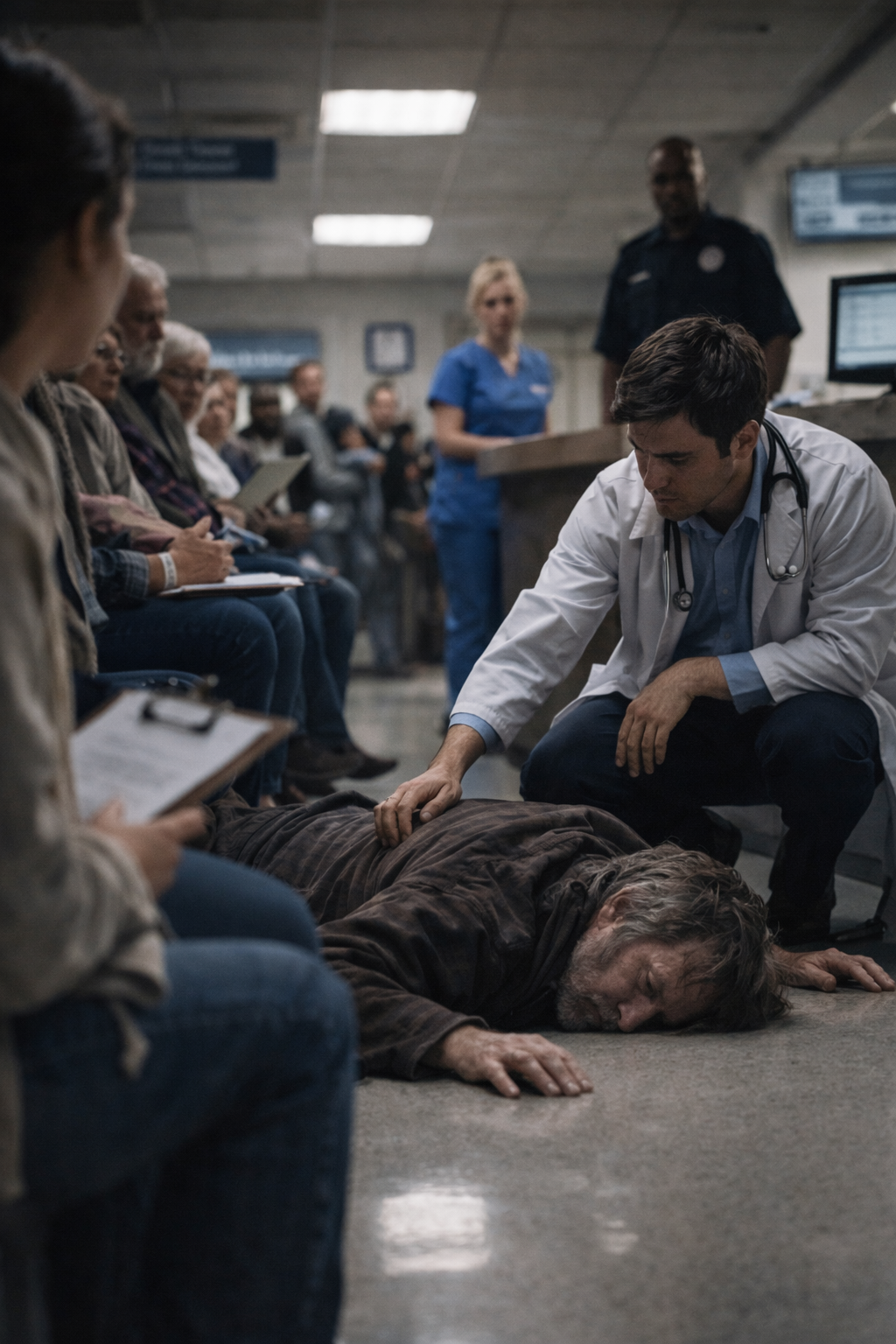
The man collapsed at 9:17 p.m., face first onto the polished hospital floor.
For a split second, no one moved.
Not the nurse at the intake desk.
Not the security guard leaning against the wall.
Not the dozen patients clutching clipboards and plastic wristbands.
The fluorescent lights buzzed overhead.
The automatic doors sighed open and shut behind strangers who had no idea what was happening inside.
The man lay on the tile, thin coat spread beneath him like a broken wing.
And the nurse said, without looking up from her computer:
“He can wait.”
I. The Waiting Room
Mercy Hill Medical Center prided itself on efficiency.
Posters on the wall promised compassionate care. A digital screen cycled through estimated wait times. A laminated sign near the desk read:
PLEASE HAVE INSURANCE INFORMATION READY.
The man had none.
He had shuffled in fifteen minutes earlier, coughing hard enough to bend at the waist. His beard was matted. His shoes didn’t match. His hands trembled when he leaned against the counter.
“I can’t breathe,” he had whispered.
The triage nurse, Carol Dunham—twenty-two years in emergency care, ironed scrubs, badge gleaming—looked him over once.
“Do you have insurance?”
He shook his head.
“We’ll need to process you,” she replied flatly. “Have a seat.”
There were no seats left.
He slid down the wall instead.
Now he lay on the floor.
Still.
II. The Intern
Dr. Elias Navarro had been at Mercy Hill for exactly eleven days.
Twenty-seven years old. Fresh from residency. Still carrying the stubborn belief that medicine was about people first and systems second.
He heard the thud from the hallway.
“What was that?” he asked, already moving.
Carol didn’t look up.
“Intake overflow.”
He rounded the corner.
Saw the man.
Saw the unnatural stillness.
“Sir?” Elias dropped to his knees. “Sir, can you hear me?”
No response.
He rolled him gently.
The man’s lips were tinged blue.
Pulse—weak.
Irregular.
“Call a code,” Elias snapped.
Carol finally stood.
“He hasn’t been admitted yet.”
Elias stared at her.
“He’s not in the system.”
“He’s not breathing,” Elias shot back.
She hesitated.
“Policy requires—”
“Policy doesn’t matter if he’s dead.”
III. Collapse
The man’s chest stuttered.
Then stopped.
Elias didn’t wait.
He started compressions.
One hand over the other.
Push.
Release.
Push.
Release.
“Bag him!” he yelled.
No one moved.
The waiting room had fallen into stunned silence.
A mother clutched her child tighter.
An elderly man slowly stood from his wheelchair.
Carol folded her arms.
“You’re not authorized to initiate treatment without—”
Elias didn’t look at her.
“Stand up!” she barked. “You don’t have clearance to bypass intake!”
He pushed harder.
Thirty compressions.
Two breaths.
Again.
Sweat slid down his spine.
The man’s ribs creaked beneath his palms.
“Stand. Up,” Carol repeated, sharper now. “This is not your call.”
Elias’s voice cracked as he counted.
“Twenty-eight—twenty-nine—thirty—”
“SHAME ON YOU!” a voice rang out.
Everyone turned.
An older woman near the vending machine was shaking, her cane clattering to the floor.
“Shame on you!” she shouted again, pointing at the desk. “He is dying!”
The words cracked something open in the room.
Another patient stood.
Then another.
“You’re just going to let him die?”
“What kind of hospital is this?”
Phones were out.
Recording.
IV. Authority
The double doors burst open.
Dr. Richard Halvorsen, Chief of Emergency Medicine, strode into the chaos.
“What is going on?”
Elias didn’t stop compressions.
“Cardiac arrest,” he said through clenched teeth.
“He was not cleared for—”
“He doesn’t have a pulse!”
Halvorsen hesitated.
Only for a second.
It was enough for everyone to see it.
To see the calculation.
Liability.
Paperwork.
Reputation.
“Move aside, Doctor,” Halvorsen ordered coldly.
Elias looked up, breath ragged.
“No.”
The room inhaled as one.
“You are an intern,” Halvorsen snapped. “You do not override protocol.”
“I am a doctor,” Elias shot back. “And he is a patient.”
Silence detonated.
The older woman’s voice came again, louder.
“SHAME ON YOU!”
This time, others echoed it.
“Shame on you!”
“Help him!”
“Do your job!”
The chant built, raw and furious.
Phones lifted higher.
Halvorsen’s face hardened.
“Get a crash cart,” he finally barked.
V. The Fight for a Life
The defibrillator arrived.
“Clear!”
The man’s body jerked under the shock.
Flatline.
Elias swallowed.
Again.
“Clear!”
Shock.
Nothing.
Carol stood frozen.
Elias grabbed the ambu bag himself.
“Breathe,” he muttered under his breath, as if speaking directly to the man’s heart. “Come on.”
Another compression cycle.
Another shock.
Then—
A blip.
Tiny.
But there.
Pulse returning.
Weak.
Fragile.
Alive.
The waiting room erupted.
Not cheering.
Crying.
Angry crying.
Elias sagged back onto his heels as nurses finally moved—finally worked—finally did what they should have done ten minutes earlier.
They wheeled the man through the double doors.
And the waiting room was left shaking.
VI. Fallout
By midnight, the video was online.
It showed Carol’s folded arms.
Halvorsen’s hesitation.
Elias’s refusal to stand.
The woman shouting “Shame on you.”
By morning, Mercy Hill was trending.
News vans lined the street.
Comment sections exploded:
SHAME ON YOU.
He could have died because he was poor.
Fire them.
This is what healthcare has become.
The hospital issued a statement.
“An internal review is underway.”
Carol was placed on administrative leave.
Halvorsen called Elias into his office.
“You jeopardized this hospital,” he said evenly.
“I saved a man,” Elias replied.
“You embarrassed leadership.”
“I did my job.”
Halvorsen’s jaw tightened.
“You don’t understand how this works yet.”
Elias held his gaze.
“No,” he said quietly. “I understand exactly how it works.”
VII. The Man with No Insurance
His name was Thomas Grady.
Fifty-eight.
Former construction worker.
Laid off after a back injury.
Lost his house two winters ago.
His heart attack wasn’t dramatic.
It was exhaustion.
Untreated hypertension.
A body pushed too far without care.
When he woke in ICU, Elias was there.
“You collapsed,” Elias said gently.
Thomas blinked.
“Did I die?”
“Not today.”
Thomas’s eyes filled.
“I don’t have insurance,” he whispered weakly.
Elias felt something twist in his chest.
“You had a heartbeat,” he replied. “That was enough.”
VIII. The Cost
Three weeks later, Elias received notice his contract would not be renewed.
“Budget restructuring,” the email read.
He packed his locker quietly.
As he walked past the intake desk for the last time, Carol didn’t meet his eyes.
Outside, a woman from the waiting room that night stood near the entrance.
The one with the cane.
She stepped forward.
“I saw what you did,” she said.
Elias nodded once.
“They needed someone brave.”
He shook his head faintly.
“They needed someone decent.”
She squeezed his hand.
“Same thing.”
IX. The Final Scene
Six months later, Elias was working at a community clinic on the west side.
Underfunded.
Overcrowded.
No marble floors.
No laminated insurance signs.
Thomas came in one afternoon, walking slower but steadier.
He carried a brown paper bag.
“For you,” he said.
Inside was a cheap stethoscope.
Plastic.
Bright blue.
“I can’t pay what I owe,” Thomas said quietly. “But I wanted you to have something.”
Elias swallowed hard.
“You don’t owe me.”
Thomas smiled faintly.
“You didn’t let me wait.”
Outside, sirens wailed somewhere in the city.
Inside, the clinic hummed with imperfect, urgent life.
And on a cracked vinyl chair near the door, a handwritten sign taped to the wall read:
NO ONE WAITS FOR BREATH.
Because sometimes the loudest words in a room aren’t the ones shouted in anger.
Sometimes they’re the ones someone refuses to ignore.
And sometimes, all it takes to change a system is one person who refuses to stand up when they’re told to.

