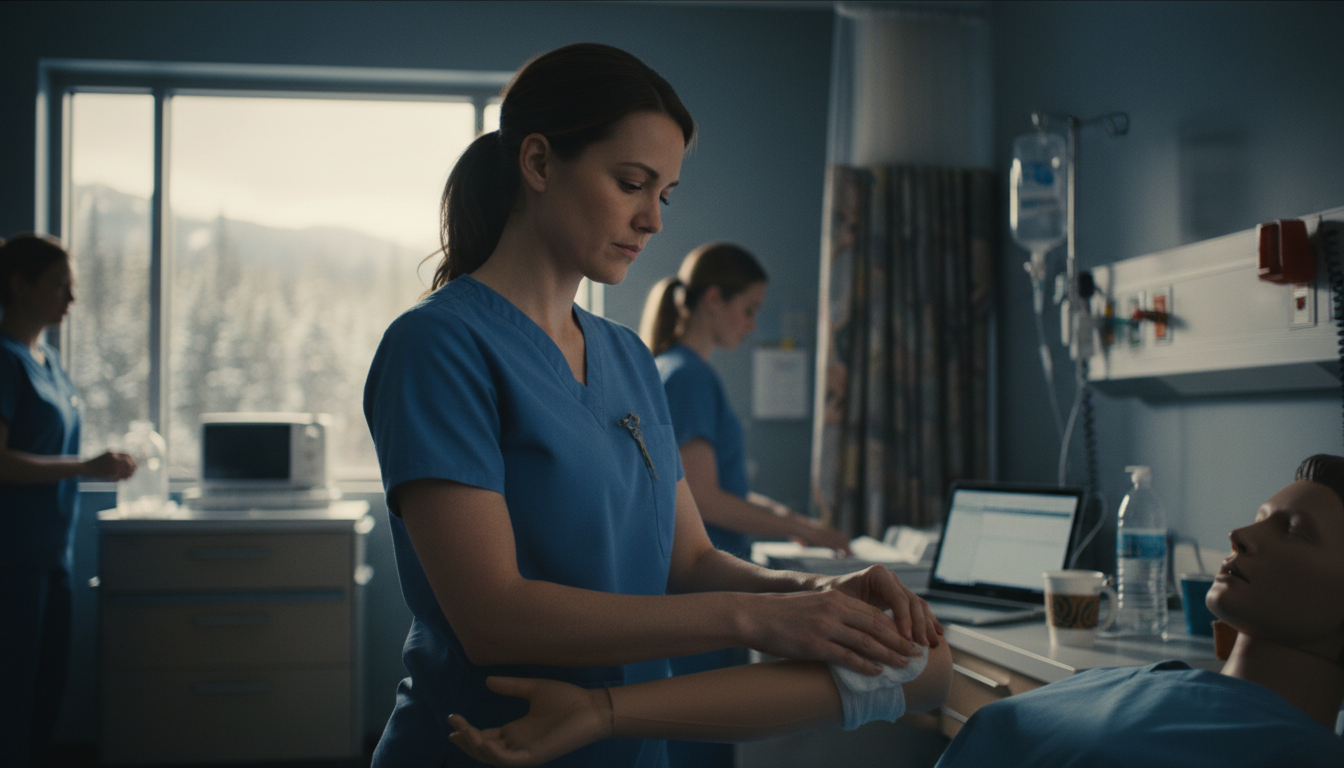
On the night the hospital ceiling cracked open above her, Evelyn Hart thought she was dying.
Not in the dramatic way people describe in memoirs. There were no cinematic flashes of childhood summers or long-forgotten songs. There was only the hum of fluorescent lights, the antiseptic sting in her nose, and the sound of someone shouting her name from very far away.
“Evelyn! Stay with me!”
The voice was hoarse, breaking.
She wanted to tell him she was trying.
But the world tilted sideways, and then there was only white.
I. The Girl Who Stayed
Before the blood and the sirens and the shattering of glass, Evelyn Hart had lived her life inside a narrow rectangle of routine.
She worked the early shift at Mercy General in Cedar Ridge, a mountain town cradled between pine forests and long winters. She was a trauma nurse—efficient, steady-handed, the kind of woman who could press gauze into a wound without flinching while the rest of the room panicked.
She rented a small apartment above a hardware store. She paid her bills on time. She avoided unnecessary risks.
She did not fall in love.
Not anymore.
Six years earlier, her fiancé had died in a climbing accident in the same mountains that framed the town like a postcard. Since then, she had decided that loving someone was like leaning too far over an edge: eventually gravity won.
She did not speak of him. She did not remove the small silver key from her necklace—the key to the cabin they had meant to share—but she tucked it beneath her scrubs where no one could see it.
Evelyn believed in usefulness. In control. In surviving what she could not change.
Until Daniel Reyes walked into the emergency department with blood on his shirt that wasn’t his.
II. The Man Who Left
Daniel had once belonged to Cedar Ridge.
He had been the golden boy of the high school track team, the kid teachers pointed to and said, “He’s going places.” And he had. New York. London. War zones with a camera slung over his shoulder, chasing stories no one else wanted to see.
He became a photojournalist. The kind who stood in rubble and smoke, documenting devastation with a steady lens.
He left at eighteen and did not look back.
Until his younger sister, Sofia, called him one October morning and said, “Mom’s sick. It’s not good.”
So he came home.
He had not expected Mercy General to smell so small. Not expected the waiting room to hold his mother’s thin, trembling body in a wheelchair.
And he had not expected the nurse who would change everything to look at him as if she could see straight through him.
Evelyn noticed him the moment he burst through the sliding doors.
He moved like a man used to urgency, not bureaucracy. His hair was longer than most men in Cedar Ridge would dare. His hands shook slightly as he helped his mother onto a gurney.
“I need someone now,” he said, voice strained but controlled.
Evelyn stepped forward.
“I’m someone,” she said calmly. “What’s her name?”
“Marisol Reyes.”
She touched his arm, grounding him. “We’ve got her.”
Their eyes met.
In his, she saw fear and something else—guilt, maybe. In hers, he saw steadiness he hadn’t felt in years.
III. Attraction in Fragments
Marisol was diagnosed with advanced heart failure.
Daniel moved back into his childhood home, the walls still lined with faded family photos. He began splitting his time between hospital corridors and the small desk in his old bedroom, editing photographs of cities far away.
Evelyn became Marisol’s primary nurse.
At first, Daniel was just a concerned son who hovered too close. He asked too many questions. He challenged dosage decisions with a sharpness that made some nurses bristle.
Evelyn did not bristle.
“You don’t trust us,” she said one evening, arms folded as he paced beside his mother’s bed.
“I’ve seen what happens when systems fail,” he replied.
“And I’ve seen what happens when families panic,” she said evenly.
He stopped pacing. “She’s all I have.”
The words escaped before he could swallow them.
Evelyn softened, just slightly. “Then let us help you keep her.”
He studied her, measuring something.
“You’re not from here originally,” he said.
She raised an eyebrow. “What makes you think that?”
“You don’t move like someone who’s settled.”
The observation unsettled her.
“People can stay without being stuck,” she said.
He tilted his head. “Are you staying?”
She met his gaze, unflinching. “Yes.”
But later that night, alone in her apartment, she traced the small silver key beneath her collar and wondered if staying was bravery or fear.
IV. First Crack
Their first real conversation happened in the hospital cafeteria.
It was nearly midnight. The vending machines hummed. Daniel sat hunched over a coffee gone cold.
“You should sleep,” Evelyn said, sliding into the seat across from him.
He laughed quietly. “I’ve slept in bomb shelters. I can handle this.”
“This isn’t a war zone.”
“No,” he said. “It’s worse.”
She didn’t argue.
“You left,” she said instead. “Everyone here talks about it.”
He smirked faintly. “Let me guess. Ungrateful. Arrogant. Too big for the town.”
“Ambitious,” she corrected.
His eyes flickered with surprise.
“Why’d you stay?” he asked.
The question hit harder than it should have.
“My life is here.”
“That’s not what I asked.”
She leaned back, folding her arms.
“My fiancé died six years ago,” she said evenly. “In these mountains. He slipped.”
Daniel’s expression shifted instantly.
“I’m sorry.”
“Don’t be. Accidents don’t care about apologies.”
He watched her carefully. “And after that, you decided this town was enough?”
“I decided risk wasn’t.”
Silence stretched between them.
“You can’t avoid it forever,” he said quietly.
Her jaw tightened. “I’m not avoiding anything.”
He held her gaze. “You’re avoiding everything.”
V. The Symbol
Marisol gave Evelyn a gift on Christmas Eve.
Daniel had stepped out to take a call. Snow fell outside the hospital window in thick, silent drifts.
“You make my son nervous,” Marisol said softly, her accent still lilting despite years in Colorado.
Evelyn smiled faintly. “That wasn’t my intention.”
“It is good for him.”
Marisol reached into her bedside drawer and pulled out a small object wrapped in tissue paper.
Inside was a delicate gold locket.
“It was mine,” she said. “I wore it when I came to this country. It holds a picture of my parents. They were afraid for me. I was afraid too.”
She pressed it into Evelyn’s hand.
“I think you are afraid of my son.”
Evelyn flushed. “That’s inappropriate.”
Marisol smiled knowingly. “Fear means something matters.”
Evelyn closed her fingers around the locket.
Later that night, she stood outside the hospital under a sky thick with stars. Daniel joined her, breath visible in the cold.
“My mom likes you,” he said.
“She likes everyone.”
“Not like that.”
Evelyn hesitated, then held up the locket.
“She gave me this.”
Daniel’s face softened. “She hasn’t taken that off in years.”
The weight of it in her palm felt heavier than gold.
“It’s not about me,” she said.
“No,” he agreed. “It isn’t.”
But the way he looked at her made her pulse quicken.
VI. The Choice
In early spring, Daniel received an email.
A major international publication wanted him embedded with a relief team in Syria. Six months. Dangerous. Career-defining.
He stared at the screen for a long time.
That evening, he found Evelyn at the hospital chapel.
“I got an offer,” he said.
She didn’t look surprised. “You’re going to take it.”
It wasn’t a question.
“It’s what I do.”
“And what about your mother?”
“She’s stable. Sofia can manage.”
“And what about—” She stopped herself.
“What about us?” he finished.
She closed her eyes briefly.
“There is no ‘us,’ Daniel.”
His jaw tightened. “Don’t do that.”
“Do what?”
“Pretend this doesn’t matter.”
“It does matter,” she snapped. “That’s the problem.”
He stepped closer.
“I love you,” he said.
The words crashed into her.
“You don’t get to say that,” she whispered.
“Why?”
“Because love is what makes people leave.”
He shook his head. “No. Fear does.”
She felt the old ache rise in her chest.
“If you go,” she said, voice trembling despite herself, “don’t expect me to wait.”
His eyes darkened with hurt.
“I never asked you to.”
VII. Devastation
Daniel left in May.
The airport goodbye was restrained, almost clinical.
“I’ll call,” he said.
“Be careful,” she replied.
He reached for her hand. She let him hold it for a moment, then pulled away first.
Months passed.
News reports trickled in. Images of bombed buildings. Refugee camps. Dust and smoke.
Evelyn watched from the safety of her apartment, the locket resting against her collarbone.
Then the call came.
A roadside explosion. Several journalists injured. One critical.
She drove to the hospital before her shift began, heart hammering.
He was already there when they wheeled him in.
Daniel. Pale. Blood soaking through makeshift bandages.
She froze.
“Evelyn!” a doctor barked. “We need you.”
She moved automatically, hands steady despite the roar in her ears.
“Daniel, can you hear me?” she demanded.
His eyelids fluttered.
“Hey,” he rasped. “Guess I should’ve taken the desk job.”
Tears blurred her vision.
“Don’t you dare,” she whispered fiercely.
Surgery lasted hours.
When he woke in recovery, tubes and monitors surrounding him, she sat beside the bed.
“You almost died,” she said, voice breaking.
“I know.”
She pressed her forehead to his hand.
“I can’t do this again,” she choked. “I can’t love someone who keeps walking toward the edge.”
He swallowed hard.
“I don’t know how to be anyone else.”
The honesty shattered her.
VIII. The Twist
Weeks into his recovery, Daniel made a decision.
He declined future foreign assignments.
The publication ran a piece announcing his “step back from frontline journalism.”
Evelyn found out from the article.
“You quit?” she demanded when she arrived at his house.
“I redirected,” he corrected.
“Because of me?”
“Because I almost died.”
“Because of me,” she insisted.
He met her gaze steadily.
“I chose to live.”
She shook her head. “You’ll resent me.”
“I won’t.”
“You will.”
Silence stretched between them.
“What if I don’t want you smaller?” she whispered. “What if I just want you alive?”
He stepped closer, crutches abandoned against the wall.
“You don’t make me smaller,” he said. “You make me want to stay.”
Tears slid down her cheeks.
“I don’t know how to not be afraid,” she admitted.
He touched the locket at her throat.
“Bring the fear with you,” he said. “Just don’t let it decide.”
IX. The Accident
The hospital ceiling cracked open above her in late November.
Evelyn was driving home from a double shift when black ice sent her car spinning.
The impact was violent. Metal screamed. Glass shattered.
When she opened her eyes, she was trapped, blood pooling warm against her temple.
And Daniel was shouting her name.
He had been driving behind her.
He had seen it happen.
“Stay with me!” he yelled, scrambling toward the wreckage.
In the ambulance, she drifted in and out.
She saw his face above her, terror stripped raw.
“You don’t get to leave,” he said fiercely. “Not you.”
In that suspended space between consciousness and dark, she understood something with startling clarity:
Loving him had never been the edge.
Living without him would be.
X. Where the Light Finds Us
Evelyn survived.
A concussion. Broken ribs. Months of physical therapy.
Daniel did not leave her side.
One evening, as she stood carefully on the porch of her apartment, wrapped in a blanket, she looked out at the mountains she had once blamed.
“They didn’t take him,” she said quietly.
“Who?” Daniel asked.
“My fiancé. It was just gravity.”
Daniel slipped his hand into hers.
“And you?” he asked softly.
She looked up at him.
“I’m done living like gravity is waiting for me.”
He exhaled, relief and love braided together.
“I can’t promise safety,” he said.
“I don’t want safe,” she replied. “I want honest.”
He leaned his forehead against hers.
“Then let’s be honest,” he whispered.
Snow began to fall again, soft and unthreatening.
Inside, on the table, the gold locket lay open beside the small silver key she had finally taken off its chain.
She no longer needed to hold on to what might have been.
Because for the first time in years, she understood that love wasn’t the fall.
It was the light that found you on the way down.

